NASA's Mars Operations Face Mounting Challenges as Key Spacecraft Encounter Critical Failures
Half of NASA's operational Mars missions have gone offline due to separate technical problems, with the Perseverance rover and Odyssey orbiter both suspending science work after encountering issues that threaten their ability to continue exploring the red planet.
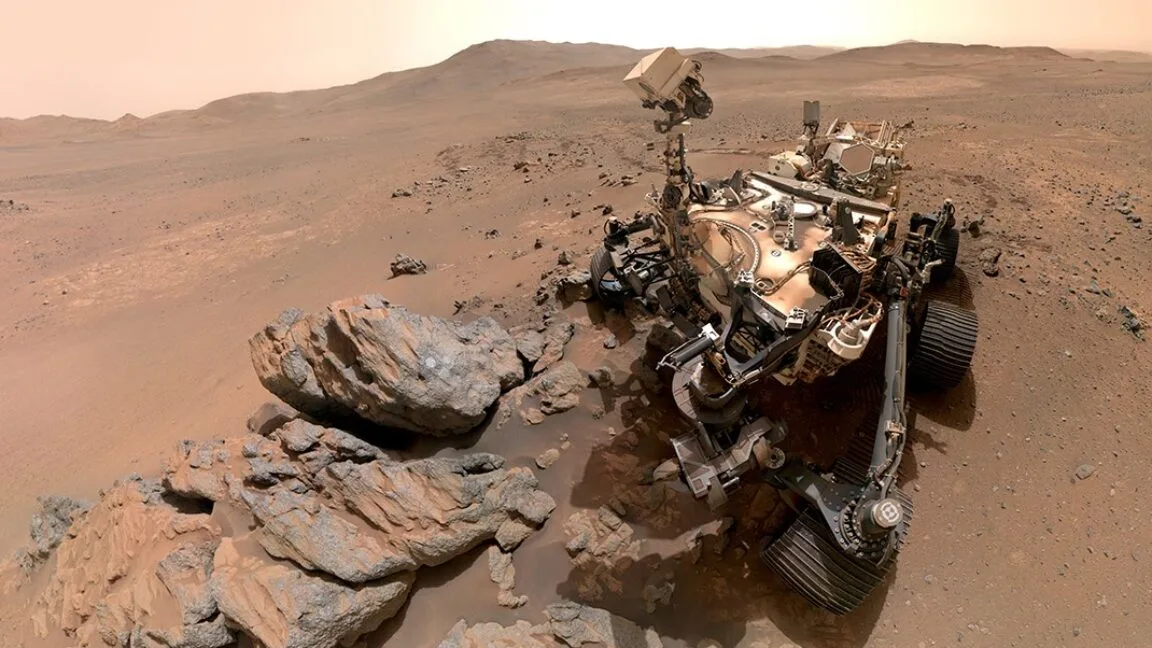
NASA's Mars exploration program is grappling with significant technical setbacks as two of its four active missions have halted scientific investigations following distinct malfunctions that emerged over recent weeks. The Perseverance rover and the Odyssey orbiter—both spacecraft operating well past their intended mission durations—are now offline pending repairs and diagnostics.
Perseverance, which has spent six years traversing the Martian surface and gathering rock and soil samples destined for Earth, is currently examining terrain near a crater rim that once held ancient liquid water. Odyssey, which entered Mars orbit in 2001, holds the distinction of being the longest-operating Mars mission ever deployed.
Communications Breakdown on Perseverance
Perseverance's troubles originate in its communications infrastructure. The rover relies on two redundant UHF radio systems for transmitting high-bandwidth data through a network of orbiting relay stations that forward information to Earth. A separate X-band radio provides a backup path for direct Earth communication, though with substantially reduced transmission speeds.
On October 30, the rover's primary UHF radio failed to respond during a power-up sequence, prompting an automatic failover to the secondary unit and triggering safe mode activation. Engineers at NASA's Jet Propulsion Laboratory subsequently determined that the backup UHF radio was operating at approximately half its normal transmission capacity.
The team has stopped using both radios until they can evaluate potential causes of the issues and one or both are deemed safe to resume operating.
NASA
Currently, Perseverance communicates with Earth exclusively through its X-band system, which provides substantially diminished data transmission rates compared to the orbiter relay method. To minimize risks during the investigation, mission controllers have suspended all scientific work. Restoring the backup UHF radio represents the immediate priority, with efforts to revive the primary unit following afterward.
The team is hopeful the rover could return to science by the end of November.
NASA
The six-wheeled explorer recently achieved a distance milestone, surpassing the 28.06-mile (45.16-kilometer) record previously established by the Opportunity rover, which ceased functioning in 2018. Perseverance's current odometer reading now stands at double its original projected distance target.
Odyssey's Propellant Crisis
The Odyssey orbiter faces a more precarious situation. During early November, one of its four reaction wheels—devices essential for spacecraft orientation—ceased functioning. This failure leaves Odyssey with only two operational wheels, having already lost a third wheel in 2013. The spacecraft requires a minimum of three functioning wheels to maintain proper alignment.
Without the three reaction wheels, the spacecraft must rely solely on its hydrazine thrusters to remain oriented.
NASA
Stable orientation is critical for Odyssey to direct its solar panels toward the Sun and point its scientific instruments toward Mars. Prior to the reaction wheel malfunction, propellant reserves were already depleted. Jeffrey Plaut, Odyssey's project scientist at JPL, had projected earlier this year that with minimal fuel consumption, the orbiter possessed sufficient hydrazine reserves to function through at least the conclusion of 2028.
That projection presumed no additional reaction wheel failures. With only two wheels remaining functional, NASA engineers estimate the spacecraft now carries enough hydrazine propellant to sustain operations for between one and two months. Encouragingly, initial troubleshooting efforts have yielded some positive results with the malfunctioning reaction wheel, though additional testing is required to determine whether restoration is feasible.
Aging Infrastructure and Future Plans
Odyssey serves as one of four orbital relay stations NASA employs to transmit data between Earth and the Perseverance and Curiosity rovers operating on the Martian surface. Curiosity continues functioning after 14 years of Martian exploration. The remaining relay platforms include NASA's Mars Reconnaissance Orbiter, deployed in 2006; the European Space Agency's ExoMars Trace Gas Orbiter, which has operated for a decade; and ESA's Mars Express, now 23 years into its mission.
NASA experienced a significant loss when its MAVEN orbiter became uncontrollable and ceased transmitting last December, concluding 11 years of service at Mars. An investigation determined that either a radiation-induced single event upset or a software malfunction caused MAVEN's flight computer to restart. According to Tiffany Morgan, director of NASA's robotic Mars Exploration Program, the spacecraft's inertial measurement unit subsequently provided incorrect orientation data, causing the orbiter to spin uncontrollably in response to the faulty information.
To strengthen its Mars infrastructure, NASA awarded Blue Origin a $700 million contract in September for the Mars Telecommunications Network (MTN), a dedicated communications orbiter designed to establish high-bandwidth links between Earth and missions operating on and around Mars. NASA's original timeline called for Blue Origin to deliver the telecom orbiter by the end of 2028, with operational deployment at Mars scheduled for 2030.
The MTN project has encountered delays following a protest filed by Rocket Lab, which lost the contract competition, with the Government Accountability Office expected to issue a ruling next month. If the GAO rejects Rocket Lab's challenge, Blue Origin can proceed with contract work.
NASA is also considering SkyFall, a potential 2028 mission that would deploy three helicopter drones to Mars for atmospheric and geological investigations. Additionally, Mars scientists have identified the need to replace the high-resolution imaging system aboard the aging Mars Reconnaissance Orbiter, a capability essential for identifying landing zones for future robotic and human exploration, including potential retrieval of Perseverance's collected rock samples.
NASA is in preliminary development stages for a mission concept that could assume MRO's imaging responsibilities, though no definitive timeline or budget allocation has been established. The agency anticipates relying on Mars Reconnaissance Orbiter for landing-site reconnaissance operations throughout the 2030s.