Beyond GPU Access: AWS EKS Tackles the Real Bottleneck in AI Model Deployment
Securing GPU capacity is just the first hurdle. Amazon's Kubernetes service is addressing the deeper challenge of how to actually use those expensive resources efficiently once they arrive.
When a second instance of an AI model needs to begin handling traffic, eight minutes represents a significant delay—particularly when requests are already arriving. Kubernetes can spin up another replica quickly enough, but the actual work of provisioning hardware, retrieving container images, loading model weights, and compiling GPU code takes considerably longer. By the time the infrastructure catches up, the model is still initializing while demand goes unmet.
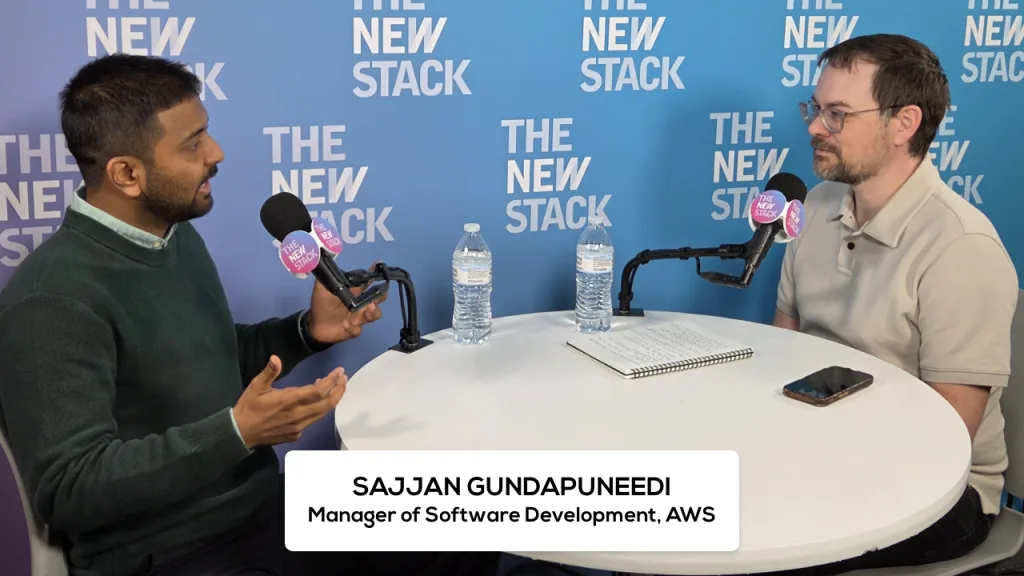
At KubeCon + CloudNativeCon in Salt Lake City this month, Sajjan Gundapunnedi, a senior engineering manager for Amazon Elastic Kubernetes Service (EKS), discussed these challenges with The New Stack's Matt Burns. Their conversation moved beyond the initial scramble for GPU access to examine the engineering choices that determine whether those GPUs operate at full capacity.
Gundapunnedi noted that "Demand for GPU capacity or any accelerated capacity is outpacing supply everywhere."
Expanding Kubernetes' Role
Gundapunnedi outlined two approaches for reserving accelerated resources through EKS Auto Mode and Karpenter, the Kubernetes node provisioner. On-Demand Capacity Reservations lock in capacity within a particular Availability Zone, contingent on availability. Capacity Blocks allow teams to reserve capacity for a predetermined time window, enabling them to align training or fine-tuning jobs with their reservations.
What this lets you do is faster communication for your job
Sajjan Gundapunnedi
Once hardware is secured, the placement of devices becomes critical. EKS Auto Mode now supports Dynamic Resource Allocation for NVIDIA GPUs and Elastic Fabric Adapters, allowing developers to specify which devices a workload requires and request a GPU and adapter on the same PCIe path.
Training and fine-tuning operations involve repeated data exchanges between components. Idle GPU time during these transfers wastes resources even as costs accumulate. By enabling Kubernetes to understand hardware topology when assigning workloads, teams can reduce these waiting periods.
Breaking Down the Eight-Minute Problem
Inference workloads present distinct scheduling challenges. Demand arrives in waves, and newly launched replicas must become productive before that demand subsides.
Gundapunnedi described several techniques his team implemented. Capacity buffers within Karpenter allow replicas to land on existing nodes during traffic spikes. The team also adopted seekable OCI to pull and unpack container images concurrently, and deployed vLLM with Run:ai Model Streamer to download model weights in parallel.
Compilation emerged as a particular bottleneck for smaller models. Each new replica on a node was performing identical compilation work. The solution involved caching compiled artifacts on the node so subsequent replicas could reuse them. Gundapunnedi highlighted the impact of this approach.
It was the cheapest configuration tuning for us, which gave the largest benefits.
Sajjan Gundapunnedi
Infrastructure Ownership and Management
The conversation also addressed how much infrastructure responsibility teams should assume. Auto Mode handles worker-node images, bundled add-ons and their update cycles, and operates the Karpenter controller on behalf of users. Standalone Karpenter remains available for teams requiring configurations that Auto Mode does not yet support.
For application developers, this distinction becomes significant when responsibilities shift from deploying a model to maintaining the underlying systems that keep it operational.