Modder Bolts 360mm Radiator to Laptop, Slashes Temperatures Below 40 Degrees
YouTuber TrashBench transformed a Metabox laptop into a watercooled workstation, achieving 60-degree temperature drops and 14% performance gains through extreme custom cooling.
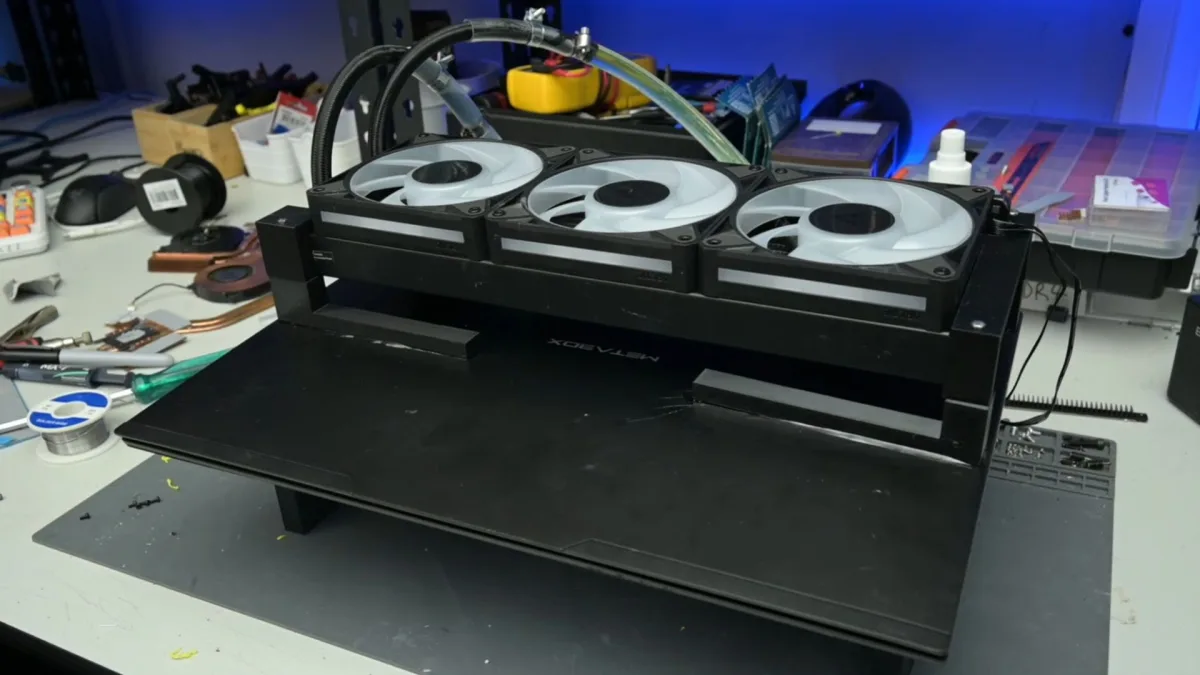
PC enthusiast and YouTube personality TrashBench has completed an unconventional cooling project: retrofitting a Metabox laptop with waterblocks, a dedicated pump, and a 360mm radiator. The Metabox P950EP, which houses an Nvidia GTX 1060 and Intel Core i7-8750H, now operates at dramatically lower temperatures. During benchmarks and stress tests, both the CPU and GPU saw temperature reductions of approximately 60 degrees Celsius, and the system achieved an average performance uplift of 14% following overclocking.
TrashBench, known for pushing watercooling technology to its limits in various extreme modification projects, repurposed a 360mm AIO unit from a previous build for this Metabox system. The Australian laptop brand itself is a rebranded version of Clevo, a Taiwanese ODM that distributes its designs across multiple markets under different names. The modder plans to use the modified laptop for his daughter to run Fortnite.
Engineering the Cooling System
TrashBench initially attempted to use the original AIO pump alongside a second waterblock for the CPU. Testing revealed the stock pump lacked sufficient pressure to drive coolant through both blocks, necessitating a larger replacement pump. Since the new pump came as a standalone unit rather than integrated with a waterblock, an additional waterblock became necessary.
Installation required custom fabrication throughout. The modder designed 3D-printed holders to mount the waterblocks, securing them to the existing screw holes that previously held the stock heatpipe and blower cooler. Behind the laptop's display, additional 3D-printed mounts positioned the radiator, but the tight clearance between screen and chassis prevented mechanical fastening. TrashBench instead applied Loctite 2-part epoxy to permanently bond the radiator mount.
Memory modules and voltage regulators also received attention. Thermal pads leveled the RAM with the VRMs, allowing a single heatsink to cool both components. The VRM heatsink was secured with thermal paste and epoxy, making the modification irreversible.
Power and Assembly
The cooling circuit came together using flexible clear tubing and screw hose clamps to connect the blocks, pump, and radiator. After assembly, TrashBench performed a leak test. "I think we're good," he says in the video, just before observing a few bubbles passing through the system.
A voltage mismatch required additional engineering. The laptop operates on 19 volts, while the pump and fans require 12 volts. TrashBench soldered a DC-DC step-down converter to the original blower fan's electrical contacts to handle the conversion. The converter powers on immediately when the laptop starts, with no load-sensing capability, so the modder installed a manual toggle switch mounted on a 3D-printed plate screwed to the bottom shell. A large opening was cut into the bottom to accommodate the pump and waterblocks.
A 3D-printed riser screwed to the bottom provides clearance for the laptop to stand, completing the build.
Performance Results

The cooling system delivers impressive thermal performance. Under full load, both CPU and GPU remain well below 40 degrees Celsius, representing a 60-degree average reduction compared to stock cooling. Benchmarks showed conservative but measurable performance improvements, prompting TrashBench to explore overclocking potential. In Forza Horizon 5, frame rates climbed from 75 FPS to 77 FPS at stock settings, then jumped to 83 FPS after overclocking.