Intel's GPU D-Series Accelerator Emerges as Inference-Focused Alternative to High-Power Systems
Intel has formally introduced its Crescent Island chip as the GPU D-Series, an AI inference accelerator delivering 1.3 PFLOPS of FP8 performance with 1.5 TB/s memory bandwidth, designed for traditional data center deployments rather than liquid-cooled rack-scale systems.
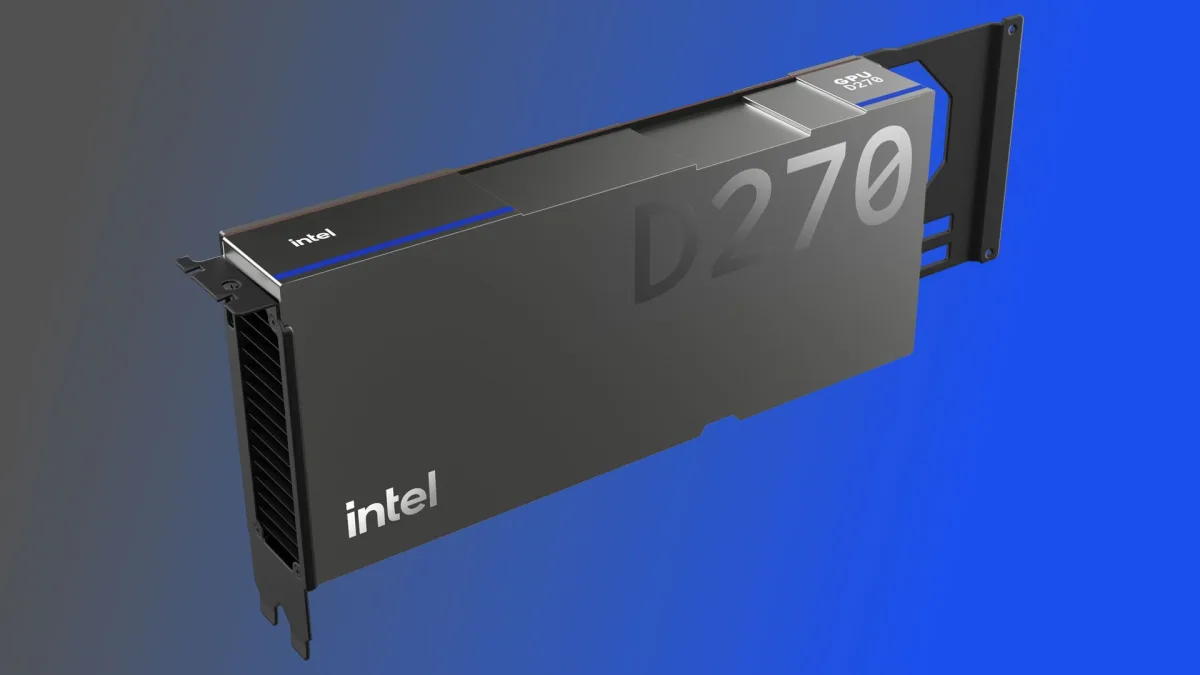
Intel unveiled the official branding for its Crescent Island AI inference accelerator at OCP 2026, christening it the Intel GPU D-Series. The announcement marked the first public disclosure of the chip's theoretical peak performance: 1.3 PFLOPS of FP8 compute. The company also confirmed final specifications for memory bandwidth, targeting 1.5 TB/s. These details represent the latest in a series of incremental revelations Intel has made regarding Crescent Island throughout 2026.
The GPU D-Series represents the inaugural product built on Intel's Xe3P graphics architecture, though the chip functions primarily as a massively parallel computing accelerator rather than a traditional graphics processor, lacking most graphics-specific functional units. Intel plans to deliver GPU D-Series products in air-cooled PCIe form factors with a thermal design power of 350W and up to 480GB of LPDDR5X memory capacity.
By comparison, Nvidia's Vera Rubin NVL72 rack-scale system contains 72 Rubin GPUs, each capable of delivering 17.5 PFLOPS of FP8 throughput. However, those chips demand liquid cooling and operate at power levels measured in kilowatts. The GPU D-Series clearly targets a fundamentally different performance tier and infrastructure footprint than the Rubin system.
Intel positions the GPU D-Series for deployment in conventional air-cooled rack servers supporting up to eight GPUs, mirroring Nvidia's HGX architecture. According to Intel, such configurations could enable inference on models exceeding one trillion parameters. The company emphasizes the accelerator's applicability to "large language models, long-context inference, and concurrent inference services," establishing a platform for "multi-tenant AI services, robotics, and other latency-sensitive workloads."
Distributed inference deployments relying on multiple GPUs functioning as a unified system require a comprehensive software ecosystem. Intel is leveraging what it describes as a "common Xe software foundation" developed across its Xe Cores in integrated GPUs and discrete GPU offerings.
To establish GPU D-Series accelerators within data center environments, Intel is collaborating with "a broad ecosystem of OEMs, ODMs, neoclouds, independent software vendors, appliance providers, and AI-native companies." The company reports that customer sampling of GPU D-Series products is underway, though specifics regarding a broader market rollout remain undisclosed.
Whether the GPU D-Series will finally deliver the AI accelerator market presence that eluded Intel following the collapse of the Data Center GPU Max family, known as Ponte Vecchio, and its abandoned successors remains uncertain. A succession of semiconductor acquisitions similarly failed to crystallize into a coherent AI strategy.
In an environment where every increment of inference compute capacity commands premium value, a product with an established architectural foundation specifically engineered for inference workloads and packaged in an approachable thermal and power envelope could represent the formula Intel requires to gain meaningful traction as AI models advance in sophistication and agentic computing workflows grow increasingly central to technology strategy.