Google's TPUs Now Power Meta's Production AI, With PyTorch-Native Engines
Meta has begun running Google's tensor processing units in production for AI inference, using new open-source software that lets PyTorch models run natively on the chips without major rewrites.

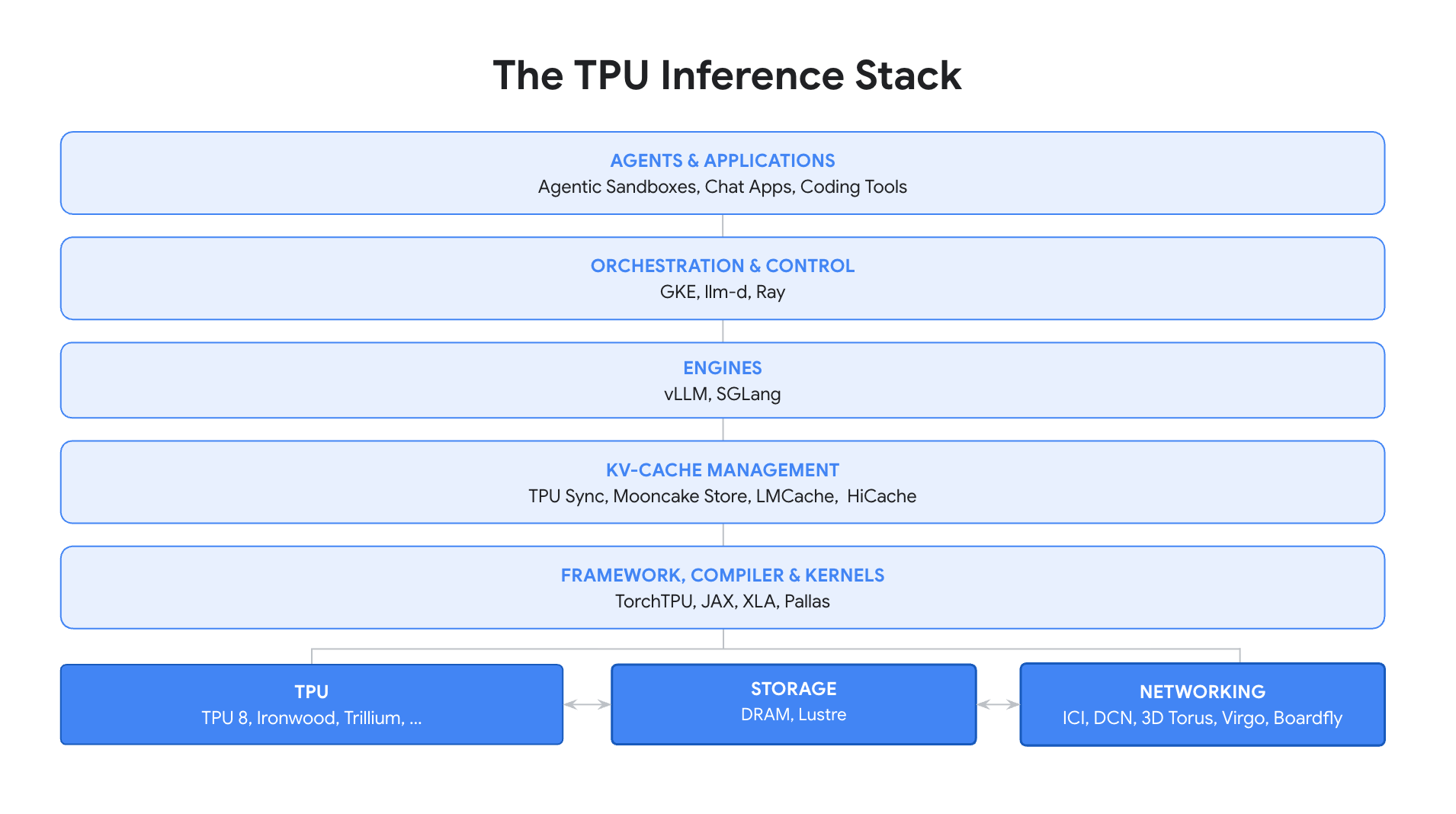
Google's custom AI accelerators, known as tensor processing units, are now handling production inference workloads at Meta through freshly announced open-source software bridges. The PyTorch-native versions of SGLang and vLLM inference engines, unveiled on Google's developer blog, allow the chips to function as a native option for PyTorch without extensive code changes.
Previously, both inference engines relied on Google's JAX framework to operate on TPUs. The shift toward PyTorch compatibility represents a significant move to broaden the appeal of Google's hardware beyond its own software ecosystem. Meta, which created and maintains PyTorch, had previously resisted migrating to JAX, making this development a critical step in the partnership.
According to Zongwei Zhou, Meta's PyTorch-TPU lead, "SGLang-TorchTPU is running in production at Meta today" following "a close three-way collaboration between Meta, Google, and the SGLang team." The SGLang engine was developed by RadixArk, a startup founded by SGLang's creators, working alongside Google and Meta. Zhou characterized the result as giving Meta "a remarkably mature, PyTorch-native serving stack."
Jana van Greunen, director of PyTorch engineering at Meta, emphasized in Google's announcement that Meta "cannot be constrained by a single hardware architecture" and that the new software "enables us to deploy our PyTorch workloads to Google TPUs." Google stated it co-developed the PyTorch-on-TPU solution with Meta's engineering team.
This partnership marks Meta's return to TPUs after a previous effort. Google identifies PyTorch/XLA, an older bridge connecting PyTorch to TPUs, as the "predecessor" to the new offering. According to reporting from SemiAnalysis, Meta research teams had used TPUs through this earlier bridge from 2020 to 2023 before terminating those contracts. Google's latest push was designed specifically to address Meta's reluctance to adopt JAX.
The precise location of Meta's production TPUs remains undisclosed. However, discussions from the previous year reportedly centered on Google Cloud TPU rentals beginning in 2026 with purchases planned for 2027. Meta subsequently signed what was reported as a multi-year rental agreement with Google.
The timing of Google's announcement—one day after Amazon unveiled TorchNeuron, its own PyTorch backend for its Trainium2 and Trainium3 chips—suggests a coordinated industry effort to reduce dependence on Nvidia's software ecosystem. Both announcements occurred at the PyTorch Conference.
Performance benchmarks show vLLM running on seventh-generation Ironwood TPUs delivering strong throughput. Testing by Inferact, the startup founded by vLLM's creators that assisted Google in building vLLM-TorchTPU, demonstrated the setup serving Moonshot AI's Kimi K3 model—an open-weight model with 2.8 trillion parameters—at over 700 tokens per second for a single user. The test employed 16 Ironwood chips with speculative decoding, a technique that accelerates large language model inference using a smaller draft model.
When compared against vLLM's published configuration running on 16 Nvidia GB200 accelerators, which achieved 452 tokens per second, Inferact's TPU kernels for Kimi K3 and Qwen 3.8 27B delivered roughly 1.4 to 2 times the throughput of the GB200 baseline at small batch sizes without speculative decoding.
SGLang-TorchTPU will expand its model support starting with DeepSeek V4.1 Flash and Reflection Beam. RadixArk has set a target of Day 0 TPU support for new open models—meaning availability on the day of release—by the first quarter of 2027. Google, Meta, and RadixArk intend to present further developments at SGLang Summit 2026, scheduled for November 12–13 in San Francisco.