Google Expands TPU Lineup With Specialized Chips for Security and Long-Context AI
The search giant has rolled out two new variants of its eighth-generation tensor processing units, tailoring them for confidential computing and complex agent workloads, though it has withheld key details on availability and pricing.
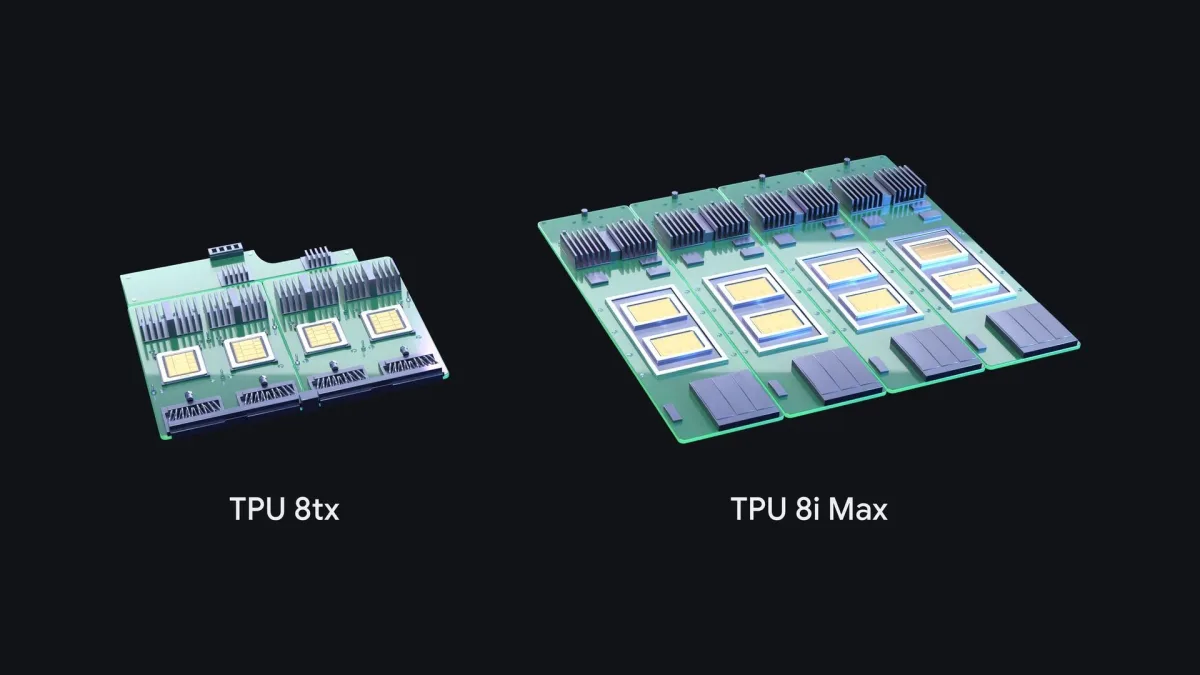
Google's TPU portfolio has grown with the introduction of two additional processors built on its latest silicon generation. The company previously unveiled TPU 8t for model training and TPU 8i for standard inference applications in April. The newly announced TPU 8tx and TPU 8i Max represent specialized variants designed to address distinct market segments and use cases.
The TPU 8tx targets enterprises and government agencies requiring secure, isolated computation. Unlike its predecessors, this variant replaces Arm-based Axion processors with a 5th Gen AMD EPYC CPU and implements a Boardfly network architecture. The TPU 8i Max, meanwhile, pairs two standard 8i chips on a single module to handle extended-context workloads for agentic applications, doubling the compute capacity, SRAM, and HBM bandwidth compared to the original 8i configuration.
The original TPU 8t and 8i split reflected a clear functional division: the 8t addresses large-scale training operations while the 8i emphasizes low-latency inference and reasoning tasks. Google's more granular approach to processor design enables the company to deliver tailored systems "in a matter of months rather than years," according to the company's positioning. This modularity has contributed to TPU adoption, with Google reporting nearly 100 customers including Meta, which recently shifted workloads to the platform.
Google has not yet disclosed specifications, pricing, or availability dates for either the TPU 8tx or TPU 8i Max.