GitHub's Infrastructure Strains Under Sixfold Surge in AI-Generated Code
The code repository giant has deployed 4 million additional CPU cores and 160 petabytes of storage to handle an explosion of machine-generated commits, with monthly activity climbing from 1.4 billion to 7.4 billion in just five months.

Concrete data now backs up what many in the industry have suspected: artificial intelligence is generating vast quantities of code. GitHub, the world's largest repository for source code, disclosed that it has invested heavily in infrastructure to accommodate an extraordinary wave of AI-produced submissions. The company deployed 4 million CPU cores, 160 petabytes of storage capacity, and 50 terabits per second of network bandwidth over the past year to manage the deluge.

The growth metrics are striking. According to GitHub's technical report, code commits—the fundamental unit of code changes—increased sixfold year-over-year. Merged pull requests, which represent completed features or fixes, climbed fourfold during the same span.
The acceleration has been breathtaking. In April, the platform recorded 1.4 billion commits monthly. By August, that figure had doubled to 2.9 billion. September's tally reached 7.4 billion monthly commits. Over a twelve-month period, GitHub processed 17.9 billion code pushes—exceeding the combined total from all of 2024 and 2025.
GitHub attributes the phenomenon directly to agentic AI systems. In March 2026, agents initiated 17 percent of pull requests. By September of the following year, that share had grown to over 40 percent. Repositories initialized through AI tooling demonstrate eight times the activity level of manually created repositories.
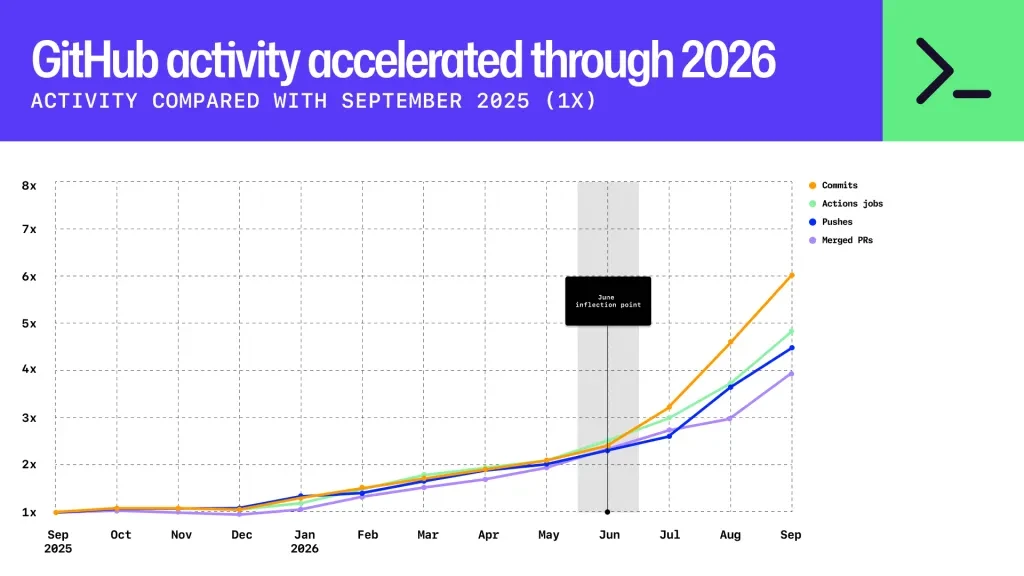
Infrastructure Under Pressure
The surge in code activity has created exceptional demands on continuous integration and continuous deployment pipelines. Each commit or merged pull request triggers numerous automated processes: verification for incomplete tasks, code formatting for consistency, and execution of unit and integration tests to verify that new code functions properly and does not disrupt existing systems or integrations.
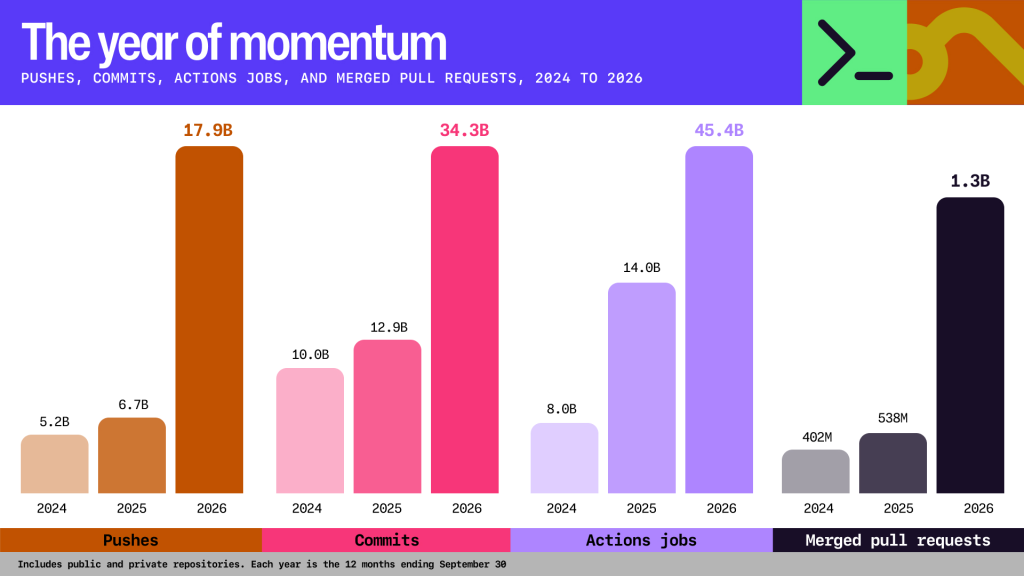
Processing these workflows for every single commit and pull request has forced GitHub to dramatically expand its computational resources and input-output capacity. The company has undertaken a significant backend redesign to separate storage infrastructure from computing resources wherever feasible. Given the velocity of demand growth, further infrastructure upgrades appear inevitable in the near term.