Dell extends AI Data Platform with semantic layers and knowledge agents for enterprise reasoning
Dell Technologies has unveiled new components for its AI Data Platform aimed at supporting agentic systems that can reason and act autonomously. The additions include semantic layer capabilities, knowledge graphs and agents designed to streamline how enterprises prepare and serve data to AI models.
The artificial intelligence landscape is shifting from systems that respond to queries toward those capable of reasoning and autonomous action. Dell Technologies Inc. has responded by expanding its AI Data Platform with features intended to support this emerging agentic computing model.
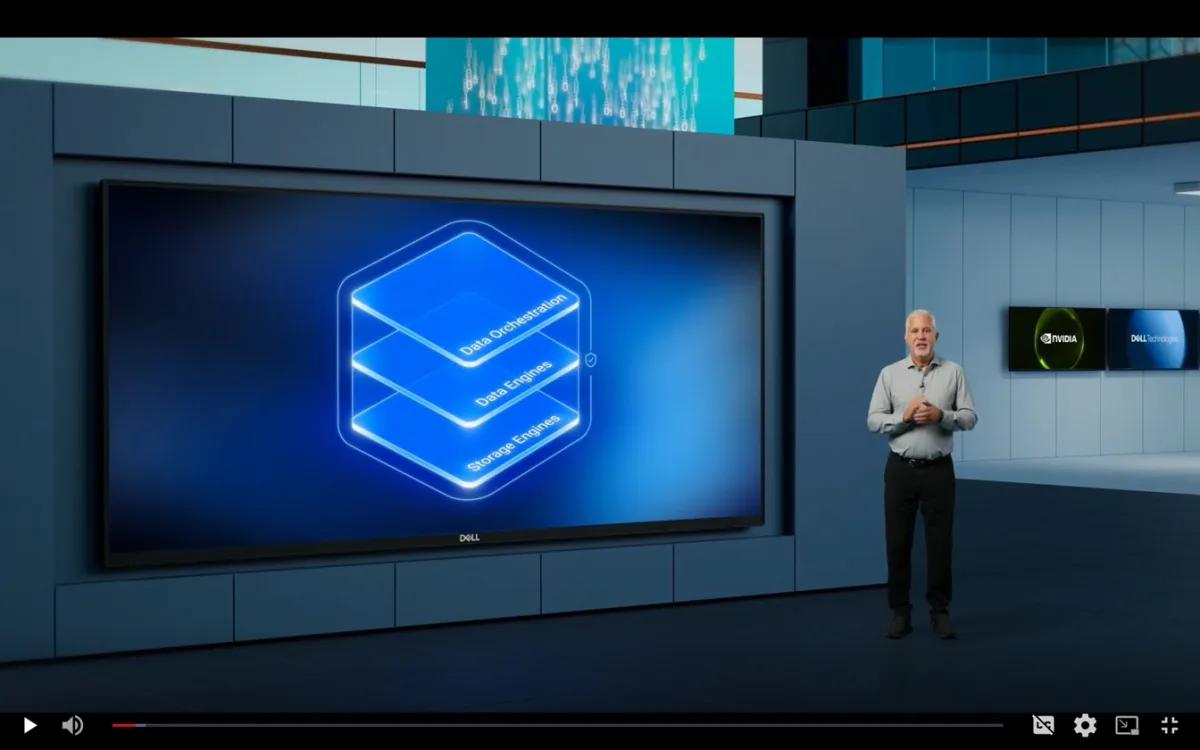
The company's announcements center on three new capabilities added to the Dell Data Orchestration Engine: a Unified Semantic Layer, an Enterprise Knowledge Graph and Knowledge Agents. Additionally, Dell introduced a new feature in its Data Processing Engine designed to accelerate how enterprises prepare data for AI workloads. This engine leverages Nvidia Corp.'s cuDF library to run on graphics processing units.
The strategy aims to reduce data movement across infrastructure by bringing processing and storage systems into closer alignment. Arthur Lewis, president of the Infrastructure Solutions Group at Dell, explained the approach during remarks at theCUBE, a livestreaming platform operated by SiliconANGLE Media. The company is implementing zero-copy data access, memory-to-memory transfer and distributed processing to create a more efficient pathway from raw enterprise data to AI-ready information.
In many cases, the model is not the next constraint, the data is. That is the problem that the AI Data Platform was built to solve. Within the Dell AI Factory, it is the data foundation that curates, connects and serves enterprise data to fuel the AI, and especially agentic AI.
Arthur Lewis, Dell Technologies
Storage infrastructure for agentic workloads
Dell's new announcements underscore storage's critical role across the AI lifecycle. By integrating the Data Processing Engine with Dell's storage architecture, the company is leveraging three distinct storage solutions tailored to different requirements: PowerScale for large-scale enterprise AI deployments supporting up to 16,000 GPUs; ObjectScale for object-based enterprise data storage delivering up to 40 gigabytes per second per node; and Lightning File System, which Dell describes as the world's fastest parallel file system for extreme throughput, large-scale training, checkpointing and demanding inference operations.
At cloud scale, storage performance directly influences business economics. The speed and efficiency of storage systems affect revenue per GPU, how fully infrastructure is utilized and the timeline for reaching billable production deployment.
Dell positions its AI Data Platform as a unifying layer connecting enterprise data sources with production AI systems. The platform integrates storage, data processing, orchestration, search, governance and GPU acceleration into a single architecture. The latest announcements link data orchestration, storage semantic capabilities, knowledge graphs at scale and cyber resilience into one cohesive design.
They're focusing on helping customers get AI right. Everybody wants to get AI right. That means getting to the right information, making sure that information is harmonized and ready, and then delivering it efficiently at a low cost with low operational complexity. Those are the big things. Two years ago, we said, look, the enterprise needs solutions. And what Dell is doing is they're bringing a solution.
Dave Vellante, theCUBE Research
Semantic layers and knowledge graph capabilities
Central to Dell's forward strategy are newly introduced extensions to the Data Orchestration Engine. These include a Unified Semantic Layer, Enterprise Knowledge Graph and Knowledge Agents—each addressing specific pain points enterprises encounter with existing semantic tools.
The Unified Semantic Layer provides an enterprise-wide knowledge graph built natively into the Data Orchestration Engine. Dell is targeting a common frustration: many existing semantic tools work only with structured data, leaving unstructured information unused. Another limitation Dell addresses is the static nature of competing solutions, which build context once and require manual updates as underlying data changes.
We're doing it differently. The semantic layer gives structured and unstructured information consistent business meaning, so a term means the same thing everywhere it appears. It uses open models to fix the hardest part of building semantic layers: generating entities, definitions and finding meaning at-scale with human-in-the-loop for verification. No more standardized ontologies. Each organization is unique. Their semantic layer should reflect that.
Vrashank Jain, lead product manager, AI Data Platform at Dell
Dell's Knowledge Graph connects entities and relationships, enabling applications and agents to understand data relationships. The system draws on metadata from both structured and unstructured sources, data lineage, storage metadata and query history to continuously refine the graph. When an agent submits a query, the platform augments the surrounding context with related entities—tables, images, vector indexes and logs—according to Jain.
Knowledge Agents represent a new interaction model for the AI Data Platform, powered by the Unified Semantic Layer and Knowledge Graph. After building these foundational layers, users can develop Knowledge Agents focused on specific portions of the Knowledge Graph, each curated with particular expertise. Agents accept prompt-based direction, data access rules, quality safeguards and token cost limits while remaining independent of any specific model.
A Knowledge Agent is like a trusted advisor on your team who is an expert on any given topic. It brings trust and accuracy to agentic retrieval.
Vrashank Jain, Dell Technologies
Broader transformations in enterprise AI
Dell's announcements reflect significant shifts occurring in enterprise computing architecture. One transformation involves the evolution of the AI stack itself, driven by the expanding role of autonomous agents. Enterprises increasingly seek to reach agent-driven outcomes as quickly as possible, requiring them to connect underlying data and convert it into context suitable for agent consumption.
We should step back and look at how we are moving from these so-called AI factories or intelligence producing factories, which they were originally conceived as, to what we are now calling agentic data centers. And when you look at an agentic data center, it's not just the model, it's not just the storage, but you need a combination of models, the storage and the data stack.
Gaurav Chawla, vice president and Dell fellow, Infrastructure Solutions Group at Dell
Dell is simultaneously restructuring how it serves enterprise customers, adopting the speed and flexibility characteristic of AI-native organizations. This represents a fundamental departure from earlier approaches, as AI extends far beyond serving as a tool for human operators.
This is a shift now evolving from human as the operator [to] where you want the agent to be the operator and agents bring humans back in the loop when they need them to review or to approve something. If architected and deployed correctly, this means agents not only execute business processes, but they also learn and get better over time. So that's what we are building at Dell AI Data Platform.
Gaurav Chawla, Dell Technologies
These developments point toward a redefined role for the AI Factory. The data center itself is becoming an industrial system, and the competition for AI infrastructure leadership now centers on data movement rather than compute capacity alone.
My big takeaway is that the most important thing that's happening here is two things: Dell has a new data architecture that's unified and two, the industry itself is moving to this phase where … data centers are going to become industrial centers, multiple data centers working together. The story here is that the data path is the new architecture.
John Furrier, theCUBE Research