DeepSeek's Sparse Attention Technique Cuts Processing Costs in Half for Long Conversations
The Chinese AI company has released an experimental model incorporating a new approach to handling lengthy text sequences, addressing a computational bottleneck that plagues existing language models.
Why does ChatGPT become sluggish when users engage in extended dialogues? The answer lies in a core computational constraint: handling extended text requires enormous processing power, even after applying existing optimization strategies. While major American technology firms can invest in additional hardware to overcome this limitation, DeepSeek—a Chinese artificial intelligence company facing restrictions on obtaining certain advanced processors—faces stronger incentives to extract greater efficiency from constrained resources.
On Monday, DeepSeek unveiled a test version of its most recent reasoning-focused language model, DeepSeek-V3.2-Exp, featuring what the company terms DeepSeek Sparse Attention (DSA). This represents the company's take on a computational method that major AI developers likely already employ. OpenAI developed sparse transformers back in 2019 and leveraged this approach when creating GPT-3, while Google Research unveiled comparable work on Reformer models in 2020. (The degree to which leading Western AI companies currently integrate sparse attention into their most recent systems has not been publicly confirmed.)
Though sparse attention has existed as a recognized method for years, DeepSeek asserts that its iteration achieves fine-grained sparse attention for the first time and has slashed API pricing by 50 percent to showcase the resulting performance improvements. Understanding what distinguishes DeepSeek v3.2 requires examining some foundational AI concepts.
DeepSeek captured attention in January after its R1 reasoning model reportedly equaled OpenAI's o1 capabilities while requiring just $6 million in training expenses, and its application briefly became the top-ranked app on the iPhone App Store, surpassing ChatGPT. The industry is watching closely as this company demonstrates competitive strength against America's most advanced AI research organizations.
The attention bottleneck
In machine learning systems, attention describes a computational mechanism that identifies which words in a passage hold the greatest significance for mutual comprehension. These connections establish context, and context generates semantic meaning. Consider the phrase "The bank raised interest rates"—attention enables the system to recognize that "bank" connects to "interest rates" within a financial framework rather than referring to a riverbank. By means of attention, semantic connections transform into numerical values within the model's architecture. Furthermore, attention directs how language models prioritize information when producing each successive word.
Computing context through machines presents difficulties, and scaling this approach only became feasible once processors like GPUs achieved sufficient capability for parallel computation of these relationships. Nevertheless, the foundational Transformer design from 2017 performed a comprehensive comparison between each word and all other words in a straightforward manner. Inputting 1,000 words produced 1,000 × 1,000 comparisons, totaling 1 million relationship calculations. With 10,000 words, this escalates to 100 million relationships. Since computational expense increases quadratically, this creates a severe constraint on managing extended conversations.
Though OpenAI presumably incorporates sparse attention mechanisms in GPT-5, extended conversations still experience performance degradation. Each time a user sends a new message to ChatGPT, the underlying model recalculates context relationships for the entire prior conversation.
The creators of the initial Transformer architecture constructed it for language translation tasks involving relatively brief sequences (perhaps several hundred tokens—units representing word fragments)—where quadratic attention remained practical. The challenge emerged when researchers began working with thousands or tens of thousands of tokens, making the quadratic expense unmanageable.
Sparse attention operates on a different principle. Rather than comparing every word with every other word, it examines only a curated selection of word relationships that the system identifies as most pertinent. For instance, when evaluating word 5,000 in a text, the model might examine its connections with just 100 strategically chosen earlier words instead of all 4,999 preceding words.
DeepSeek's system acquires the capability to prioritize relationships through the training process, employing what DeepSeek designates a lightning indexer. Per DeepSeek's technical documentation, this compact neural component rates the importance of word pair connections and retains the 2,048 most significant relationships for each word, though the documentation does not fully detail the indexer's selection methodology. DeepSeek maintains that its approach can determine which connections to disregard while preserving the model's comprehension of the complete text.
Early benchmarks show promise
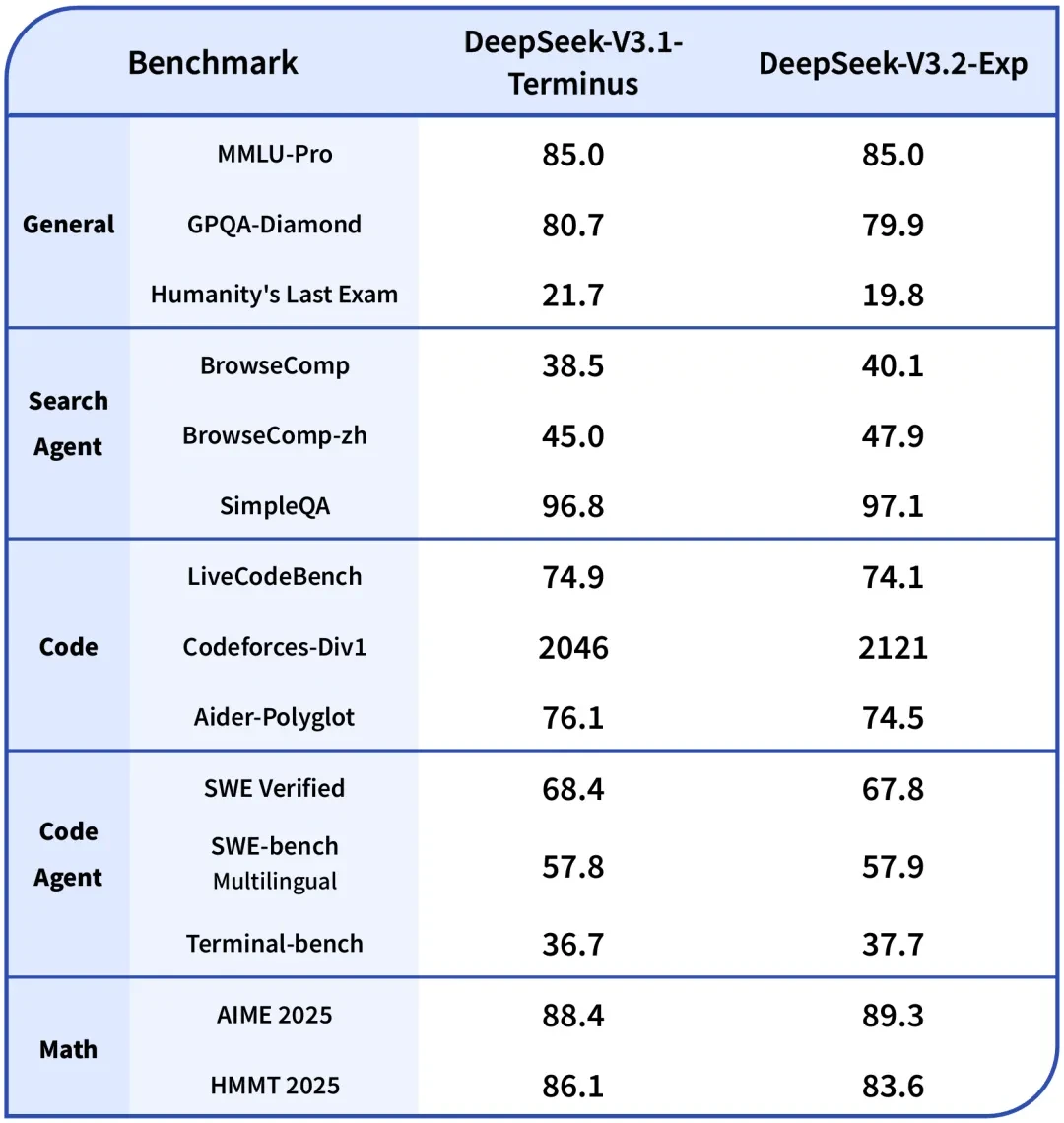
DeepSeek-V3.2-Exp extends the company's preceding V3.1-Terminus model while integrating DeepSeek Sparse Attention. Per the company's performance metrics, the experimental version matches its predecessor's capabilities despite employing sparse attention.
Distinctly, in contrast to OpenAI and Anthropic's premium AI systems, this release contains open source elements distributed under the MIT License alongside open weights, enabling other researchers to expand upon the innovation.
According to TechCrunch, DeepSeek's internal evaluations demonstrated that API expenses might decrease by as much as 50 percent when handling extended-context scenarios. However, these measurements originate from DeepSeek's own assessments, and independent researchers have not yet had the opportunity to confirm the performance assertions or assess the claimed efficiency gains. Should the findings prove accurate, refinements to sparse attention methodology could substantially decrease the expenses associated with AI inference operations in the future.
Source: Ars Technica