Andela's 47,000-Job Study Shows AI Creating Specialized Roles, Not Generalists
Analysis of nearly 47,000 engineering job postings from Fortune 500 companies reveals AI is spawning highly specialized hybrid roles that blend skills from multiple disciplines, contradicting claims that AI will push engineers toward generalism.

The prevailing narrative suggests artificial intelligence will nudge engineers toward broader skill sets. Yet research from Andela, an AI-native talent and services platform, tells a different story. The company examined 47,000 recent engineering job postings from Fortune 500 firms and discovered over 2,000 skills distributed across 23 emerging job titles—each one strategically combining expertise from established roles rather than replacing them.
Throughout technology's history, major shifts have followed a predictable pattern: roles consolidate, then new ones emerge to address friction points. DevOps engineers arose when developers and operations clashed. DevSecOps followed when security became integral to the delivery pipeline. The current AI wave is no different.
Among the 1,832 job postings specifically targeting AI or machine learning engineers, Andela found that 53% required at least two skill sets from different established roles. The research, released Thursday, shows companies responding to AI in three distinct ways: some are overloading generic AI engineer or ML engineer titles with excessive requirements; others are attempting to replace workers with AI; but forward-thinking organizations are redesigning job titles and descriptions to reflect the realities of deploying AI safely and efficiently through the software delivery lifecycle.
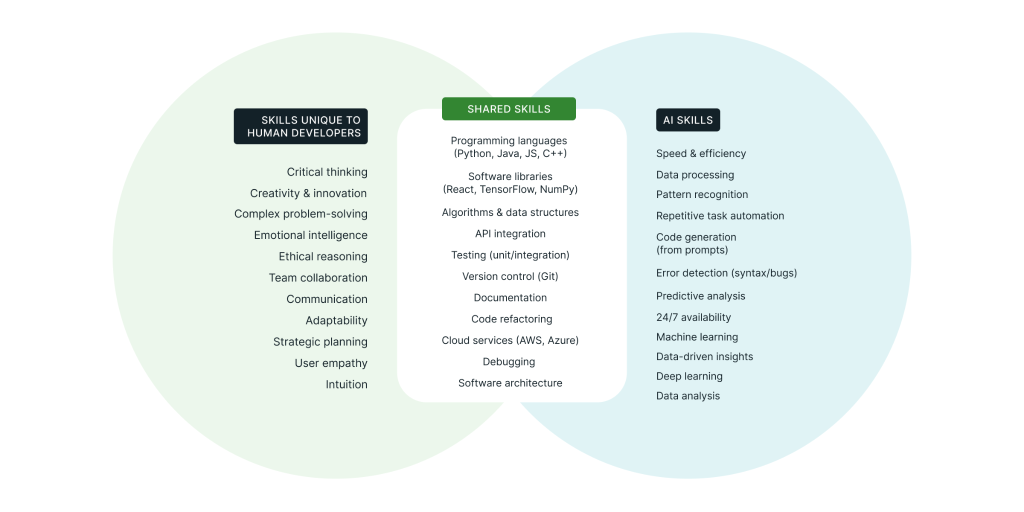
Cory Hymel, head of research at Andela, explained the conceptual framework driving this shift. "If you're going to look to deploy AI within your organization, the way to look at it is that an AI has a certain set of skills, and then a human has a certain set of skills. If you Venn diagram those and see where they cross over, an AI should do the skills it can. But the human circle is still exponentially larger than that of AI. When you're looking to deploy AI, it's not about trying to replace that human circle with an AI one. It's about what certain skills you need to carve out and delegate to it."
Specialization Remains Essential
Industry leaders promoting AI often claim the technology will push workers toward generalism. Hymel pushes back against this narrative. "You've heard from the AI salespeople of the world that AI is going to push people to be more generalist, and the data that we found here doesn't necessarily support it."
The emerging roles Andela identified are anything but generalist. Instead, they bridge multiple skill domains while addressing specific operational or product requirements tied to AI adoption.
The Top Five Emerging Engineering Roles
- MLOps pipeline engineer: Constructs and maintains automated infrastructure for deploying, versioning, and monitoring machine-learning models in production. The role draws 46% from ML engineer backgrounds, 23% from DevOps engineers, 15% from data engineers, and 8% each from AI engineers and data scientists.
- LLM application engineer: Develops and assesses foundational models through large language model applications and conversational systems. This position combines 48% AI engineer skills with 34% ML engineer expertise, supplemented by product designer, software architect, and embedded software engineer competencies.
- FinOps reliability engineer: Manages cloud infrastructure balancing both reliability and cost optimization. The role merges 36% DevOps engineer, 27% site reliability engineer (SRE), 18% cloud engineer, and 9% each DevSecOps engineer and cloud solutions architect skills.
- Docs-as-Code engineer: Applies program management and DevOps engineering methodologies to traditional technical writing, transforming static documentation into specification-as-code frameworks.
- Product frontend engineer: Approximately one-third traditional frontend engineer and one-third product manager, with additional elements from full-stack engineers, UX researchers, and product designers.
Hymel elaborated on how AI reshapes skill requirements within established roles. "If you're a DevOps engineer, historically, your skill bundle might have allocated 30 to 40% of pure DevOps-required skills that are rich and specific to that role, and you have a remaining bundle that is cross-role habitable, meaning that those skills would translate between DevOps or to an engineer or to a technical product manager. Some of those skills can now be replaced with AI, which means that those skills that are more directly focused on your role become more important than ever."
Beyond technical competencies, so-called soft business skills are gaining prominence. However, Hymel expressed skepticism about anyone seamlessly transitioning across finance, marketing, engineering, and sales functions.
Enterprise Job Descriptions Fall Short
The current state of job descriptions and resumes presents a paradox: they are simultaneously the best and worst tools available. Large enterprises face particular challenges. "When you're talking about large enterprises, and you're having to deal with scale, your hiring process gets farther away from the work," Hymel noted.
When HR departments initiate hiring processes rather than engineering teams, the language must survive multiple organizational layers. The job title itself should originate from the engineer closest to the actual work. Many enterprises maintain 50 different front-end developer listings, each with distinct skill requirements. Specificity benefits both candidates and organizational fit, including adoption of new role titles.
Generic job titles once attracted larger applicant pools, but in today's saturated engineering market, this approach dilutes the hiring pool further. Companies often end up reviewing the 100 fastest applications—frequently generated by AI systems themselves.
Organizations that have not thoroughly revised their job postings and titles face significant disadvantage. "There's a very high probability that you're going to end up hiring the wrong person simply because you didn't take the time to describe the role well enough," Hymel cautioned, outlining three consequences: employee churn, extended ramp-up time as new hires discover misaligned expectations, and disrupted roadmaps and timelines requiring replacement hiring cycles.
Adding another layer of complexity, both HR and engineering managers increasingly use AI to generate job descriptions—a practice Hymel advises against for something so fundamental to organizational success.
During periods of significant change, when candidates may lack the exact required experience, companies should reframe job descriptions around desired outcomes. "The cost of code is going nearer to zero." Organizations should instead articulate: "Here are the outcomes that we're looking for. If you have the soft skills and additional skills around it to get there, whether that is backlog prioritization, being able to be collaborative, having worked on project deployments before, and we don't necessarily care that you can score a 10 out of 10 on Python anymore."
Clearly separating essential qualifications from preferences reduces ambiguity and unnecessary barriers. While research does not universally support the claim that women apply only when meeting every requirement—application behavior proves more nuanced—transparent distinction between required and preferred skills may expand the applicant pool, though it does not guarantee greater diversity.
Career Paths for Engineers in Emerging Roles
Engineers drawn to product focus, collaboration, and strategy should consider the product front-end engineer role, which owns the complete user-facing feature lifecycle from definition through shipping. "You are required to have more mindshare towards prioritization of features," Hymel explained, noting the shift away from ticket-based work. "Now you have more control because AI allows you to span out a little bit deeper."
Backend engineers increasingly think beyond their core stack, now considering deployments, scalability, and underlying infrastructure reliability. This expansion has created roles like the polyglot back-end integration engineer.
Technical writers concerned about AI-generated documentation should explore docs-as-code engineer positions, which layer technical program management and DevOps engineering skills onto traditional writing expertise. "If you're writing the docs, you're essentially writing the specs that enable spec-driven development. You now have the capability to actually contribute software," Hymel observed. "And it starts all the way at the top too. If you're a product manager, you can now start building and contributing code, like a product experience designer."