Valve's Steam Frame VR Headset Launches at $1,059, Blending Wireless Streaming With Standalone Gaming
Valve engineers explain how the company built a lighter, more accessible VR headset that works both as a wireless streaming device and a standalone gaming machine, while grappling with elevated component costs.
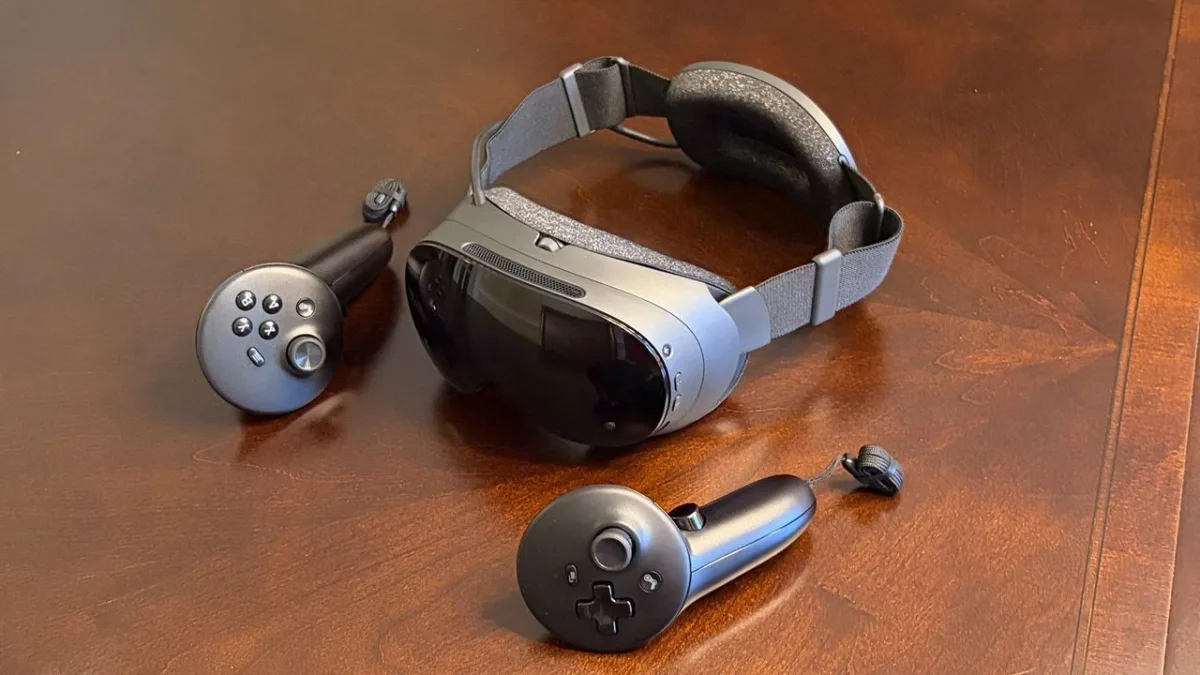
Nearly a year after its initial announcement, Valve is now accepting reservations for the Steam Frame VR headset, which arrives amid a challenging period for hardware pricing. The company sat down with engineers Pierre-Loup Griffais and Jeff Leinbaugh to discuss the design philosophy, technical challenges and market realities that shaped the finished product. Starting at $1,059 for the 256GB model, the Steam Frame represents Valve's attempt to make virtual reality more approachable than its previous Index headset.
From Index to Frame: A Shift in Design Philosophy
Development of the Steam Frame began immediately after the Index shipped, according to Leinbaugh. The team explored various technologies and use cases before settling on a core objective: creating a headset that prioritized ease of use over raw capability. "Work started on Steam Frame basically as soon as we shipped the Index," Leinbaugh said. "And so we did a lot of exploration into technologies and features and use cases to try to answer that question. And the goals that we aligned on for what became the Steam Frame was to make a much easier to use, which to us meant, lighter, more comfortable, easier to get into and out of, VR headset."
The Index represented a different engineering trade-off. Valve prioritized maximum performance at the time, accepting various compromises to achieve that singular goal. With the Steam Frame, the strategy shifted fundamentally. Leinbaugh explained the new direction: "But this time around we thought we could achieve something that was a lot more comfortable, a lot more accessible. And so streaming technology was a big part of that. So the headset can be wireless so that there's not a lot of complicated setup to get to the game, whether that's playing on the headset or streamed. So what we want to be possible is for somebody to put on the headset, browse their Steam library, and then just pick something that they want to play and not worry about too much else."
Standalone Gaming on the Steam Frame
The Steam Frame can operate in two distinct modes: wirelessly connected to a PC, or as a fully independent device powered by the Qualcomm Snapdragon 8 Gen 3 SoC. Achieving this flexibility required substantial engineering work. Leinbaugh described the central challenge: "Yeah, a lot of the engineering challenges were around making sure that we had the right kind of compute and enough compute on the headset to both support a really good streaming experience, but also to be able to run games on the headset. So we picked the Qualcomm 8650 chip. It had a lot of capability, but in order to make use of that, we had to solve a lot of engineering challenges around thermal management and power delivery. So really treating this like making a really capable PC that just happens to run this particular mobile hardware was how a lot of the engineers approached that problem."
Valve leveraged experience from the Steam Deck and Steam Machine to deliver SteamOS on the Frame, this time adapted for Arm architecture and paired with Proton for compatibility. The mobile-focused processor does impose limitations on local gaming performance. Griffais acknowledged the constraints: "Sure, games that are trying to push the boundaries on the AAA stuff that's very graphically intensive. Most of those recent ones won't run very well because it's a smaller compute envelope, right?"
However, a substantial library remains playable on the device. Griffais pointed to recent releases and older titles as examples of what works well. "But there's a ton of stuff that is coming out that is a great experience on the Steam Frame. For example, I think last week the Metal Gear Solid Collection Part 2 released. And, you know, MGS4 is a game that I haven't played in, I don't know, 20 years at this point, but it's great from there." He noted that indie games and back-catalog AAA titles that don't demand cutting-edge compute resources perform well on the hardware.
Valve is ensuring that flagship VR titles receive native optimization. "And we're doing the same for Half-Life Alyx where, you know, we're doing a lot of work to support the Frame more natively and trying to remove performance barriers that are induced by some of the translation, the emulation there that you get on normal and modified PC games. And that's yielding great results also to get kind of to the next level of performance there," Griffais said.
Streaming Architecture and Wireless Resilience
Despite standalone capability, Valve designed the Steam Frame primarily as a streaming device. The headset incorporates eye-tracking cameras that enable foveated streaming—a technique that allocates network resources intelligently based on where the user is looking. Leinbaugh explained the technology: "So the Steam Frame has eye-tracking cameras on the inside of the headset that know where your eyes are looking. And when you have that, there's a lot of potential use cases, but the one that we're using most consistently is foveated streaming, which really means when you're streaming, especially VR content, there's a lot of video data that you have to send."
By prioritizing the portion of the image the user is viewing, Valve achieves significant efficiency gains. "But because we know with eye-tracking cameras what part of the image you're looking at at any time, we can refocus some of those resources to make sure that the important parts of the image are treated as like first-class bits. And then the rest gets kind of the last part of the resource pool, which is the part of the image that you can't see and you won't notice the image degradation," Leinbaugh continued. He added an analogy: "So it's the best analogy really is it's almost as if the part that you're looking at is using about 10 times as much bandwidth and encoding bit rate as it actually is for the entire image, because we just squished it all into that part that follows where you're looking."
The Steam Frame communicates with a PC via a dedicated Wi-Fi 6E USB dongle, transmitting data over the 6 GHz channel. To handle wireless interference, Valve built in redundancy. Leinbaugh described the fallback system: "So there's a fallback mechanism built into that, which, if you have two links active and one of them drops out because of interference or, you know, you walked out of range or, you know, what all the many reasons that wireless interference can happen, if something happens to one of those links, the other one will immediately pick up and cover the gap. And it's just very unlikely that a lot of those sources of interference will hit both links at the exact same time."
Additional strategies provide protection against brief disruptions. If a latency spike occurs, a previous frame can be "reprojected and replayed" to mask the gap. Extended outages have no recovery mechanism; the stream terminates and the user returns to the default environment.
Pricing and Availability
The Steam Frame's pricing will likely provoke discussion among consumers. The 256GB model costs $1,069, while the 1TB variant reaches $1,299. These figures reflect the broader hardware cost environment. Griffais acknowledged the market pressures: "I think as far as, you know, memory prices and those kinds of conditions, we're really in it like everyone else. We've been working hard on trying to, you know, get the parts that we can get at the best price possible."
Component shortages and elevated costs extend beyond memory and storage. "It's an unfortunate situation all around. We wish that gaming hardware was cheaper, but we're definitely trying to be on the cheapest side that we can get, you know, despite all those conditions," Griffais explained. He elaborated on the scope of price pressures: "Even just things like motherboards, copper, anything, even shipping anything worldwide right now is way more expensive than it was, you know, last year and two years ago. So every part of the sticker price is affected there."

Reservations open today, with the Steam Frame becoming available starting September 14. Valve will employ a reservation system similar to the one used for the Steam Machine to limit scalper activity.