Valve's Steam Frame Headset Balances Standalone Play With PC Streaming, but Price Remains a Barrier
Valve's latest VR headset combines onboard processing power with wireless streaming capabilities, delivering strong performance when tethered to a gaming PC but commanding a premium price that may limit its appeal.
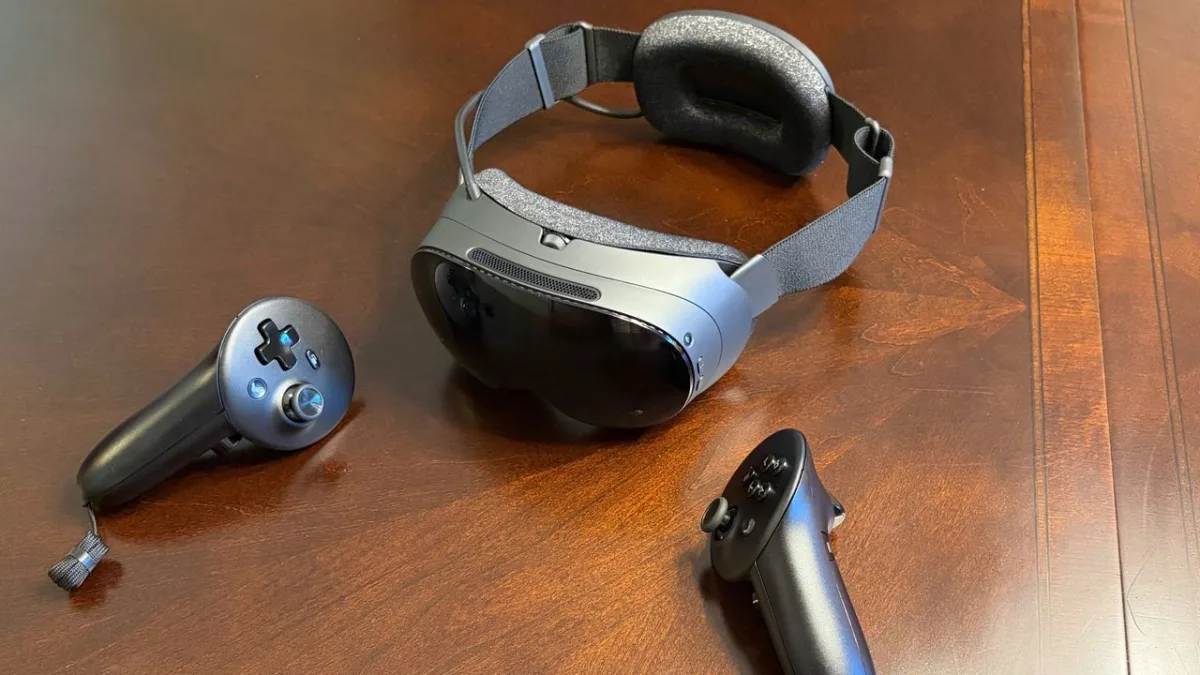
Valve has accelerated its hardware roadmap throughout 2026, introducing the Steam Controller in spring and the Steam Machine during summer. The company's latest device, the Steam Frame, represents the culmination of this push—a VR headset designed to handle both standalone gaming and wireless streaming from a desktop PC.
Unlike its predecessor, the Valve Index, which functioned primarily as a streaming platform, the Steam Frame incorporates a Qualcomm Snapdragon 8 Gen 3 processor and up to 1TB of internal storage, enabling it to run games independently. This dual-mode approach comes with an ambitious starting price of $1,059, rising to $1,299 for the fully configured model tested here.
Design and Comfort
The Steam Frame's aesthetic departs significantly from the Daft Punk-inspired look of the Index, instead resembling oversized ski goggles. Its organic curves and thin plastic construction keep weight to just 440 grams with the headstrap—nearly half the Index's 809 grams. This lightweight design proves crucial for extended wear, as the pressure-relieving front gasket and rear cradle that houses the 21.6 Whr battery effectively distribute weight across the head.
The headset integrates six cameras total: two forward-facing units on the front providing monochrome passthrough, two side-mounted cameras for headset and controller tracking, and two internal cameras dedicated to eye tracking. A built-in cooling fan manages thermal output from the processor, helping prevent discomfort during longer sessions. An expansion port sits at the bottom front, while an interpupillary distance (IPD) adjustment knob at the top accommodates a range from 57.6 to 69.6 mm, with an internal lock switch preventing accidental adjustment.
Control inputs include two buttons on the right side (Aux and Power) and volume controls on the left. Four speakers—two per side—sit low beneath the adjustable strap's arm pivots. The headset supports Bluetooth audio devices as an alternative. The USB-C charging port, positioned on the rear cradle rather than the front, allows charging while wearing the device without cable obstruction.
The review unit arrived with the headset, two wireless controllers, a USB-C cable, and headstrap. A $29 USB-C power adapter and a $59 Ergonomic Accessories Kit (containing an additional headstrap, controller hand straps, and an extended light blocker gasket) were also included, though neither proved essential to the experience.
Controllers and Input
The two wireless controllers feature a shiny, textured black plastic finish contrasting with the headset's matte grey. Each supports six degrees of freedom and includes a dual-stage grip button, analog trigger, bumper, Steam button, and a magnetic thumbstick with capacitive finger sensing—the same thumbstick found on the Steam Controller used with the Steam Machine.
The right controller adds AXBY and Menu buttons, while the left includes a View button and D-pad. Both feature haptic motors and capacitive finger tracking, communicating with the headset via dedicated Bluetooth. Each controller runs on a single AA battery, with Valve claiming approximately 40 hours of runtime per pair of alkaline batteries.
Hardware and Specifications
The Steam Frame functions as a dual-purpose device: it streams games from a high-end gaming PC or operates as a standalone headset thanks to its Snapdragon 8 Gen 3 ARM processor and 16GB of unified LPDDR5X RAM. The review unit featured 1TB of UFS storage, though a more affordable 256GB variant is available. A microSD slot behind the magnetically attached foam gasket permits further expansion.
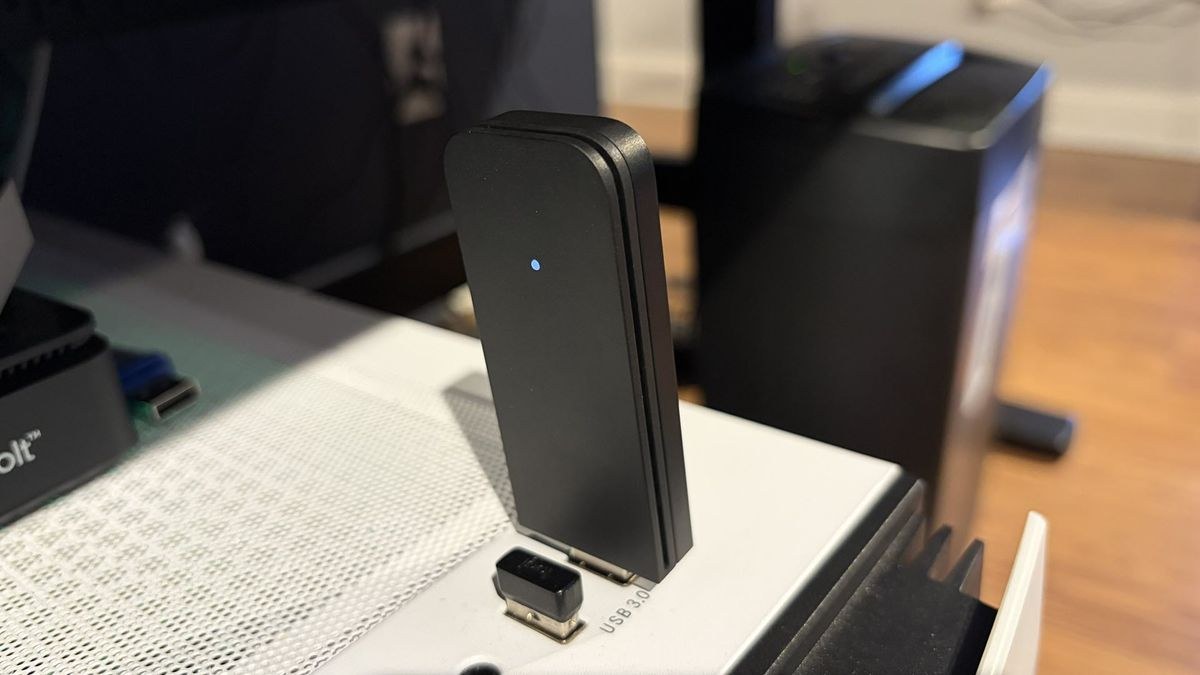
Standalone gaming relies on FEX emulation and Proton to run x86 Windows titles on ARM64 architecture. For optimal performance, however, streaming from a desktop PC via the integrated Wi-Fi 7 radio and included Wi-Fi 6E dongle is recommended. The dongle connects to a USB 3.0 port on the host computer, establishing a low-latency direct link that bypasses the home network and reduces bandwidth congestion.
The dual wireless approach splits connectivity: the 5 GHz band handles internet access and system updates, while the 6 GHz link connects exclusively to the Wi-Fi 6E dongle. This architecture enables foveated streaming, which uses internal eye-tracking cameras to prioritize full-resolution data for the user's direct field of view while delivering lower-resolution content to peripheral areas. This optimization reduces bandwidth demands and preserves performance during streaming sessions.
The display system employs dual LCDs delivering 2160 x 2160 resolution per eye. Valve selected LCDs over micro-OLEDs to meet design, performance, and cost targets—a decision that appears sound given the already-premium pricing. Displays support refresh rates from 72 Hz to 144 Hz, though the higher rate remains experimental; all tested games defaulted to 72 Hz. Pancake lenses provide a horizontal field of view of up to 110 degrees, a modest improvement over the Index's 108 degrees.
Setup and Configuration
Initial setup proved straightforward. After charging the headset for approximately one hour, the process involved logging into the Steam app via smartphone to identify the device, followed by installation of the latest SteamOS update from the Stable channel. On the PC side, inserting the Wi-Fi 6E dongle into a USB port resulted in immediate automatic recognition and readiness.
Streaming Performance
Testing employed a system featuring an Intel Core Ultra 7 265K processor, 32GB of DDR5-5600 memory, and an NVIDIA GeForce RTX 4060 Ti GPU. Half-Life: Alyx demonstrated the headset's VR capabilities, maintaining consistently high frame rates without drops—critical for VR comfort. Gunman Contracts "Stand Alone" delivered intense gunplay with sharp visuals, though its default smooth locomotion controls induced motion sickness due to the disconnect between physical and virtual movement.
Non-VR titles like Batman: Legacy of the Dark Knight, BeamNG, and Forza Horizon 6 played without issues in Theater Mode, displaying on a simulated cinema screen with ambient background fill. However, the Steam Frame controllers do not function with non-VR games, necessitating an Xbox Series X wireless controller for these titles. While less immersive than full VR, this mode proved preferable to traditional monitor-based gaming.
Standalone Gaming
Standalone testing included Stellar Café, a cartoonish title allowing voice interaction with in-game robot characters serving beverages. The conversational exchanges felt surprisingly natural, with human-like responses and realistic commentary enhancing engagement.
Battery Life
Battery endurance varies significantly between streaming and standalone modes. Playing Half-Life: Alyx natively at 72 Hz yielded approximately one hour of runtime, while streaming the same title at identical refresh rates doubled that duration, as the ARM processor faces reduced load. Gunman Contracts "Stand Alone" delivered slightly over one hour of native play, whereas non-3D titles like Forza Horizon 6 lasted well beyond two hours when streamed from a PC.
Despite shorter standalone runtimes, battery life presented no practical limitation. Taking breaks every hour or so for mental recovery and reality orientation proved beneficial regardless of remaining charge.
Verdict
The Steam Frame emerges as a versatile, comfortable headset weighing under a pound. Its lightweight construction, balanced weight distribution via rear battery placement, and secure foam seal enable extended wear without fatigue. Streaming performance from a PC excels, while standalone gaming suffers due to ARM emulation overhead—though Valve positions streaming as the primary use case, making standalone play a bonus feature for portable sessions away from a desktop.
Valve demonstrated thoughtful engineering through its wireless architecture, monochrome passthrough for environmental awareness, and adjustable IPD accommodation. However, pricing represents the critical barrier. Starting at $1,059 for 256GB storage and reaching $1,299 for 1TB, the Steam Frame demands significant investment in an economic climate already burdened by elevated component costs. While microSD expansion offers a workaround for the base model, portable storage carries its own premium.
For users prioritizing a lightweight VR experience with capable PC hardware to support streaming, the Steam Frame delivers compelling performance. Those sensitive to cost, however, may find the pricing difficult to justify.