Google Releases Gemini 3.8 Flash, Its Third Model Variant in Six Weeks
Google has unveiled Gemini 3.8 Flash alongside a restricted-access Cyber variant, with the standard model approaching Anthropic's Opus 5 on coding benchmarks and the Cyber version limited to 650 trusted security partners through a new Fairwind Program.
On Wednesday, Google introduced another iteration of its Gemini Flash lineup, continuing a rapid cadence of releases. The company has now shipped three Flash variants within a six-week window, with Gemini 3.8 Flash arriving just three weeks after version 3.7 Flash. This newest model demonstrates substantial improvements, particularly in agentic coding work and computer use scenarios.
Pricing for Gemini 3.8 Flash remains consistent with earlier Flash releases at $0.75/$3.75 per million input and output tokens during an introductory period. This promotional rate expires on December 31, 2026, after which pricing will increase to $1.50/$7.50 per million tokens.
Fairwind gates Flash 3.8 Cyber
Alongside the standard Flash release, Google has introduced Gemini 3.8 Flash Cyber, a specialized model available only through a newly established program called Fairwind. This approach mirrors Anthropic's strategy for controlling access to sensitive capabilities. Google characterizes the Cyber variant as its "most capable cybersecurity model with frontier-level performance in vulnerability detection and automated patching."
Access to Flash 3.8 Cyber is restricted to approximately 650 vetted partners, including organizations such as Accenture, CrowdStrike, the Center for Internet Security, Datadog, Palo Alto Networks, Snowflake, and Wiz. According to Four Flynn, Google's VP for Security and Privacy, "The defender's edge comes from shrinking the time between detecting a flaw and patching it. Through Google's Fairwind Program, government and enterprise partners gain autonomous tools to repair systems faster and at scale, keeping them one step ahead of agentic-speed threats."
Google had previously launched a limited-access program for Flash 3.5 Cyber in July, though that initiative lacked an official designation and appeared less structured than the current Fairwind framework.
Gemini 3.8 Flash: long-horizon coding and agents
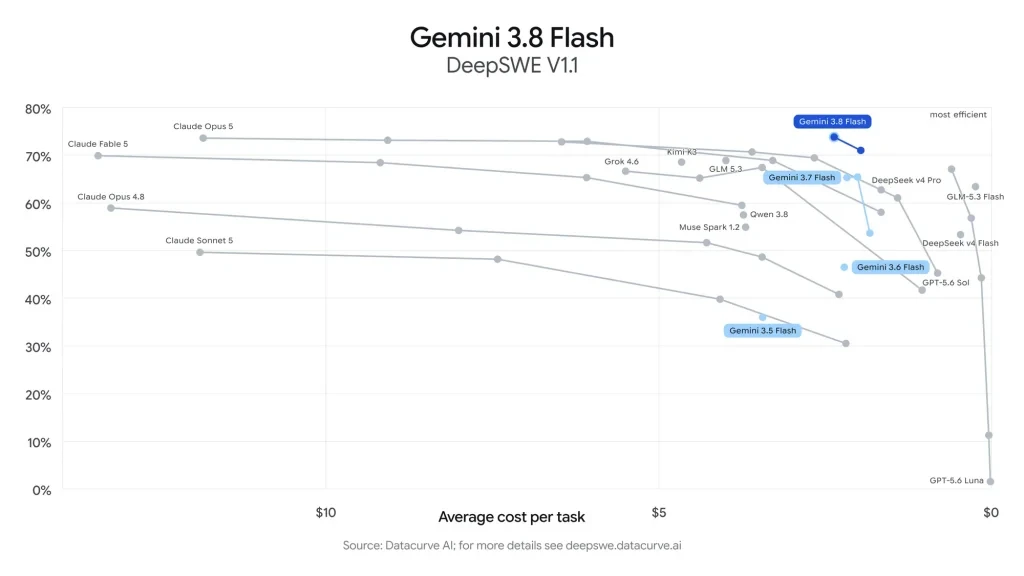
On complex engineering tasks, Gemini 3.8 Flash frequently surpasses competing models including OpenAI's GPT-5.6 Sol and Anthropic's Claude Sonnet 5 and Opus 5. Performance on the DeepSWE benchmark shows the model matching Opus 5 while outperforming both GPT-5.6 Sol and Sonnet 5.
However, Google acknowledges a trade-off: achieving this performance requires additional computational effort. The company states that "3.8 Flash works harder" and explains that "On complex tasks, it exhibits greater diligence — executing extra reasoning steps, and calling tools iteratively. At times, the model might use more tokens to maximize performance, especially at higher effort levels." Developers can mitigate token consumption by selecting from multiple reasoning modes.
Google's benchmark comparisons exclude Anthropic's Fable 5.1, released the day prior to this announcement. While Fable 5.1 represents a substantially more capable model, it commands significantly higher costs. On the general agentic benchmark Terminal-Bench 4.0, Fable 5.1 achieves 55.8% compared to Flash 3.8's 19.1% and Opus 5's 51.8%. On Terminal-Bench 2.1, which emphasizes coding tasks, Flash 3.8 outperforms its competitors.
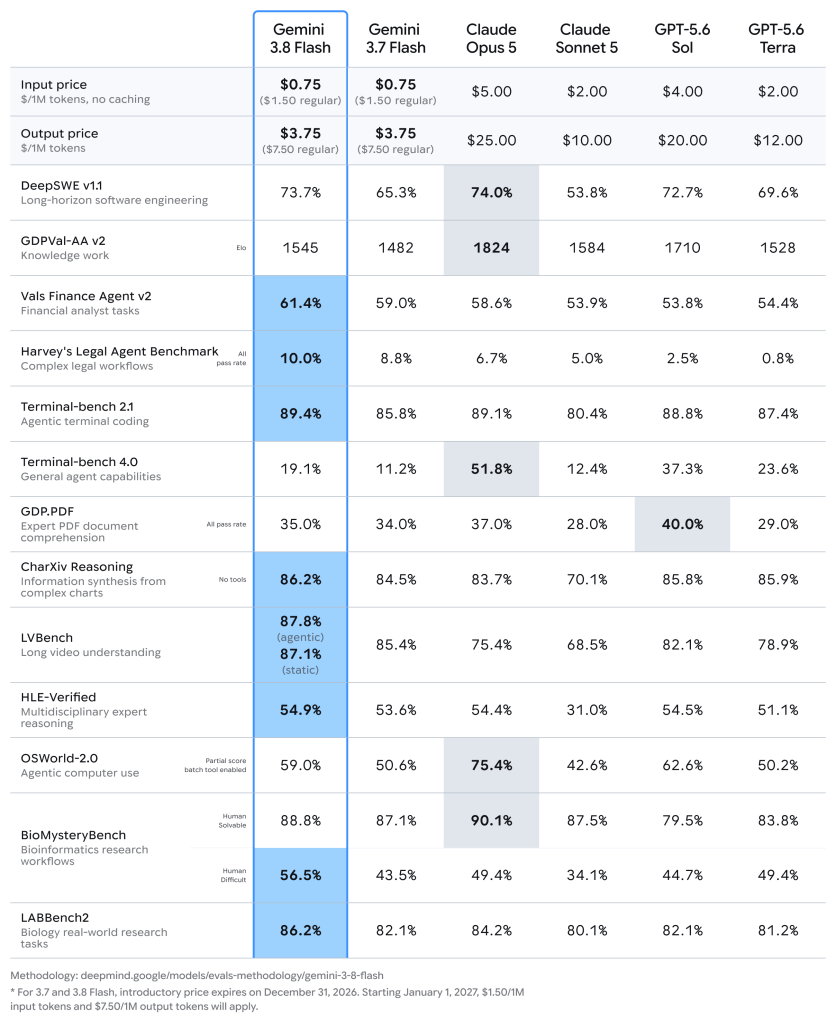
The model shows strong performance across other agentic tasks relative to flagship alternatives, though specific weaknesses persist. On computer use benchmarks, Flash 3.8 scores 59% versus 75.4% for Opus 5 on OSWorld-2.0. On GDPVal, which assesses knowledge work capabilities, Google's model reaches 1545 compared to Opus 5's 1824 and Sonnet 5's 1584, indicating incremental progress but continued gaps.
Google attributes the rapid improvement cycle to employing agentic loops in model development itself. The team notes that "Both of today's releases are powered by the same foundational intelligence, and further accelerated by long-running agentic loops designed to recursively evaluate and refine the underlying models."
Chinese models close the gap
Google's published comparisons concentrate on OpenAI and Anthropic competitors, yet Chinese models merit consideration. On benchmarks such as DeepSWE 1.1, models including GLM-5.3, GLM-5.3 Flash, DeepSeek v4 Pro, and Kimi K3 demonstrate comparable performance and frequently offer superior price-to-performance economics.
Cyber benchmarks
For Flash 3.8 Cyber, Google reports "frontier-level performance in autonomous vulnerability discovery" on the CyberGym benchmark, where it exceeds both the July-released 3.5 Flash Cyber and "significantly larger frontier models." Since CyberGym covers only C and C++ code, Google also evaluated the model against an internal benchmark spanning 20 programming languages, achieving a success rate exceeding 70%.
On Collinear's CWE-Bench, the model achieves a pass@1 score of 47.2%, marginally behind an unnamed "leading frontier model at 47.8%." Real-world validation from Chrome's security team indicates the model generates 2.6 times more correct patches than "the best commercial models that are much larger," while Wiz reports 7.5% to 9.7% higher recall on its internal penetration testing benchmark at 2.3 to 5.2 times lower cost.
Safety
Gemini 3.8 Flash incorporates "safeguards against misuse in the domains of Chemical, Biological, Radiological, and Nuclear (CBRN) and cyber offense, while enabling beneficial use cases, as per our Frontier Safety Framework." Flash 3.8 Cyber employs a less restrictive safety configuration, justified by its limited distribution to authorized users.
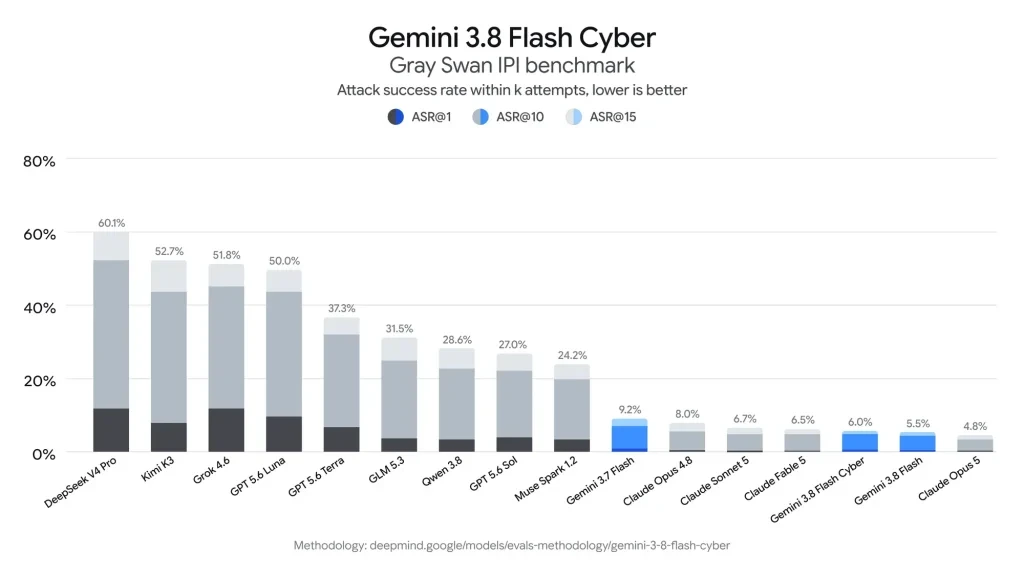
The model demonstrates enhanced robustness against prompt injection attacks, achieving near-leading performance on the Gray Swan IPI benchmark.
Gemini Pro?
The timing of the next Gemini Pro model release remains uncertain. Flash variants are advancing at an accelerating pace, and while Google's Pro launch strategy has faced challenges, the eventual release may justify the extended development period. By prioritizing Flash models, Google has constructed a compelling price-to-performance narrative that competing U.S. frontier labs have struggled to match.
At the current release velocity, Gemini 3.9 Flash could arrive before Gemini 4 Pro becomes available.
Availability
Gemini 3.8 Flash is accessible through Google's standard platforms including Antigravity, Google AI Studio, Android Studio, and Stitch, as well as Gemini Enterprise. Users with AI Pro and Ultra subscriptions can access the model through the Gemini App, AI Mode in Google Search, and Gemini in Google Sheets.