Zed's Delta Challenges GitHub's Dominance as AI Agents Reshape Code Review
Zed has launched Delta, a collaborative coding platform built around shared threads rather than pull requests, arguing that GitHub's review model no longer suits a world where agents generate code at unprecedented scale.

By 2026, a broad consensus has taken hold among developers: GitHub, originally designed for human collaboration, no longer meets the needs of modern software development. The platform faces mounting pressure from the sheer velocity at which AI agents can generate, modify and submit code—a cadence that strains infrastructure built for humans working through traditional commits, branches and pull requests.
The interaction model itself poses a deeper challenge. When much of the reasoning behind a code change occurs in a conversation with an agent, a pull request shows reviewers only the final diff while hiding the journey that produced it. Meanwhile, GitHub's reliability has deteriorated under the load. The platform experienced hundreds of incidents over the 12 months leading into June as monthly commit volume surged from approximately 1 billion across all of 2025 to 1.4 billion by April. By August, that figure had climbed to 2.9 billion commits monthly. A near-eight-hour outage in August saw web and API error rates reach around 20% at peak.
Nathan Sobo, co-founder and CEO of Zed, declared in a Wednesday blog post that "everyone is in a race to replace GitHub right now," with multiple technology companies developing alternative tools. Zed itself has announced the public beta of Delta—a collaborative environment where developers and coding agents work, review and revise code together in shared threads rather than pull requests.
From Editor to Platform
Zed began in 2021 as a high-performance, multiplayer code editor built in Rust by veterans of GitHub's Atom editor team, including Sobo, who spent nine years there. By 2025, AI editing and agentic capabilities had become central to the product. When Zed announced a $32 million funding round led by Sequoia Capital in August 2025, the company also introduced DeltaDB, an operation-based version control system designed to record code changes at edit-level granularity. Delta itself emerged in private beta in August before Wednesday's public beta launch.
The Thread Model
Delta's core concept is the thread: a continuous record of an agent-assisted coding task where conversation and file changes remain connected. A developer can assign work to an agent, continue refining it through discussion, and later share the entire body of work with teammates. Each thread operates against its own project copy, allowing multiple pieces of work to proceed independently without agents competing for the same checked-out files. Teammates can join an existing thread or create a separate review thread to examine a proposed change, question the agent, and test revisions before feeding accepted changes back into the original work.
DeltaDB records activity at finer granularity than Git. Rather than waiting for developers to package work into commits, it captures individual events as they occur—including code edits and conversation activity—and uses that history to keep participants synchronized. Zed calls these individual records "deltas."
Git remains in the picture. Delta currently works with Git repositories, and developers can continue using branches, commits and remotes as usual. DeltaDB effectively adds another layer of history between commits, preserving the intermediate human and agent activity that Git would otherwise discard.
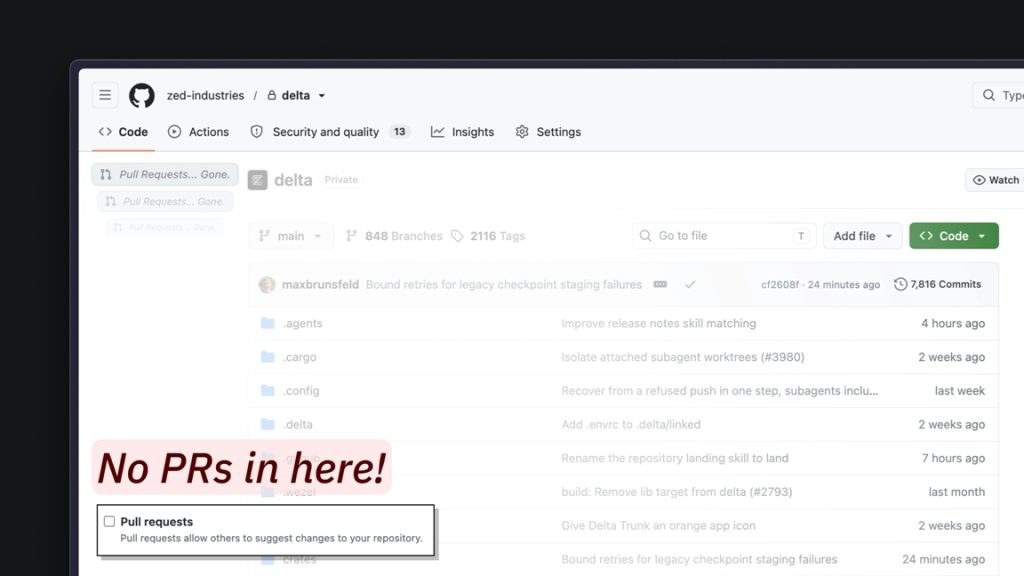
Zed has already disabled pull requests on Delta's own repository and now develops the product through Delta threads instead. Since making that change, 33 developers have landed 570 changes to main without using pull requests. Sobo writes that "We now build and collaborate on Delta entirely within Delta."
Transitioning Away from GitHub
Zed views this shift as an intermediate step. Sobo expects the company is only "a few months away" from leaving GitHub behind entirely, with developers focused exclusively on Delta already having little reason to visit GitHub because their conversations, reviews and handoffs now take place inside Delta.
Some dependencies remain. Zed's next major priority is bringing Git storage into DeltaDB, while CI and releases also need to migrate away from GitHub. Sobo sees CI as largely a solved problem and says Zed expects to integrate with existing options rather than build a replacement system simply to eliminate GitHub.
Zed's main open-source code editor repository will remain on GitHub for now, where an established contributor community reports issues and proposes changes. Those contributors can use Delta to expose the agent session behind their work while still submitting the final change through a conventional pull request, leaving the Git experience unchanged for collaborators who do not use Delta. That public repository presents a different challenge than Zed's internal development, given the hundreds of external developers contributing each month.
Sobo told The Silicon Ledger: "We're moving more thoughtfully with Zed's public repo because we have hundreds of monthly contributors who depend on that workflow. GitHub has an established social component that will take longer to replace, and we're not going to strand contributors to prove a point. We're only going to move our community layer when we can offer something better."
Delta is available as a desktop app for macOS, Linux and Windows, with a browser version for viewing, sharing and reviewing threads. It will remain free throughout the public beta, with paid individual and team plans to follow; Zed says there will always be a free version. One item on Delta's roadmap is repository-based access, which will use a GitHub repository's existing permissions to determine who can access shared Delta threads.
A Crowded Field
Zed is not alone in attempting to reinvent code collaboration for the agentic era. SpaceX-owned Cursor formally launched Origin in August, bringing Git repository hosting, pull requests and its coding agents under one roof while allowing existing GitHub repositories to remain the source of truth. GitLab is working on a "next-generation source-code management" project called Project Switch, currently in private beta.
The Thread as Fundamental Unit
Sobo argues that Delta's differentiation begins with the basic unit around which it is built. "I believe the thread will replace the commit or branch as the fundamental unit of software development," he explains. Commits will continue to provide useful checkpoints, but they do not preserve everything that happens between them: the discussion with an agent, the decisions made and the incremental changes that eventually produce the committed code. That is the gap Zed wants DeltaDB to fill, with the thread rather than the commit serving as the fuller record of how software came together.
"Delta's advantage is that we're building around the thread from the start, including the infrastructure underneath it," Sobo continues. Preserving incremental edits alongside the agent conversation gives subsequent collaborators something a conventional diff cannot: the ability to enter the work where the previous developer left it and continue interacting with the same agent and context, rather than reconstructing the thinking behind a change after the fact.
Delta's bet is that the central object of software development should become the ongoing interaction between developer and agent, with the resulting code attached to that history rather than presented later as an isolated diff.
Sobo expects the next era to echo the structure of the Git era, with competing developer platforms built on top of a common technical foundation. "On consolidation, we look at how the last era played out. Git became the common foundation because it was open and everyone could build on it," Sobo says. "GitHub won the layer above through network effects. I expect lots of viable products will compete on the agent experience, with a common infrastructure underneath."