ReactOS Clears Major Hurdle With Native NTFS Installation Support
The open source Windows clone has achieved a significant development milestone by enabling direct installation onto NTFS partitions, moving the long-running project closer to beta status.
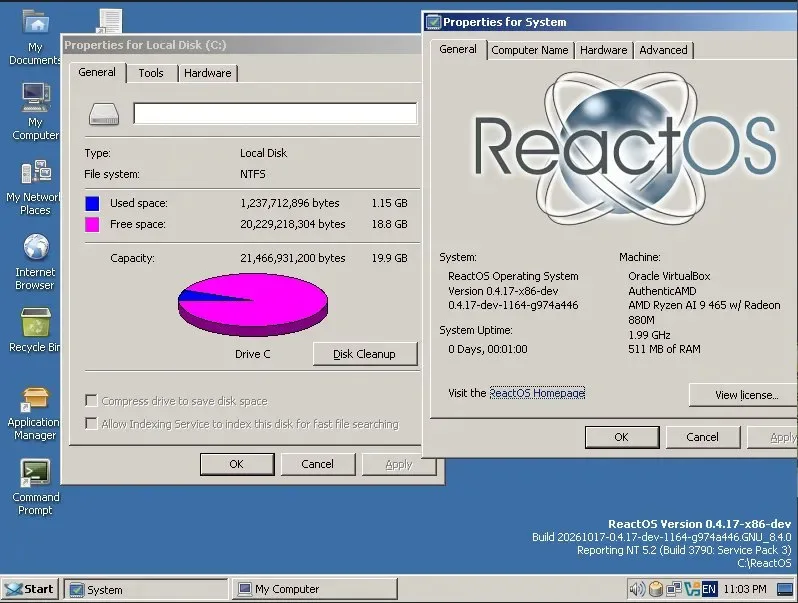
ReactOS, an open source reimplementation of Windows, has crossed an important threshold in its development: users can now install the operating system directly to an NT Files System partition. According to reporting from Phoronix, this capability removes a substantial technical obstacle that has long constrained the project and represents meaningful progress toward a beta release.
Until now, ReactOS deployments required maintaining a separate FAT32 partition. NTFS, developed by Microsoft, traces its lineage to Windows NT 3.1 in 1993, with the version deployed in Windows XP in 2001 becoming the standard across contemporary Windows installations. Since ReactOS targets binary compatibility with Windows Server 2003, the inability to install onto NTFS represented a genuine practical limitation in recreating the Windows environment.
Prospective users should not rush to abandon Windows just yet, however. ReactOS acknowledged that the new driver still "lacks caching (which causes inferior performance), journaling and security support." The development team cautioned on X that "potentially undiscovered bugs" remain in the implementation, suggesting that even adventurous system administrators should exercise caution.
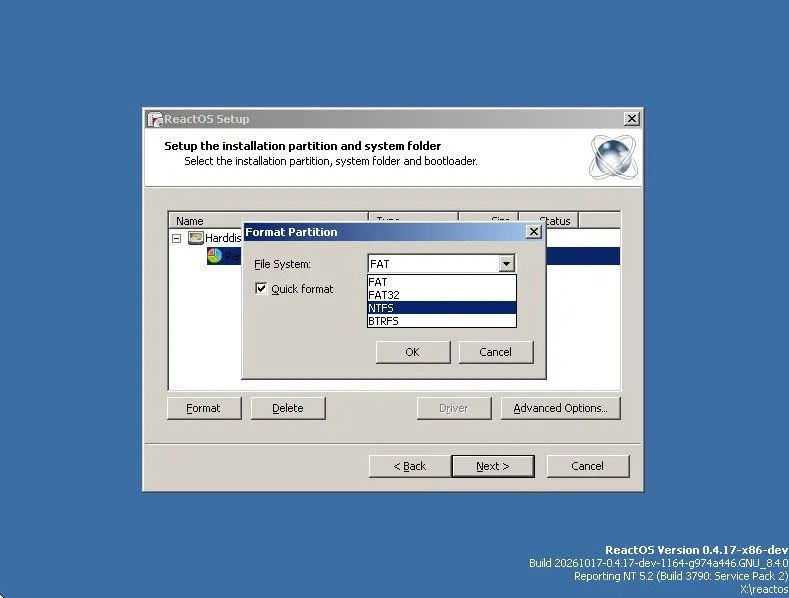
This driver represents the culmination of roughly a decade of incremental progress. Read-only NTFS support arrived in 2016, followed by boot support through FreeLoader in 2022. Those capabilities allowed the bootloader to access NTFS partitions, but the operating system itself could not be installed there until now.
ReactOS operates as a community-driven open source initiative staffed predominantly by volunteers. Development coordination occurs through public infrastructure including GitHub and dedicated project forums. Individuals interested in contributing to ReactOS can access the project website for participation guidelines. The project's extended development timeline illustrates both the complexity of building an operating system from the ground up and the reasons ReactOS has remained in alpha status throughout its existence.
While ReactOS may never become a practical Windows replacement for mainstream users, this advancement means the project can now be deployed on the same filesystem as the commercial operating system it seeks to emulate.