openEuler Embeds AI Throughout Its Stack, From Community Infrastructure to Agent Operating System
The Linux distribution is integrating artificial intelligence across its development workflows, developer tools, and operating system itself, positioning itself as an "AgentOS" platform designed to run autonomous agents natively.
While most Linux distributions are still determining how to incorporate artificial intelligence into their ecosystems—with some rejecting AI-generated contributions and others shipping AI tools as system components—openEuler has adopted a more ambitious approach. The project is weaving AI throughout every layer of its platform, from the infrastructure that manages its own development to the operating system delivered to end users. This comprehensive strategy aims to establish what the project calls an "AgentOS," an operating system fundamentally designed around AI agents.
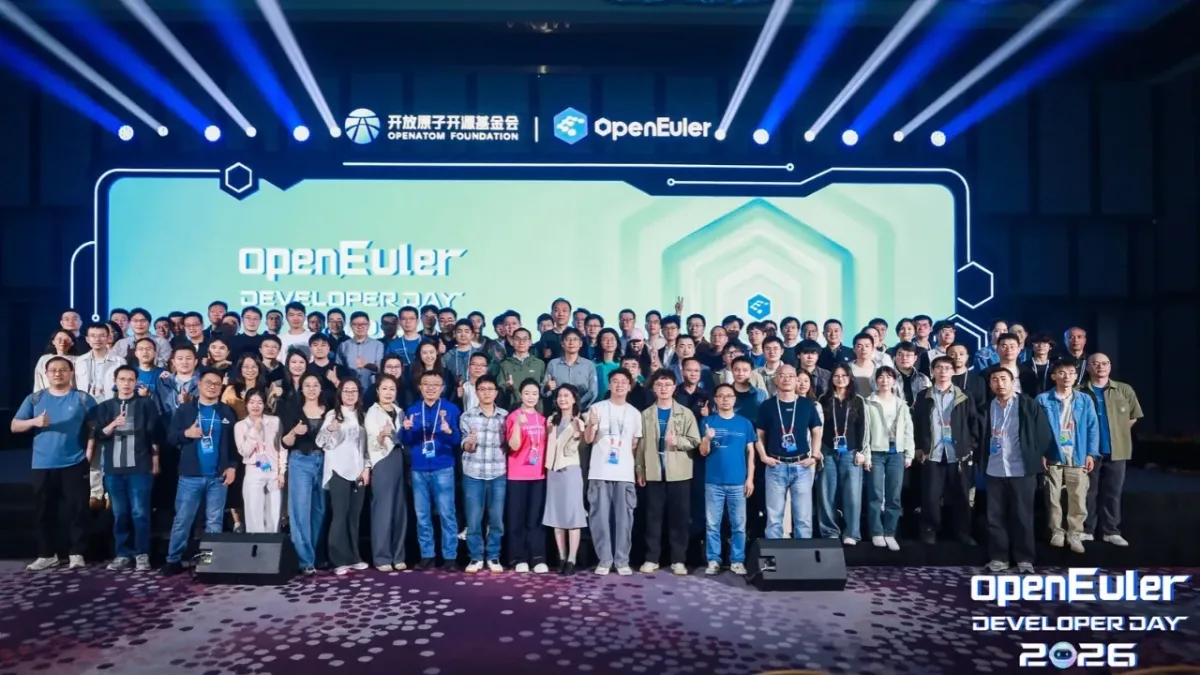
The integration unfolds across three distinct domains: the machinery that powers the openEuler community itself, the development workstations contributors use, and the operating system kernel and services. openEuler unveiled this direction at its Developer Day 2026, emphasizing improvements to developer experience as a central goal.
AI embedded in community infrastructure
Before asking users to deploy AI within their operating systems, openEuler is deploying AI to manage its own codebase. This shift carries particular significance for contributors, as it streamlines their workflows and reduces manual effort.
The openEuler community has introduced AI-assisted code review into its continuous integration pipelines, beginning with kernel patches. This means AI systems evaluate code before human maintainers review it. Additionally, AI agents are automatically generating package spec files—the configuration files that define how source code becomes RPM packages—eliminating tedious work that typically discourages new packagers from joining the project.
The most concrete application appears in vulnerability management. According to openEuler's April 2026 monthly report, the infrastructure special interest group constructed a CVE repair agent team comprising six distinct roles, including architect, reviewer, quality assurance, and CI monitoring positions. This system automates the entire process from identifying a CVE to submitting a fix as a pull request. When builds fail, the system learns from EulerMaker logs and refines its own decision rules. openEuler reports this approach "significantly" shortened repair cycles, though specific metrics remain unpublished.
Model Context Protocol and agent infrastructure
Data accessibility represents the second component. Community information exists scattered across special interest group pages, CVE advisories, and distribution mirrors. openEuler is leveraging the Model Context Protocol (MCP), an open standard enabling AI assistants to access external tools and data sources, to centralize this information.
The openEuler Portal MCP Server exemplifies this approach. When connected to Claude Code, Cursor, or Cline, it allows developers to ask natural language questions like "who maintains this SIG?" or "which CVEs affect this version?" without navigating multiple systems.
Strategically, openEuler is focusing on where agents execute their code. The project is constructing agentic sandboxes—isolated execution environments where agents can run code without affecting the broader system—built on hardened security foundations. The objective is establishing a dependable infrastructure for running and managing agents, with integration points discussed further below.
Developer workstations adapted for AI
Running contemporary AI agents on traditional enterprise Linux distributions presents a familiar obstacle: agents often require Python 3.12 or Node.js 22, while stable releases ship significantly older versions.
openEuler's DevStation developer desktop now offers an Innovation Edition addressing this mismatch. This variant tracks the master development branch and incorporates updated software every two weeks rather than every six to twelve months, with Python 3.12+ and Node.js 22+ as standard components.
This builds on earlier work: DevStation in openEuler 24.03 LTS SP4 shipped an MCP-based assistant capable of modifying system settings through natural language commands. The expanded vision maintains AI software in a perpetually updated state while making community infrastructure welcoming to both human developers and autonomous agents.
The path toward AgentOS
openEuler is advancing toward AgentOS, a system that fuses AI capabilities directly with operating system functions. Hu Xinwei, chairman of the openEuler Technical Committee, characterizes the vision as a "production-grade AgentOS" engineered to address usability, security, and operational cost.
The architecture organizes into layers: Agent App, Agent Service, and Agent Kernel. The application layer avoids vendor lock-in; openEuler's design accommodates Claude Code and OpenClaw alongside its own agents, preserving user choice.
Four foundational capabilities define the platform:
1. An intelligent hub
Users interact with AgentOS through PolyMind, a graphical interface, or a terminal-based interface. The system rapidly integrates community-developed skill modules. openEuler emphasizes that memory consumption remains minimal even during extended operations. The xiaoO repository, described as "the intelligence hub of AgentOS," attributes this efficiency to layered memory management and context compression techniques.
2. End-to-end security protection
AgentOS implements an active defense framework combining behavior analysis with eBPF monitoring. eBPF, a Linux kernel technology, enables small, verified programs to observe file access, network communications, and process launches with minimal computational overhead.
In operation, the system monitors what agents actually execute rather than relying on their stated intentions. For systems executing shell commands on behalf of users, this approach represents sound security practice.
3. The Conch sandbox engine
Conch provides each agent with strongly isolated execution space using lightweight virtual machines. According to an openEuler technical analysis, it restores filesystem snapshots, virtual machine memory, and virtual machine state collectively, allowing sandboxes to resume from saved checkpoints rather than booting completely.
This design achieves startup times around 100 milliseconds. The result delivers virtual machine-level isolation at container-comparable speeds—the performance trade-off every agent platform pursues.
4. Extreme token-efficiency optimization
Tokens represent both financial and temporal costs, whether paid to API providers or consumed by locally-run models. openEuler provides single-click integration of acceleration components including X-LITE, a lightweight inference runtime from its GVirt project, and LMCache, which reuses cached model computations across repeated contexts.
openEuler reports these optimizations improve TTFT (time to first token, the latency before responses begin) and TPOT (time per output token, the streaming speed) by 20 to 30 percent. Since agents typically issue numerous sequential model requests, these improvements compound significantly.
What comes next
Contributors to openEuler or other distributions will encounter AI integration first on the community side: AI-assisted kernel patch review, automatically generated spec files, and automated CVE fix submissions. This reduces manual labor while preserving human oversight of agent-generated work.
For teams requiring current infrastructure for AI agents, the DevStation Innovation Edition warrants attention. Its two-week update cycle eliminates the primary barrier preventing adoption of enterprise-grade distributions for agent development.
AgentOS itself merits close observation. Sandboxing, eBPF monitoring, and token efficiency address genuine challenges that organizations deploying agents in production environments encounter. Conch, xiaoO, PolyMind, and the Portal MCP server are all accessible through their respective public repositories.
Beyond its AI-native orientation, openEuler is performing the less glamorous work of applying AI to its own maintenance operations first. Published performance data will prove valuable, particularly regarding CVE repair timelines and Conch performance under real-world conditions.