OpenAI Rolls Out Optional Text Watermarking via API With textGrain System
OpenAI has introduced textGrain, a watermarking system for API-generated text that developers can voluntarily enable, marking a different approach from Anthropic's mandatory global rollout of Claude watermarking.

The company announced Monday that API users worldwide can now activate watermarking on supported models, with the feature remaining disabled by default. OpenAI will begin automatically watermarking eligible text from ChatGPT and Codex in the European Union starting in the coming weeks, responding to transparency mandates under the EU AI Act.
The textGrain system embeds a "statistical signal" into generated text by making subtle adjustments to word selection—choosing one suitable term over another when both would work grammatically. These cumulative choices create a detectable pattern across longer passages.
Text watermarking will remain off by default in the API. This lets customers decide how watermarking fits their transparency obligations and the experiences they provide to users.
OpenAI
Contrasting strategies between OpenAI and Anthropic
OpenAI's opt-in model contrasts sharply with Anthropic's approach announced in August for Claude watermarking. Anthropic chose to apply watermarking globally across supported Claude models, stating it lacked a dependable method to restrict the technology by geography. Anthropic's watermark applies uniformly across Claude, Claude Code, and API access, with no equivalent opt-out mechanism for developers.
OpenAI API customers who elect to use watermarking can activate it at the project or organization level, selecting which supported models should include the feature. Once enabled, no modifications to individual API calls are necessary.
OpenAI's broader content provenance initiatives
OpenAI has previously deployed multiple provenance technologies for other content types. The company began incorporating Content Credentials into generated images in 2024 using the open standard from the Coalition for Content Provenance and Authenticity (C2PA). Google's SynthID watermarks were added to images in May 2026 and audio in July, with OpenAI also offering a Content Provenance API for verifying these signals in supported images and audio.
Rather than adopting existing text watermarking solutions like SynthID or Meta's TextSeal, OpenAI developed textGrain in-house. The company states this choice provides "more control….over the balance between watermark detectability and the variety of responses generated from the same prompt." According to OpenAI's testing, textGrain matched or exceeded SynthID's detection performance, and the company plans to open-source the technology to enable broader improvements.
Code is also harder to watermark: Where the signal fades
The textGrain approach faces notable constraints. Because the watermark operates through word-choice decisions, detection becomes unreliable when a model has limited alternatives to select from.
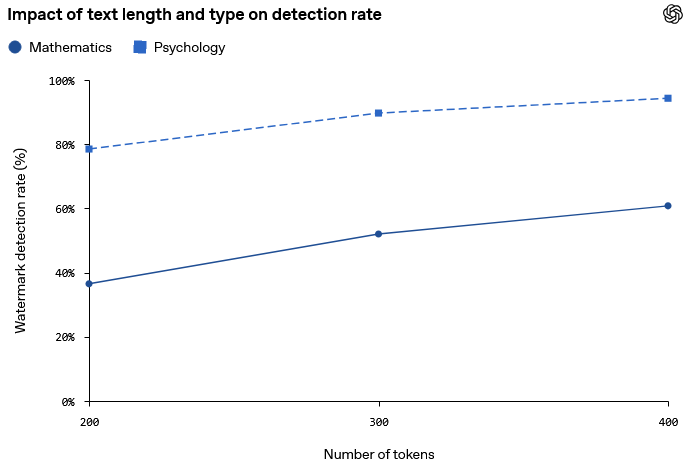
OpenAI reports its detector identifies approximately 80% of watermarked 200-token passages and 95% of 400-token passages in domains like psychology, maintaining a 1% false-positive target rate. Detection rates drop significantly for more constrained content such as mathematics.
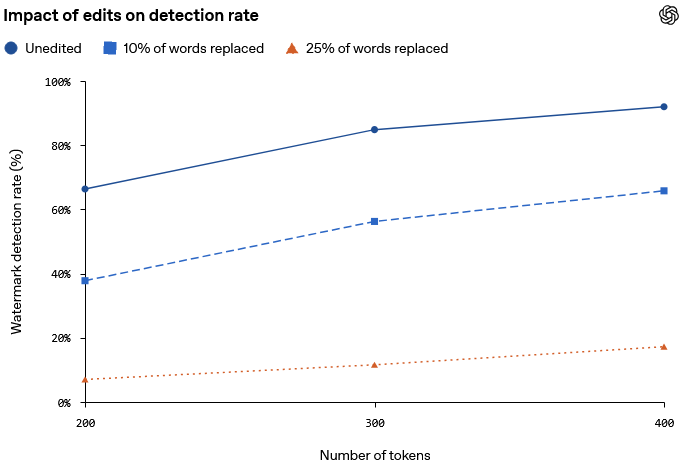
Post-generation editing substantially degrades watermark strength. When OpenAI replaced 10% of words in a 400-token passage with synonyms during testing, detection fell from roughly 92% to 66%. Substituting 25% of words dropped detection to just 17%. The company also cautions that very short passages may lack sufficient material for reliable watermark identification.
Code is also harder to watermark because there are fewer plausible choices for what comes next than in ordinary prose.
OpenAI
The planned Codex watermarking rollout in the EU warrants close attention. OpenAI intends to automatically watermark eligible Codex output while acknowledging that source code itself presents particular watermarking challenges. The company has not yet clarified what "eligible" Codex output encompasses or whether the watermark will apply to generated code itself.
Anthropic has encountered comparable obstacles with Claude. Code presents fewer opportunities to embed a watermark signal without potentially affecting program functionality, though natural-language elements within code such as comments are more amenable to watermarking.
OpenAI tested its Astra model with and without watermarking across multiple coding and agent benchmarks including DeepSWE, AutomationBench, and Terminal-Bench. The company found no meaningful performance degradation, suggesting textGrain can function without substantially compromising code generation quality. However, this does not address how reliably the resulting watermarked code can be subsequently detected.
Detector access represents a separate consideration. API customers who enable textGrain do not automatically receive watermark-detection capabilities. OpenAI is initially restricting detector access to approved research and academic institutions investigating text provenance and detection reliability. This access could enable researchers to assess watermark resilience through editing and other transformations, or examine false-positive and false-negative rates.