Nvidia PAIR Taps Idle Computers to Accelerate AI Agent Workflows
Nvidia's new Personal AI Router lets households distribute AI model inference across multiple machines, enabling agents to parallelize work through subagents running on available Macs and PCs.
Unused computing capacity in your home network can now serve AI agent requests. Nvidia's PAIR software directs workloads through existing Ollama or LM Studio installations, with each model executing on a single machine within the network.
The company has been steadily building out its strategy around open-source models and on-device AI execution. A forthcoming acquisition of Hugging Face will reinforce this direction, while new product releases demonstrate Nvidia's commitment to expanding the base of users capable of running AI models locally.
On Thursday, Nvidia unveiled the Personal AI Router (PAIR), an open-source network router designed for residential environments that enables idle Macs and PCs to execute compact models on-demand and enhance agent-based workflows through the use of parallel subagents.
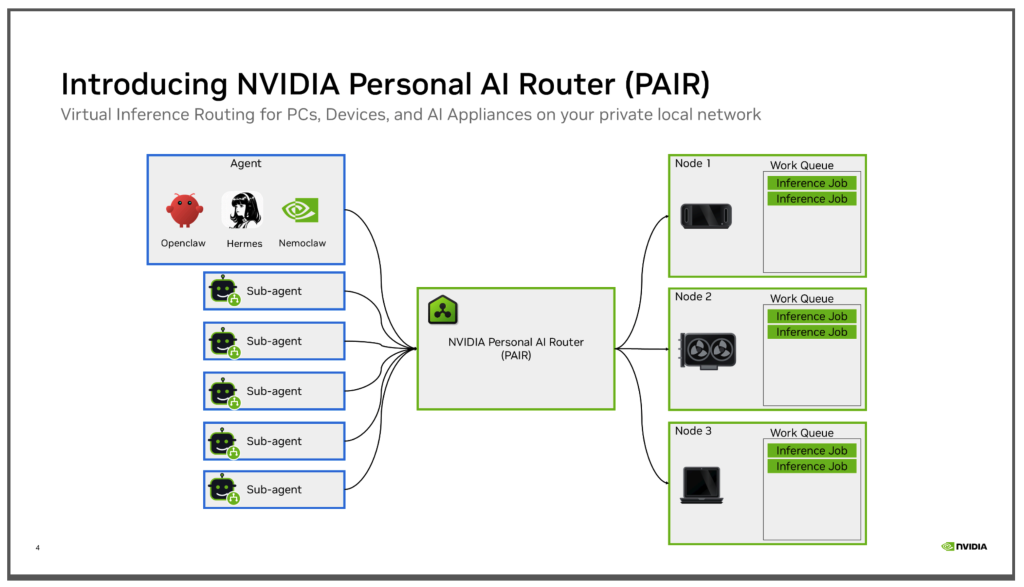
The software aims to enhance agents such as NemoClaw, OpenClaw, and Hermes by facilitating the deployment of multiple subagents simultaneously. A primary agent can distribute work across subagents, whose model inference requests then execute on dormant machines throughout the network.
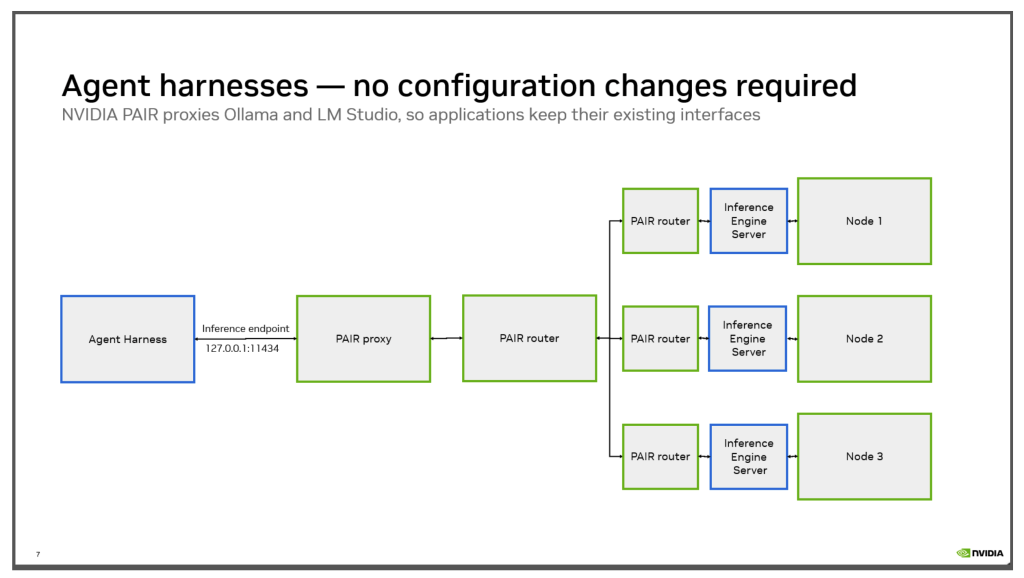
Nvidia describes PAIR as a "virtual inference router" and emphasizes that it functions as a routing layer rather than a novel inference engine. The system leverages pre-existing Ollama or LM Studio deployments on each device and orchestrates model execution across them. After installation on every participating machine, PAIR automatically identifies systems on the local network via mDNS and assesses their capacity to handle incoming requests.
A significant limitation exists: PAIR cannot distribute a single inference request across multiple machines. Nvidia clarifies that the system neither consolidates GPUs nor pools VRAM into a unified accelerator, nor can it partition individual inference tasks across nodes.
Agents can send a request through the familiar local interface it expects. PAIR receives the request through its proxy, identifies its engine and model requirements, and selects one eligible node. That node executes the request from start to finish and sends the response back through PAIR. The agent continues to see one connection while PAIR handles placement behind it.
Nvidia
Hardware compatibility spans Windows, macOS, and Linux systems equipped with suitable GPUs. This encompasses Nvidia GeForce RTX 20 series cards and later generations (Nvidia's stated minimum threshold), Macs running M4 silicon or newer, plus Nvidia DGX Spark units, with RTX Spark PCs and laptops becoming available later in the year.
Nvidia's inclusion of Mac support represents a notable decision, given the platform's growing adoption for local model execution and agent applications like OpenClaw, despite lacking Nvidia GPU acceleration.
Individual machines within the network can host distinct models, though PAIR only directs requests to nodes with the appropriate engine active and the exact requested model present. Deploying identical models across multiple machines provides the router with additional flexibility when distributing parallel requests.
PAIR monitors machine availability and halts local inference when a user resumes active work or gaming on a device, freeing up the GPU for other purposes.
In Nvidia's demonstration, deploying PAIR across two PCs equipped with high-performance RTX 5090 GPUs containing 32 GB of memory (currently priced at $5,000, despite an initial $2,000 MSRP) running the Qwen3.6 35B A3B model achieved approximately 1.6x acceleration when managing five concurrent subagents.
Given that most households lack multiple RTX 5090 cards or DGX Spark systems, practical performance in mixed setups—such as a Mac Studio, several Mac minis, and a gaming PC—remains to be demonstrated, though such configurations should still yield measurable improvements in local agent execution.
Availability
Nvidia PAIR is currently available in beta form. Setup requires installing the software on each machine intended for participation, configuring system discovery and pairing, and ensuring Ollama or LM Studio is operational with downloaded models.
PAIR streamlines the setup process by handling Ollama or LM Studio installation and initiating model downloads on connected machines.
Source: The New Stack