How AI Coding Agents Pick Their Tools—and Why Vendors Are Scrambling to Adapt
A new analysis reveals that Claude Code, Cursor, and Codex make wildly different tool choices for identical tasks, forcing software vendors to rethink their entire go-to-market strategy in an age where machines, not humans, decide what gets deployed.

Research from developer tool growth services firm Armature suggests that the traditional playbook for software marketing is becoming obsolete. The company examined how three major coding agents—Claude Code, Cursor, and Codex—select tools when building real-world applications, and the findings paint a picture of radical unpredictability that has vendors racing to understand and influence these algorithmic decisions.
The shift mirrors broader changes in how content reaches audiences. Where companies once optimized for search engines through SEO, they now pursue Answer Engine Optimization (AEO) to appear in AI-generated responses. Beyond that lies Generative Engine Optimization (GEO), where brands attempt to shape how language models themselves perceive and recommend their products.
Brand equity frozen in a new era
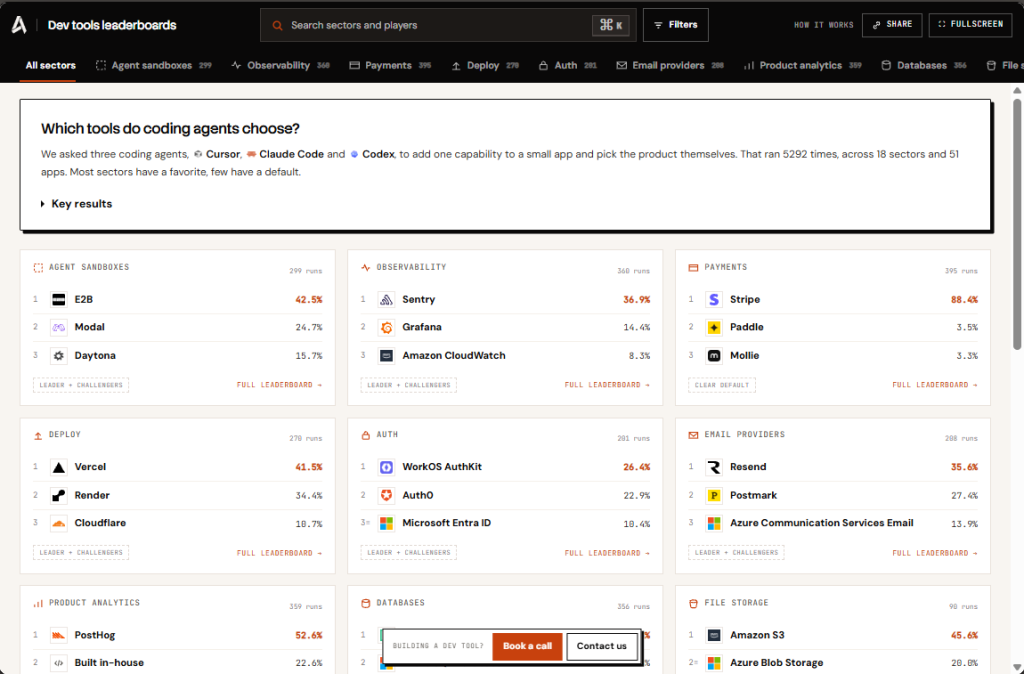
Armature conducted an experimental study analyzing how coding agents discover, evaluate, and select tools across different software categories—from debugging suites to package managers to databases. The company examined 1,163 prompt variations across 75 repositories using three distinct coding agents, tracking which tools each agent would actually implement rather than merely recommend.
Theodore Otzenberger, Armature co-founder, describes what the research revealed as a fundamental break with the past. "Watching seventeen thousand tool choice sessions in the analysis undertaken, we saw twenty years of brand building carried out by tool vendors simply frozen in time," Otzenberger tells The New Stack. "Agents reach for Docker the second containers come up, then draw a blank on the sandboxes it offers now, so that it actually ends up not picking the tool. Your reputation follows you into the weights, attached to the product that made you famous… but that weight operates under a different kind of gravity today."
According to Otzenberger, this shift carries existential consequences for tool vendors. Because agents now determine which software gets wired into production codebases, vendors must ensure their products are discovered, selected, and elevated to must-have status by these systems. The alternative, he argues, is that they "simply stop existing in the stack" tomorrow.
How the research was structured
Armature and co-founder Louis Scremin observed tool selection patterns across different developer personas—from solo coders to junior engineers at startups to senior developers at enterprises. The team extracted data from public GitHub repositories, studying how Claude Code, Codex, and Cursor would implement solutions in real-world scenarios.
To minimize bias, the researchers used fake company names, artificial Git histories, and phoney API keys. They also introduced a simulated human decision-maker powered by Gemini 3.7 Flash, which would either accept the agent's top recommendation or ask the agent to choose and implement the best option. This human-in-the-loop approach produced more realistic results than allowing agents to build everything in-house without external input.
Where agents diverge most sharply
The analysis uncovered striking differences in how agents select tools for the same task. When tasked with choosing an email service provider, tool preferences varied dramatically by programming language:
- Resend wins on TypeScript code (55 out of 89 runs)
- SendGrid wins on Python (22 out of 24)
- Postmark wins on Go (20 out of 24)
- Azure ACS wins on Java (22 out of 23)
The three agents also rely on fundamentally different information sources when making decisions. Cursor bases its choices on web search in roughly two-thirds of sessions. Codex performs web searches in 94 percent of cases but heavily relies on site-specific operators. Claude Code, by contrast, depends primarily on its training data and searches the web only about 30 percent of the time—though when it does, it examines three times as many pages as Codex.
The agents reached consensus on tool selection in only 42 percent of test cases. Claude Code also showed a tendency to build functionality in-house nearly twice as often as Codex and Cursor, at 19 percent compared to 10 percent.
Mention does not equal selection
Jeet Pattanaik, founder and CTO of Glokal AI OÜ, characterizes Armature's work as "procurement arriving through the back door." He points to a striking finding: PayPal appeared in 139 search results but was never selected by any agent, while LangChain was mentioned 194 times yet chosen only four times.
"The finding I pick up on most is that getting mentioned isn't the same as winning," Pattanaik says. "That gap is the entire business model, because it means the lever isn't brand awareness any more, it's whatever the agent happens to read at the moment it decides."
Pattanaik predicts that vendors will next optimize their documentation and pricing pages with non-human readers in mind—systems that do not respond to visual branding, do not skim content, and interpret every detail with literal precision. "It's a strange new kind of SEO and it'll get gamed exactly the way the old one did," he adds.
A pattern emerging across the industry
Ken Simpson, founder of MailChannels, noted on Hacker News that he has conducted similar analysis for his own company. "Armature is on to something. You start by analyzing the choices agents would make for various use cases and then glean what, if anything, you might do to start tilting the agents in the direction of your own product and away from the competitor," Simpson wrote.
Armature itself is a newly founded organization, established in 2026, making this early work in understanding how agents shape software adoption. As agents increasingly make decisions based on public codebases, open data repositories, and web content, the traditional marketing handbook may require a complete rewrite.
Otzenberger emphasizes that Armature has published all research traces and prompts for public scrutiny, and plans to rerun the full study on newer models and agents as they emerge. "The decision makers are changing and it's now an engineering problem to understand them," he says.