Dynatrace Acquires Arize AI to Bridge Application and AI Observability
As artificial intelligence transforms enterprise software, Dynatrace and Arize AI are converging observability platforms to help operations teams move from detecting problems to acting on them automatically.
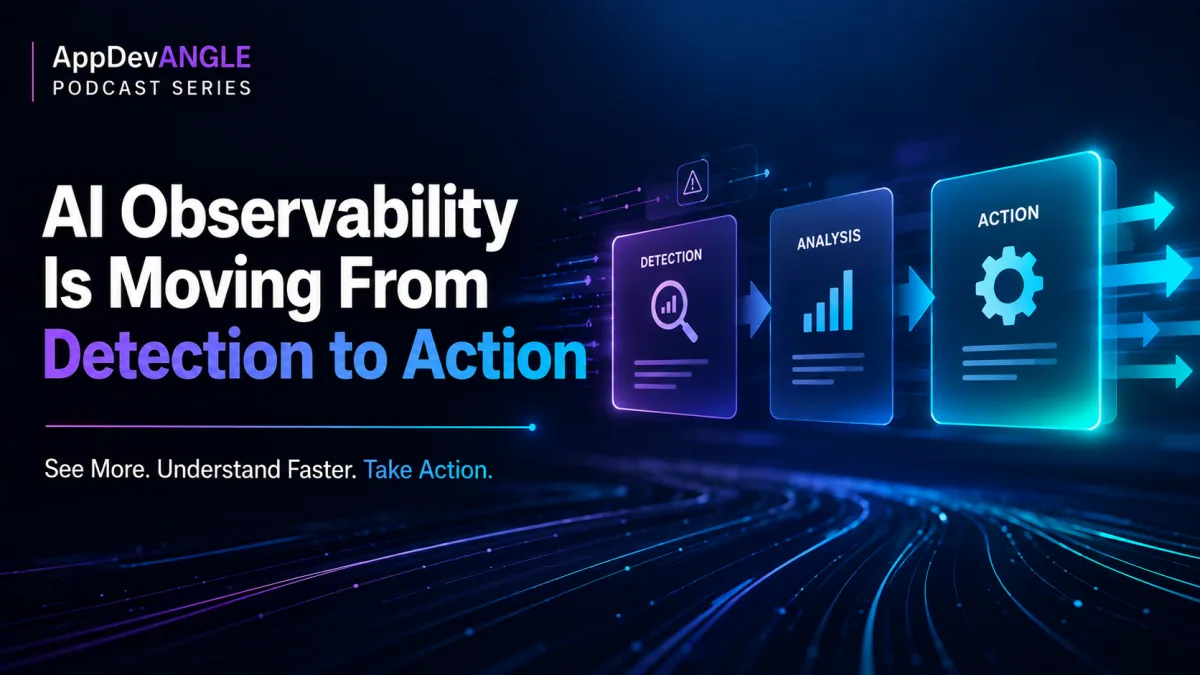
The observability landscape is shifting as AI reshapes what enterprises must monitor and how their teams respond to operational issues. Observability systems designed for traditional, deterministic software—relying on logs, metrics and traces—now face a fundamentally different challenge: AI applications and agents produce variable outputs even under identical conditions. Enterprises are also demanding that observability platforms transcend simple problem detection, instead delivering the context needed for both human operators and AI systems to diagnose, fix and automatically remediate issues.
Dynatrace's acquisition of Arize AI brings AI observability, evaluation and agent monitoring into Dynatrace's application observability platform, marking a convergence of two previously separate domains. During an episode of theCUBE Research's AppDevANGLE podcast, Paul Nashawaty, Practice Lead and Principal Analyst, spoke with Steve Tack, chief product officer of Dynatrace, and Aparna Dhinakaran, co-founder and chief product officer of Arize AI, about this shift. Tack observed that "The world has shifted so much. AI brings new problems, new domains to the space."
From deterministic software to nondeterministic systems
Applications built with traditional software architectures typically deliver consistent, predictable results. AI-driven systems—especially those using large language models and autonomous agents—operate nondeterministically, making diagnosis and troubleshooting substantially harder. Observability teams can no longer limit their focus to application availability or infrastructure performance metrics. They must now verify that AI systems generate the intended outputs and assess whether response quality meets organizational standards.
Dhinakaran explained the shift: "Evaluating no longer just becomes about is it right or wrong. It becomes about actually measuring the quality of the responses, which is just a very fundamentally different problem." Arize developed its platform specifically to address this challenge, offering capabilities for tracing, evaluating and enhancing AI applications and agents. The company's open-source Phoenix platform serves more than 4,000 enterprises, according to Dhinakaran, while Arize AX delivers a managed service for teams running AI systems in production environments.
For Dynatrace, these capabilities extend observability into application layers that are becoming critical as enterprises transition AI initiatives from pilot programs to production deployments.
Observability brings shared context across AI and application telemetry
AI applications seldom function in isolation. Agents invoke application programming interfaces, query databases, rely on cloud infrastructure and integrate with enterprise systems. When troubleshooting AI behavior, teams must account for the fact that AI represents just one component of a larger software ecosystem.
Dhinakaran noted that Arize's customer base increasingly sought tighter integration between AI telemetry and conventional application and production telemetry. Dynatrace customers, conversely, were requesting stronger AI observability and evaluation features. Merging these two environments could provide developers, site reliability engineers, platform teams, AI engineers and data scientists with unified visibility into the entire application stack. Dhinakaran stated: "The agent systems and the software systems are joined at the hip. Having this ability to not only debug agents with AI observability, but also have all the context of the software that they use to call tools or the underlying infra behind the agents … just makes us build better products."
Unified context could also tackle a longstanding observability challenge: the proliferation of monitoring tools. Research cited during the discussion indicated that 75% of organizations deploy between six and 15 observability tools. As enterprises add AI monitoring, evaluation and governance platforms, there is a risk that AI becomes another isolated operational silo rather than simplifying the overall architecture.
Tack contended that integrating application and AI observability enables organizations to achieve a comprehensive system-level perspective rather than forcing teams to manually correlate data across fragmented systems. He stated: "The real loss often happens [when] they lose the ability to have a system mindset. How can we bring a broader view together? How can we have shared context? How can we take action?"
From dashboards to operational action
A more profound transformation may concern not what observability platforms track, but rather who or what interprets that information. Historically, observability has centered on engineers reviewing dashboards, responding to alerts and manually investigating incidents. AI agents introduce an alternative operational paradigm where telemetry serves as input that software agents themselves can process and act upon.
Dhinakaran remarked: "Observability is no longer about humans looking at dashboards and metrics and logs. It's about action." This reframes the purpose of observability data. Rather than merely documenting what occurred, telemetry becomes part of the reasoning framework agents employ to identify issues, suggest solutions or execute fixes.
This shift heightens the importance of accuracy and completeness in observability data. Autonomous operations depend on organizations having confidence in the information guiding those decisions. Tack emphasized that delivering precise analytics and dependable insights will prove essential as enterprises expand agent authority. He added: "How can we help them act, helping them move faster, creates so much opportunity."
Dynatrace has already pursued this direction through its AI and automation initiatives, including Dynatrace Intelligence and BlueBox AI, which supports agentic development and site reliability engineering workflows. Arize strengthens this strategy by contributing deeper evaluation and observability capabilities for the AI systems embedded in these workflows.
AI changes how software teams operate
The acquisition also signals a broader transformation in software development practices. AI agents are increasingly deployed not only within applications but also to build, test, troubleshoot and manage those applications. Tack envisioned a future in which architects spend less time directly in development environments and more time orchestrating specialized agent teams.
Observability becomes part of the feedback mechanism connecting autonomous development to production operations. Tack stated: "The market's not just layering another technology on top. They are changing the way they want humans to work. Where does the agent step in?" For enterprises, this could position observability as an operational intelligence layer spanning application development, AI evaluation, infrastructure and automated remediation.
The challenge ahead involves ensuring that automation advances in tandem with the governance, reliability and assurance enterprises need before delegating significant operational decisions to agents.
The bottom line
Dynatrace's acquisition of Arize AI reflects two concurrent developments: enterprise applications are becoming less deterministic, and observability is shifting toward action-oriented systems. AI applications demand new methods for assessing behavior and quality, while AI agents increasingly require application and infrastructure context to make sound operational choices. Combining these telemetry environments positions Dynatrace to advance beyond conventional application monitoring toward a model centered on shared context, evaluation and automation.
For development and platform teams, the implication is that observability may increasingly function as machine-readable infrastructure. Dashboards will persist, but future observability platforms must serve both engineers diagnosing systems and agents increasingly responsible for operating them. Dhinakaran concluded: "Every business is going to become an AI company, and tools for understanding and improving those agents will become a core part of every stack."