Developer Compresses Full Windows 11 onto Single CD-ROM with Pico11 Tool
NTDEV has demonstrated a working Windows 11 installation that fits within 700MB, small enough for a CD-ROM, using an unreleased compression tool called Pico11.
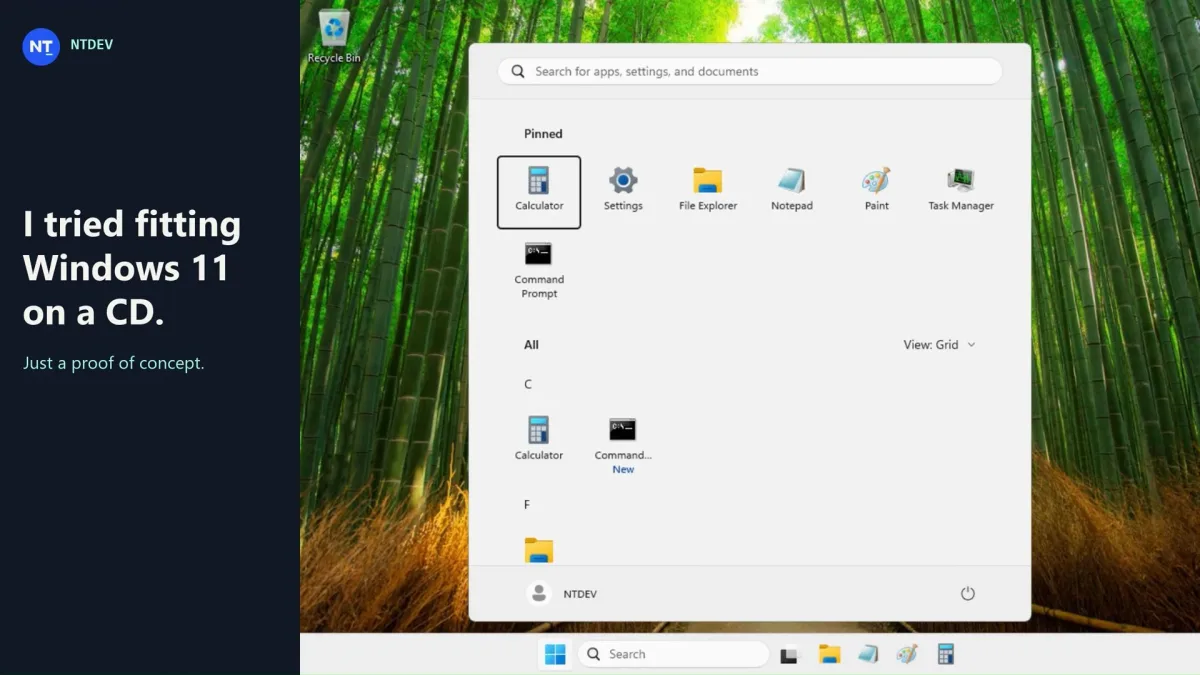
A developer known as NTDEV has unveiled a compression technique that squeezes a functional Windows 11 operating system onto a single CD-ROM. The achievement, built on an experimental tool called Pico11, resulted in an ISO image measuring 699,811,840 bytes—fitting comfortably within the 700MB capacity of a standard disc.
In a demonstration video, NTDEV showed the compressed Windows 11 running on a virtual machine allocated 4GB of RAM, which consumed approximately 883MB during operation. The resulting system retained a recognizable Windows 11 desktop interface alongside several standard applications. According to NTDEV, "Calculator and Settings still open, Notepad saves files, and Paint still lets me draw questionable logos." The developer also noted that Task Manager appears in an older form, possibly derived from an earlier Windows version, though its exact source remains unspecified.
NTDEV characterizes the current effort as "an experiment, not a replacement for a normal Windows installation." The extreme size reduction came at a cost: Windows Update functionality and system servicing capabilities were stripped away to meet the CD-ROM storage constraint.
The developer plans to integrate Pico11 capabilities into Tiny11, an open-source Windows 11 ISO builder available on GitHub. Tiny11 already offers multiple construction modes, including Tiny11 mode, Tiny11 Core mode, and Custom mode. Pico11 appears most similar to Tiny11 Core in that it removes servicing and recovery features, though additional optimization work distinguishes the new tool.
Previous iterations of Tiny11 have achieved even more aggressive compression, with some builds reaching as small as 100MB, though those versions lacked the Windows 11 user interface. Certain configurations used minimal RAM—as little as 176MB—while more practical custom builds that removed unnecessary software typically measured around 2GB.