Delegated Identity: Giving AI Agents Access Without Handing Over the Keys
As developers deploy AI agents to troubleshoot infrastructure, the challenge becomes granting them just enough access to do their job without exposing entire systems to compromise. Teleport's approach separates the agent's capabilities from the credentials that enable them.
Picture this: a developer enlists an AI agent to diagnose why a Kubernetes pod has stopped responding. The agent will need to retrieve logs. Depending on what those logs reveal, it might require access to another service. The developer possesses the credentials to grant that access, yet sharing them would hand the agent the keys to everything those credentials unlock. By the time the pod returns to normal operation, the team could be facing a second crisis.
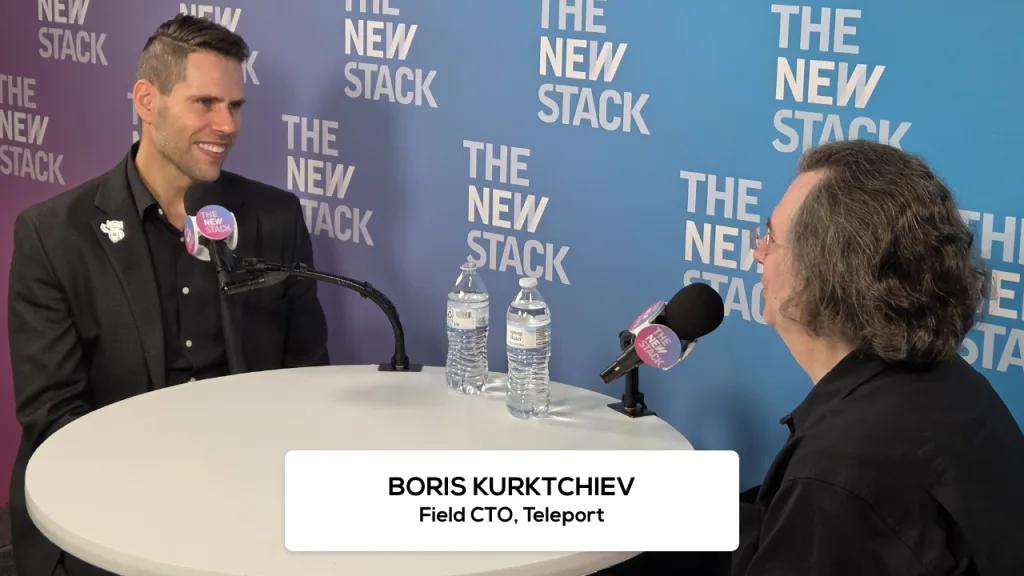
At KubeCon + CloudNativeCon this month in Salt Lake City, Teleport field CTO Boris Kurktchiev discussed this exact scenario with The New Stack's Frederic Lardinois to illustrate the concept of delegated identity. Rather than receiving blanket access upfront, the agent makes targeted requests for what it needs to complete its assigned task. An audit trail connects the developer who initiated the work to each action the agent performs. This arrangement allows a developer to deploy an agent for investigation without surrendering their own credentials.
The agent had access on behalf of Boris
Boris Kurktchiev
One access policy across the stack
Teleport's fundamental architecture aims to provide organizations with a unified method for defining access across infrastructure components that each maintain separate permission systems. For engineering teams, this becomes essential when troubleshooting requires jumping from Kubernetes to databases or when continuous integration pipelines need infrastructure permissions. Kurktchiev explains how the same policy framework can govern people, automated processes and agents alike, with access limited to specific resources like individual pods or database tables.
The value proposition sharpens when a single developer spins up multiple agents simultaneously. Each can submit access requests independently, and a human reviewer who must approve every routine action will eventually lose patience. As Kurktchiev and Lardinois explored, the convenience of disabling approval prompts takes on a different character once work enters production systems. The practical challenge becomes determining which decisions teams can embed into policy rules and which ones demand human judgment.
What happens inside the sandbox
Teleport unveiled Beams at KubeCon, which Kurktchiev characterizes as an agent runtime that integrates sandboxing, identity management, access control, and observability with auditing capabilities. Isolation provides a contained environment for the agent to operate. However, teams must still evaluate which credentials exist within that environment and the scope of systems those credentials can reach.
So just having a sandbox is not enough.
Boris Kurktchiev
Through Beams, Kurktchiev explains, an agent begins with zero permissions. Organizations can establish which resources it may request, the duration of access, and what constitutes an acceptable sequence of operations.
The default is always zero.
Boris Kurktchiev
This model enables developers to separate the agent's proposed course of action from the actual permissions it receives. Should execution deviate from the intended plan, Kurktchiev outlines options to notify personnel, terminate execution, or branch into an alternative investigation path. That branching capability matters because unexpected detours can surface valuable findings. The cost implications of token consumption, the two note with humor, represent a distinct consideration.
The conversation extended beyond Teleport's offerings. Kurktchiev highlighted SPIFFE as a potential standard for machine identity across distributed systems and contemplated what agents might require from it when operating across organizational lines. He also identified ongoing development needs for the Model Context Protocol (MCP), which provides agents with a mechanism to integrate with tools and data sources. Connecting an agent to a service introduces additional questions regarding what actions it can perform and how teams will track those actions in their records.
The full conversation between Kurktchiev and Lardinois is available on The New Stack's YouTube channel, covering the transition of agents from isolated development environments to production deployment, strategies for managing approvals as agent deployments scale, and the requirements for audit trails when investigations take unexpected turns.