Building Smarter AI Agents Through Strategic Context Engineering
Developers face a critical challenge in balancing how much information to feed AI agents. A structured approach to context engineering—combining the right tools, memory systems, and retrieval methods—can dramatically improve agent reliability and task accuracy.

In the world of AI agents, context determines everything. When you combine a capable reasoning model such as Claude, DeepSeek, or GPT-5 with carefully curated context, the results include better planning, smarter tool selection, and stronger multistep reasoning. This leads to more personalized interactions, higher accuracy on assigned tasks, and responses that actually matter. This article explores why context engineering matters, what obstacles developers encounter when implementing it, and proposes an architectural framework to overcome those obstacles.
Solving the Context Dilemma: Too Much vs. Too Little
Organizations sit on mountains of data—both structured and unstructured. Yet dumping all that data directly into an agent's context creates problems. The noise obscures what matters, critical information gets buried, and the model's understanding of the situation suffers as the context window fills up. A longer context window is not necessarily the answer. Conversely, starving an agent of context triggers hallucinations. The principle is straightforward: poor inputs produce poor outputs. Context engineering solves this by deploying a suite of techniques and tools that ensure agents receive only the information they genuinely need to succeed. Harrison Chase of LangChain has outlined the key components:
- Tool selection ensures agents can access the right tools to retrieve necessary information. For instance, an agent planning a family trip to Maui with two children and a dog should be able to pull every tool required to answer that request and execute it reliably.
- Memory use matters equally. Agents benefit from short-term memory that personalizes the current session and long-term memory that maintains continuity across multiple sessions. This includes profile, semantic, episodic, conversational, and procedural memory types, plus working memory for coordination in multiagent setups.
- Prompt engineering guarantees agents have access to well-crafted prompts that define behavior, specify instructions, and establish constraints.
- Retrieval dynamically pulls relevant data based on the user's question and inserts it into the prompt before the LLM processes it. Retrieval-Augmented Generation (RAG) and direct database queries accomplish this. For enterprises with multiple data sources, the Model Context Protocol (MCP) allows developers to fetch context from various systems using a unified approach.
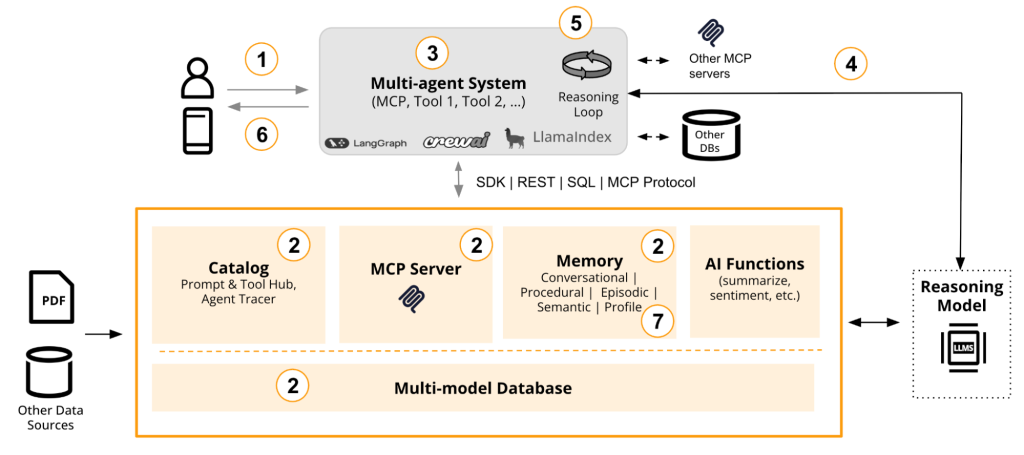
The consolidated context flows to the agent and then to the reasoning LLM. Enriching the agent prompt with relevant tool names and specifications, short and long-term memory contents, the prompt itself, and retrieved content from RAG, databases, and SaaS platforms enables reliable task execution.
The workflow unfolds as follows. A user submits a request to the multiagent system. The agent application retrieves context through APIs covering prompts and tools from a catalog, RAG context from a vector store, summarized conversations from memory systems, and summaries, sentiment analysis, and extracted entities from operational databases and external sources via MCP servers. The application then augments the prompt with this consolidated context to form the agent prompt, which goes to a reasoning model like Claude, DeepSeek, or GPT-5. A reasoning loop within an agent framework such as LangGraph exchanges messages with the model while invoking relevant tools. Depending on the setup, other agents may be called with context shared between them. The final answer reaches the user, and the conversation is stored in memory for future sessions.
Extracting Context From Unstructured Data at Scale
Eighty percent of enterprise data lacks structure and remains largely unusable as context. To unlock this data for AI agents, developers typically build extract, transform, load (ETL) jobs using Spark, Flink, or similar platforms. These jobs pull unstructured data from source systems, process it, and write results back for agent consumption. While these custom solutions perform well, they slow development, introduce operational complexity, and demand ongoing maintenance. Real-world examples include summarizing support ticket descriptions so customer service agents understand issues quickly, extracting medical terms from patient records to help triage agents form initial diagnoses, and labeling email content as irrelevant, promotional spam, scams, or phishing attempts so email assistants can decide whether to respond automatically.
AI functions offer a shortcut. They let developers invoke LLMs directly from SQL statements while controlling output format, tone, and other characteristics through prompts. Consider a retailer who augments product reviews in a database with sentiment and summary using AI functions. A retail AI agent later retrieves this enriched data via a tool call and decides whether to offer a compelling deal to a dissatisfied customer to boost Customer Satisfaction Score (CSAT) based on reported issue severity. The agent also generates product feature requests. Take this disappointed customer review of a blender: "I had high hopes for this blender based on the product description and reviews, but it's been a let-down from day one. The motor struggles even with soft fruits, and it overheats after just a couple of minutes of use. I've had to stop mid-smoothie several times to let it cool down, which completely defeats the purpose of having a 'high-speed' blender."
A no-code SQL analysis produces this result:
SELECT review_id, SUMMARIZE(review_text) AS summary, SENTIMENT("review_text", prompt = "Evaluate the sentiment of the "customer_review" field on a 5-point scale: very negative, negative, neutral, positive, very Positive") AS sentiment FROM customer_reviews WHERE review_text IS NOT NULL;
Output: "sentiment": very negative "summary": The blender needs a stronger motor to handle frozen fruits and ice without overheating, sharper blades for smoother blends and a better-sealed lid to prevent leaks. Durability should be improved to eliminate loud grinding noises and burning smells after short-term use.
This requires a database that automates these tasks without code by invoking leading LLMs from within SQL statements.
Fitting Context Into a Limited Context Window
When managing context, less (but highly relevant) beats more. A context limit exceeding one million tokens does not grant unlimited memory. Every additional token carries cost, latency, and performance penalties. Rather than padding the prompt with lengthy, unnecessary context that buries important details—especially in the middle—leverage techniques like RAG to maintain lean, highly targeted context. Listing every available tool creates prompt bloat and confuses agents when similar tools share comparable names or specifications. Tool proliferation, driven by poor reusability and weak governance, increases agent failure risk. However, centralizing all tools in a catalog promotes reusability and retrieves only tools relevant to the user's question. Combined with clear tool descriptions and smart tool routing, this boosts accuracy. An API like this retrieves only relevant tools:
catalog.find_tools(query="Plan a trip to Maui")
Agent behavior hinges on prompt quality, so prompt changes demand careful oversight. Cataloging prompts with versioning and rollback capabilities maintains consistent agent behavior despite updates. An API like this retrieves the right prompt for the query:
catalog.find_prompt("query="Plan a trip to Maui")
A performant multimodel database achieves this by extracting context from large volumes of structured and unstructured data using vector search through RAG, while storing and selecting highly relevant tools and prompts.
Managing Decay and Resolving Conflict in Agent Memory
Agent memory forms a cornerstone of context engineering. Yet implementing memory decay and conflict resolution presents genuine challenges for developers. Conversational agents accumulate vast interaction data. If an agent recalls every past message, the context window fills rapidly, coherence breaks down, and new information cannot be processed. Outdated information must decay. The complication: different information decays at different rates. A retailer's return policy changes slowly, while demand for fast fashion shifts constantly. Developers need information-specific Time to Live (TTL) settings across user conversations so a clothing recommendation agent does not surface stale memory. Developers also need the ability to purge outdated context when required. This demands a database supporting TTLs to decay memory at specified rates and delete memory consistently as needed.
In multiagent systems, a single agent may hold conflicting information, or multiple agents in the same user session might try to save conflicting data to memory. Timestamps on each message, shared with the LLM as context about information evolution, resolve this conflict. Messages can also carry agent names and other metadata, enabling the LLM to choose which information belongs in memory.
Sign up for a Preview
At Couchbase, engineering context and delivering it rapidly stands as a priority, empowering developers to build performant and reliable agents. Couchbase Capella AI Services, currently in private preview, combined with Capella NoSQL DBaaS, provides a unified data platform spanning operational, analytics, vector, tool, prompt, and memory stores. Developers can extract context using SQL++ and enrich prompts. AI functions, a Capella AI Services feature, streamline context extraction from massive datasets by calling leading LLMs from within familiar SQL statements. Agent memory built on Couchbase tackles complex issues like memory decay and conflict resolution. Sign up for the private preview of Capella AI Services and try Capella NoSQL DBaaS at no cost to begin developing your agentic application.
Source: The New Stack