As AI Writes Code, Engineers Shift to Building the Factory
Automation has made code generation cheap and fast, but the processes around shipping software haven't adapted. Engineers are becoming process engineers, designing the systems and human checkpoints that manage AI agents throughout the development pipeline.

The economics of software development have fundamentally shifted. Throughout the industry's existence, skilled programmers were the bottleneck. Development practices—sprints, code reviews, staging environments, release cadences—all centered on human labor as the limiting factor.
That constraint no longer exists. By September, GitHub data showed that more than 40% of pull requests began with an agent's initial draft, a jump from 17% in March. Yet while machines now generate code at scale, the infrastructure for validating and deploying that code has not kept pace. CircleCI's 2026 delivery metrics revealed that average daily workflow runs climbed 59% year over year, with top-performing teams seeing 97% growth while the bottom quartile showed essentially flat activity. One company that doubled pull request output discovered that reviewer workload also doubled, and automated review systems quickly surpassed human review in total coverage.
When work gets automated in any industry, the people don't disappear. They stop doing the work and start designing the system the work runs through.
Engineers are not vanishing—their role is transforming. Rather than writing code, they now architect the machinery through which code flows. The emerging discipline is process engineering, and its product is a software factory.
Three manufacturing lessons carry over to agents
Software development differs from automotive manufacturing in fundamental ways. A car plant produces identical units repeatedly; software releases are never the same twice. Yet three principles from industrial production apply directly to systems where machines perform the work.
The first principle concerns where improvement happens. Ford reduced the time to build a Model T from 12.5 hours to 93 minutes by 1914, not because workers became eight times faster, but because engineers redesigned the assembly line itself. System design, not individual output, drives efficiency.
The second principle is that quality must be embedded throughout the process, not inspected at the end. Sakichi Toyoda created a loom that automatically halted whenever a thread snapped, allowing one operator to manage multiple machines instead of monitoring a single one. Toyota's entire production philosophy rested on this concept. W. Edwards Deming spent decades persuading manufacturers to abandon end-of-line inspection in favor of quality built into each step.
The third principle, articulated by Eliyahu Goldratt in "The Goal," holds that the slowest step determines overall pace. Accelerating any step before the bottleneck simply creates a backlog upstream. Agents have accelerated code generation; the bottleneck has now shifted to review and verification.
A software factory is a network of agents
A functioning software factory comprises multiple specialized agents, each performing a distinct function and passing work downstream. A research agent transforms usage patterns and customer feedback into a brief. A spec agent writes requirements with acceptance criteria. A coding agent implements the change. A review agent examines it. A test agent validates the change and reports failures back. A release agent deploys behind feature flags. A site reliability engineering agent monitors production, identifies failures, and initiates the next cycle of work.
Most handoffs in this chain occur between agents rather than humans, fundamentally changing what a handoff means. Between people, a handoff might be a Slack message and shared understanding. Between machines, it must be a formal contract specifying what is transferred, in what format, and with what evidence of correctness. A specification lacking acceptance criteria gives the coding agent no clear target. A change without test evidence gives the release agent no basis for trust.
A spec without acceptance criteria gives the coding agent nothing to aim at, and a change without test evidence gives the release agent nothing to trust.
Agent-to-agent handoffs introduce novel failure modes. Errors cascade because each agent builds on its predecessor's work. Agents may reach agreement too readily or enter infinite loops exchanging the same correction repeatedly. A factory of agents requires what a factory of machines requires: verification checkpoints between stations and someone responsible for deciding where those checkpoints belong.
Software engineers become process engineers
That responsibility falls to the software engineer. The role evolves from code authorship to designing the entire system that writes, tests, and releases code. This shift demands greater technical depth, not less, because the engineer now owns how all code is produced. The work breaks into four distinct responsibilities.
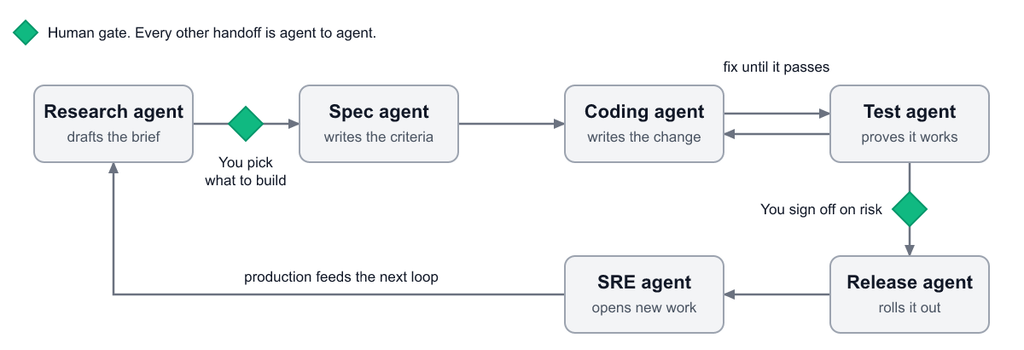
First is designing the flow: determining which agents exist, what each controls, what executes in parallel, and what information each handoff must contain.
Second is defining quality standards. An agent cannot hit a target that was never written down. Specifications, acceptance criteria, performance budgets, and API contracts once lived implicitly in engineers' minds. Now they must be explicit enough for machines to verify.
Third is optimizing the line. When an agent ships a defect, the relevant question is not why the agent failed but why the process allowed the failure. Every defect that reaches production reveals a process flaw.
Fourth is positioning human checkpoints. Humans should intervene where mistakes carry high cost and decisions require judgment. Line-by-line human review of every agent-generated pull request is a remnant of craft-era thinking, equivalent to hand-inspecting every bolt on an assembly line.
When an agent ships a bug, the useful question is not why the agent did that but why the line let it through. Every escaped defect is a process bug.
Agents excel at writing code and fixing tests. A database schema migration carries high risk of failure but is inexpensive for a machine to validate, so agents execute it behind strict checks. User interface text involves subjective taste but costs little to revise, so humans review it after deployment. Decisions about what to build and where security boundaries exist warrant human gates.
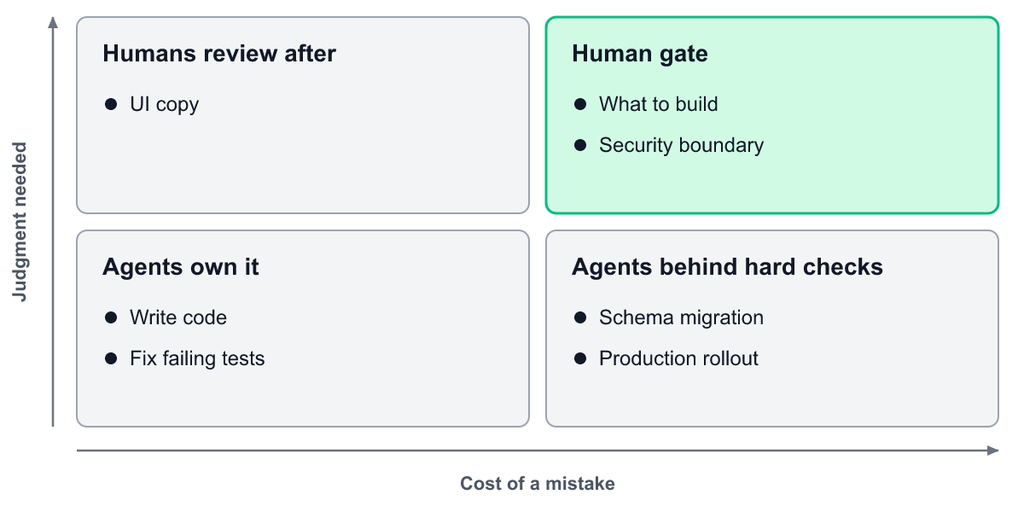
Quality gets built into every change, not inspected at the end
Most organizations still operate under the traditional quality model. Changes accumulate, then undergo a single inspection phase: a shared staging environment and human reviewer. This represents a single test station for the entire factory, and when agents multiply the volume of changes, it becomes the bottleneck Goldratt identified.
Toyoda's loom achieved efficiency by checking every thread continuously and stopping immediately when one broke. Code written by agents requires the same mechanism. In a mature software factory, the test agent validates every change as it is created, the coding agent corrects failures, and nothing advances until it passes.
This validation only carries weight if it runs in an environment where failures would actually occur. Mock systems are insufficient because they verify behavior in a world that does not exist. Mocks were a practical compromise when change velocity was low and provisioning a production-equivalent environment for each change was prohibitively expensive.
Each change now requires its own environment mirroring production, complete with the services, databases, and APIs it will encounter after release. Humans see a change only if it triggers a gate, and by that point it already functions, with evidence attached.
This approach demands a test station for every change, inexpensive enough to use on every attempt. Practically, this means an environment that initializes in seconds, deploys only the modified components while sharing everything else, and enables end-to-end verification before the change merges.
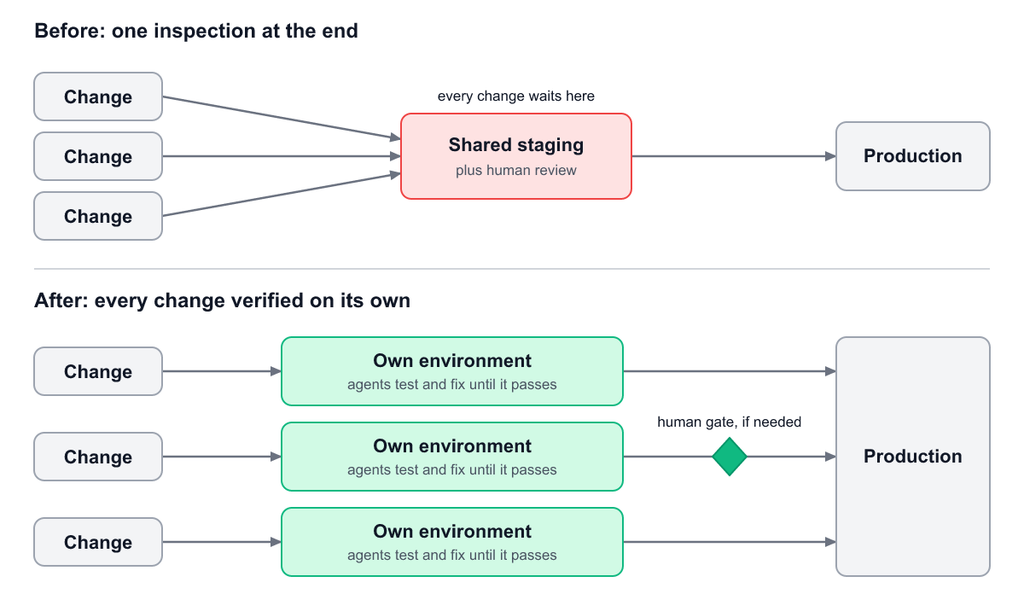
Guardrails belong in the line, not in the prompt
Verification catches mistakes after they occur. Guardrails prevent mistakes that would be expensive to catch late. The design principle is straightforward: assume agents will attempt anything the system permits, and structure the system so that everything it permits is safe.
Manufacturing terminology calls this error-proofing. Rather than posting a sign instructing workers to insert a part correctly, you engineer a fixture that accepts the part only in the correct orientation. For agents, a prompt instruction is a sign, while a permission boundary is a fixture.
Each agent should possess only the access its role requires. The coding agent never holds production credentials. Every execution is isolated so one agent's test cannot contaminate another's. Required checks are mandatory, every release can revert independently, and when a check cannot run, the change halts.
A line that silently bypasses a failed inspection is worse than having no inspection, because it creates false confidence. Agent-to-agent work introduces another principle: trust does not cascade down the chain. A review agent approving a change should not expand what the release agent is permitted to do.
Judgment stays human, and it becomes most of the job
Factories did not eliminate engineers; they created the field of industrial engineering. You cannot design a line for work you do not understand, so the most effective factory architects will be engineers with hands-on experience knowing what good code, good tests, and safe rollouts look like.
Some work remains off the line. The initial version of something novel, an unusual production failure, and a design pattern never before attempted are bench work. They stay hands-on until they are sufficiently understood to standardize.
Some decisions never move to machines: what is worth building, what a customer actually needs rather than what they stated, when to sacrifice speed for safety, and who is accountable for what ships. These were always the hardest aspects of the job. Now they comprise most of it.
The best process wins, not the best model
Agents have commoditized code generation, and every team can access the same models. What distinguishes teams pulling ahead is the line they construct around those agents: contracts between stations, human gates where judgment matters, and verification on every change. Designing that line is now the software engineer's core responsibility.