National Archives quietly deployed Chinese AI model on Federal Register before swift removal
A Chinese-made search tool from Alibaba briefly appeared on a US government website, creating an awkward moment as federal law enforcement simultaneously accused the company of stealing American AI technology.

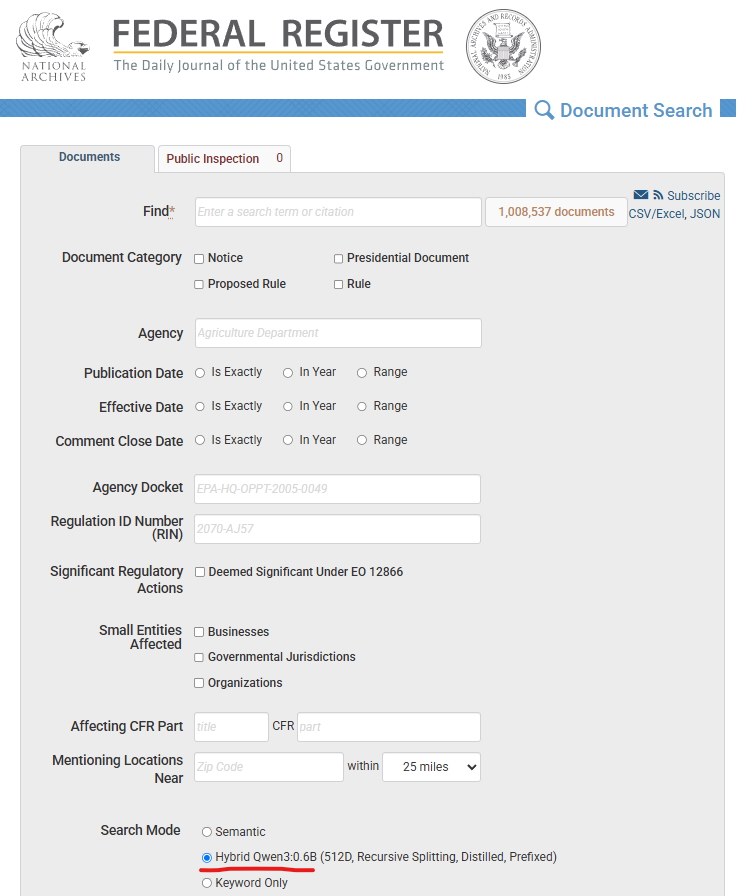
Federal officials took down a Chinese artificial intelligence search function from the Federal Register website on Wednesday, according to Reuters. The removal followed discovery by social media users of what appeared to be a policy contradiction: The National Archives had integrated one of Alibaba's Qwen AI models into the site even while the Federal Bureau of Investigation was publicly accusing Alibaba and five other Chinese technology firms of engaging in what it termed "industrial-scale distillation"—a practice the agency claims allows competitors to reduce expenses and accelerate development in the global artificial intelligence race.
The exact timing of when the National Archives, which operates the Federal Register website, began offering visitors access to the Qwen model for searching public comments on proposed regulations remains unclear. The independent agency responsible for expanding public access to federal documents has not issued a statement regarding the removal and declined to respond to inquiries. Neither the White House nor the FBI has commented on the matter.
On September 15, a user identified as "tleilax___" shared a screenshot on X showing the search option available on the government website. Reuters verified through archived versions of the site's code that the Qwen model was removed on Wednesday, meaning the service operated for at least one day.
Daniel Castro, who leads the Information Technology and Innovation Foundation, characterized the situation to Reuters as an "insane" contradiction—a federal agency deploying an Alibaba product while the FBI was simultaneously urging stakeholders to rely exclusively on American models.
Security implications remain debated
Whether deploying the Qwen model on a government website created security vulnerabilities hinges on training methodology and data handling, according to Anupam Chander, a law professor at Georgetown University, who spoke with Reuters. Senator Mark Warner (D-Va.) emphasized the importance of whether any American data passed through systems controlled by Alibaba.
Despite the FBI's warnings that Chinese models could pose national security threats by creating government dependence on Chinese technology, security researchers told Reuters that the Qwen deployment on the Federal Register site likely presented minimal actual risk. Chander pointed out that the Federal Register's materials are "already public, so the model was not working with sensitive government information."
According to reporting from Chinese news outlet Sina.com, the Federal Register deployed a lightweight open-weight variant designated "Qwen3 0.6B level," not Alibaba's most advanced model. This version operates as open-source software, functions exclusively for document retrieval, and neither performs sophisticated analysis nor transmits government data to Alibaba or external parties.
For government agencies, deploying the Qwen search tool provides greater data protection because the models can be downloaded and executed on local systems rather than sending queries to larger externally-hosted models, security experts explained to Reuters. The capacity to prevent sensitive information from leaving agency networks partly explains why it has become a "default" artificial intelligence search tool, Sina.com reported, alongside its lower and more stable cost structure.
Once organizations take possession of these models, they arguably cease functioning as Chinese services, Sina.com's analysis suggested. The United States, however, has only recently begun addressing the question of whether AI models originating in China but operated by American institutions should face identical restrictions as other Chinese services deemed higher security threats.
Congress pushes back against Chinese AI
The Federal Register incident emerges within a broader international conversation about artificial intelligence safety and an American debate concerning whether regulatory frameworks for AI are necessary or would undermine competitive standing, Reuters noted.
Numerous business leaders who increasingly depend on open-source models have appealed to the Trump administration to avoid restricting access to Chinese models. China, which has rejected allegations of copying advanced models, has urged the United States to heed its business community or risk widening its economic disadvantage.
Research prepared for Congress and delivered to the US-China Economic and Security Review Commission in March indicated that America may already face competitive disadvantages stemming from excessive focus on maintaining leadership in advanced models while neglecting development of its own open-source infrastructure. China, recognizing this opening, has worked to fill the gap.
US export controls are calibrated to constrain frontier training by restricting access to advanced semiconductors. They do not address the small-model deployment cycle, which requires less advanced compute, draws on openly available base models, and generates advantage through application rather than pre-training. If the models that matter most for industrial AI are small, specialized, and open, the current US policy framework could be targeting the wrong layer of the competition.
Major corporations including Nvidia and Meta have pledged to assist the United States in closing this gap. Researchers have cautioned that if America loses substantial market share to China, it could damage the nation's "ability to set the technical standards and norms that will govern AI development for years to come." Some members of Congress worry that such a loss of technological leadership could threaten national security and economic interests.
US Representative John Moolenaar (R-Mich.), chairman of the House China Committee, has adopted a stringent position, insisting that "no federal government entity should use a Chinese AI model," according to Reuters. "Doing so only makes the federal government more dependent on Chinese AI models, and that is not in the national interest," Moolenaar stated.