Thermalright TR-KG750 750W PSU: Budget Gold Certification Comes With Acoustic Compromises
Thermalright's entry-level KG-series power supply delivers current ATX 3.1 and PCIe 5.0 compliance at $91, but efficiency margins are razor-thin and fan noise becomes intrusive under sustained loads.
Thermalright built its reputation over two decades as a CPU cooling specialist, establishing itself in Taipei in 2001 with iconic air coolers like the Ultra-120 eXtreme and HR series before fading from prominence. The 2021 launch of the Peerless Assassin 120 revived the brand's standing among budget builders, leading to rapid product expansion: case fans, liquid coolers, thermal compounds, and chassis all joined the lineup. Power supplies arrived in 2022, though this category demands different scrutiny than Thermalright's core competencies. Like most brands, Thermalright does not manufacture its own PSUs but instead commissions them from OEMs—a cooling company's engineering credibility extends only as far as the platform supplier allows. Each Thermalright power supply must be evaluated based on its underlying platform rather than the badge affixed to it.
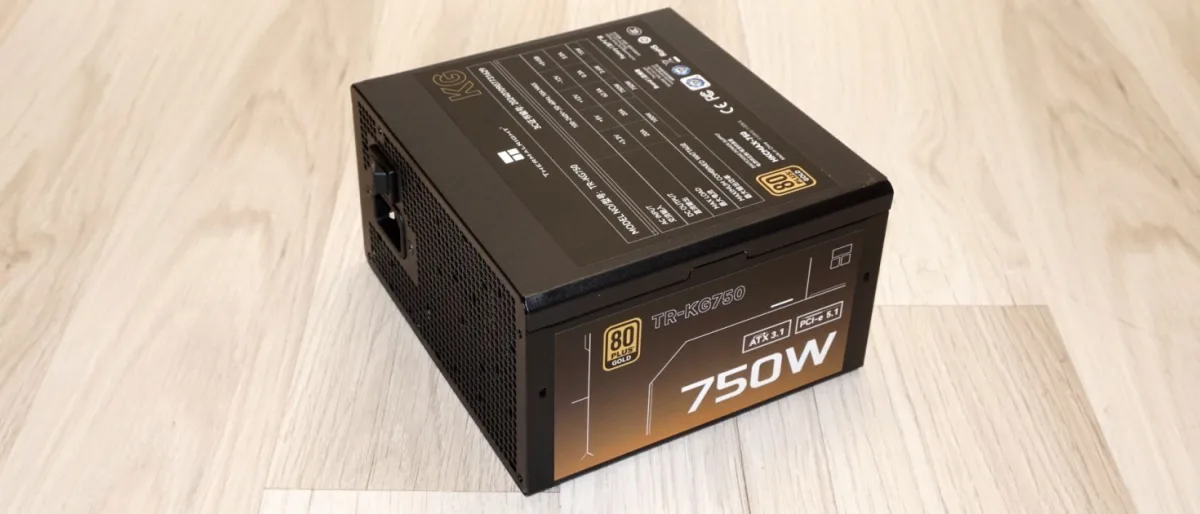
The KG series occupies Thermalright's value segment, with the TR-KG750 representing its 750W offering. On paper, specifications appear current: ATX 3.1 and PCIe 5.1 compliance, native 12V-2x6 connector, full modularity, 80 PLUS Gold certification at 115 VAC, a 120 mm fan inside a 140 mm-deep chassis, and a five-year warranty. The unit's label reveals the platform identity without difficulty. Somore Tech Co., Ltd. is listed as manufacturer, with production credited to Jiushouyangguang Power Supply (Shenzhen), and the internal designation HKCMAX-750 printed beside the 80 PLUS badge identifies this as an HKC platform. The main board's silkscreen dates the design to April 2023. Without a Cybenetics certification entry at the time of testing, the 80 PLUS report remains the sole third-party performance data. At $91 retail, the unit undercuts virtually every name-brand 750W Gold PSU available in the US market—the entirety of its value proposition.
In the Box
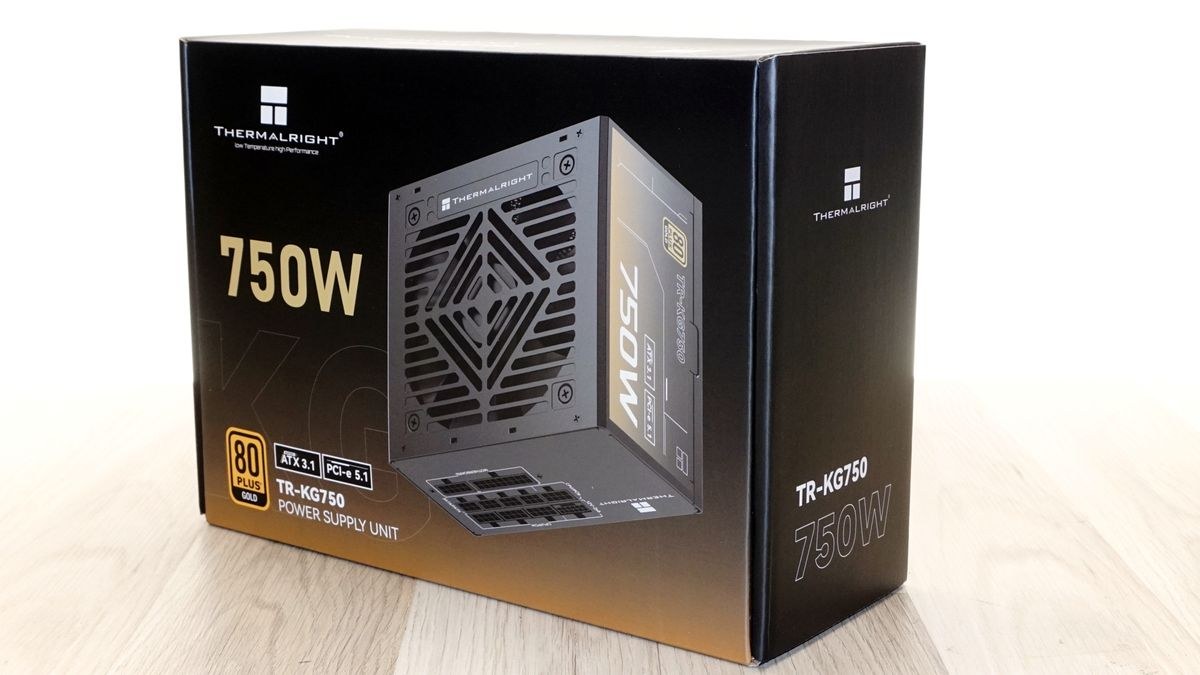
The TR-KG750 ships in a compact cardboard box wrapped in a black-to-bronze gradient sleeve, featuring a three-quarter render of the unit and the wattage displayed in large gold lettering. The bottom badge strip is minimal: 80 PLUS Gold, ATX 3.1, PCIe 5.1, and model number.
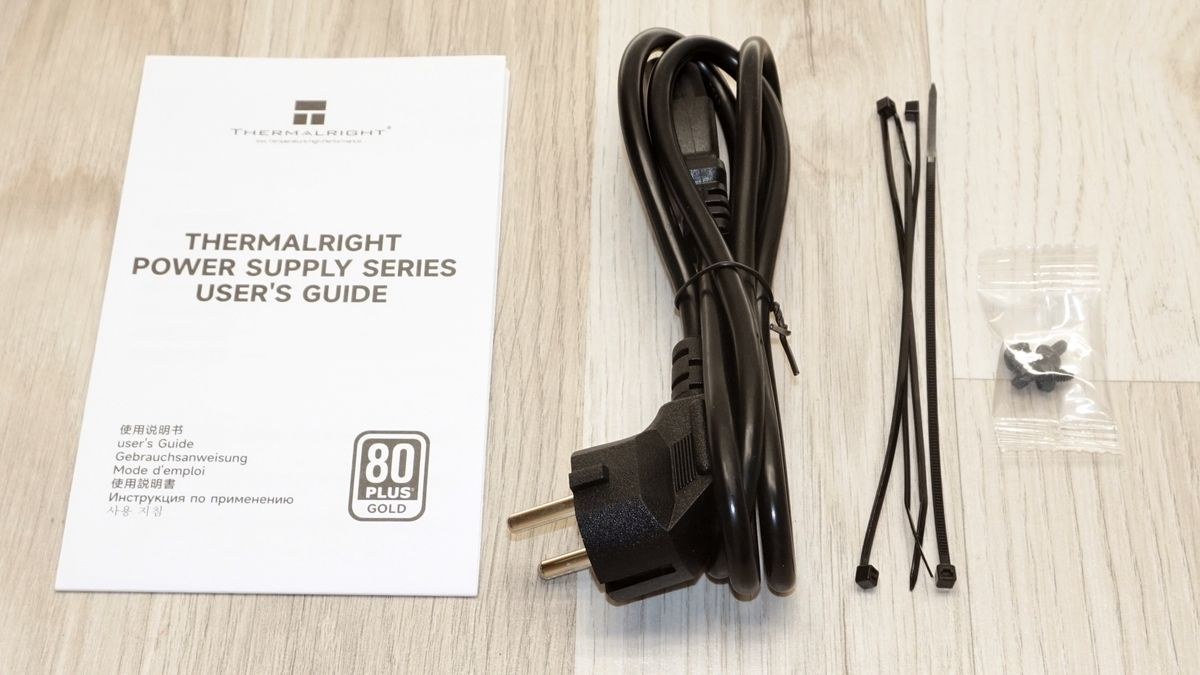
The accessory bundle is sparse. Beyond protective packaging, the supply includes a multilingual user guide, AC power cord, mounting screws, and four zip ties—nothing more. For an eight-cable modular supply, four zip ties represent a token gesture rather than practical provision, and this is one of the first places where the $91 price point becomes apparent before opening the chassis.
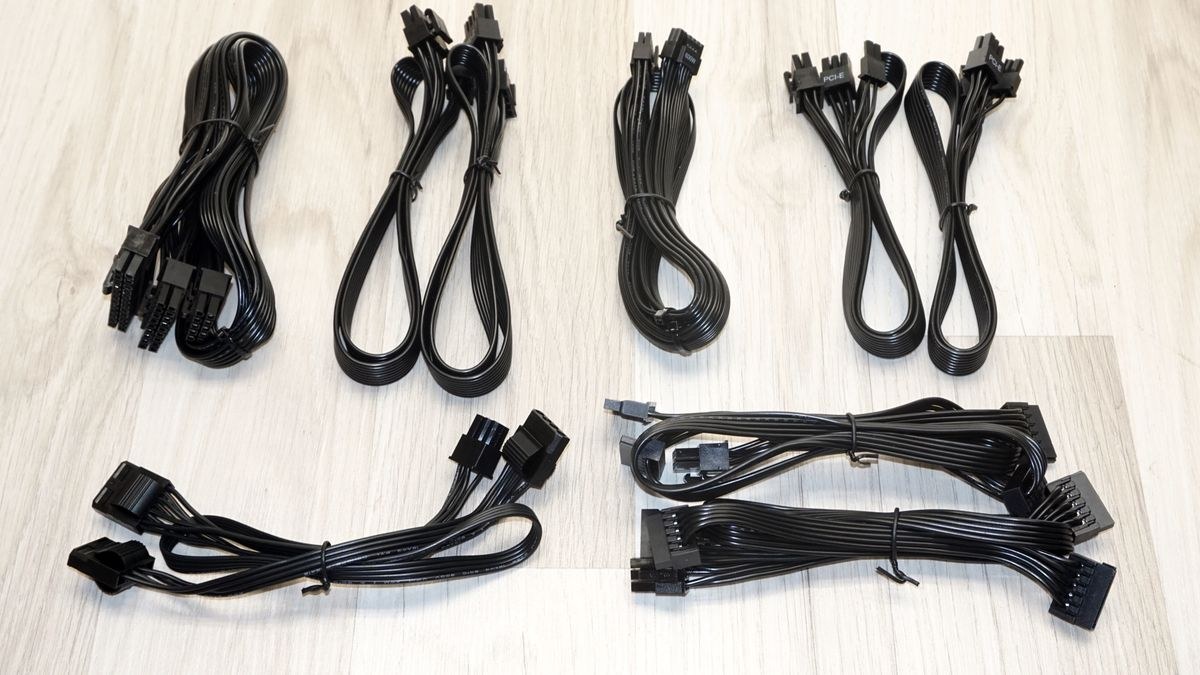
All cables are flat ribbon types in black with no sleeving throughout the set. Uniformity across the cable run enhances aesthetics. The 12V-2x6 cable is native—a single run from the modular panel to the graphics card with no adapter or splitter—though its plug lacks the dual-color keying that ATX 3.1 encourages, making an incompletely seated connector harder to identify at a glance.
External Appearance
Measuring 150 x 86 x 140 mm, the TR-KG750 is a standard-width ATX unit with a short 140 mm body—about as compact as a 750W supply practically becomes—leaving adequate slack for cable management even in mid-tower cases. The chassis wears a matte black finish with fine texture, and the top panel features a stamped fan grille in a diamond-and-chevron pattern—four angled spokes radiating from a central square, framed by long slotted vents—with the Thermalright wordmark pressed into a raised panel at the edge. Four exposed corner screws sit at the corners, one beneath the warranty-void sticker.
The rear face presents a large square perforated exhaust panel with the AC receptacle and rocker switch. The front face hosts the modular connector bay, cleanly silkscreened into four labeled groups: MOTHERBOARD for the split 24-pin, SATA/PATA for peripheral cables, CPU/PCIe for the four eight-pin sockets, and a dedicated 12V 2x6 socket in the bottom corner. A scratch-off authenticity tag with QR code sits alongside the panel.
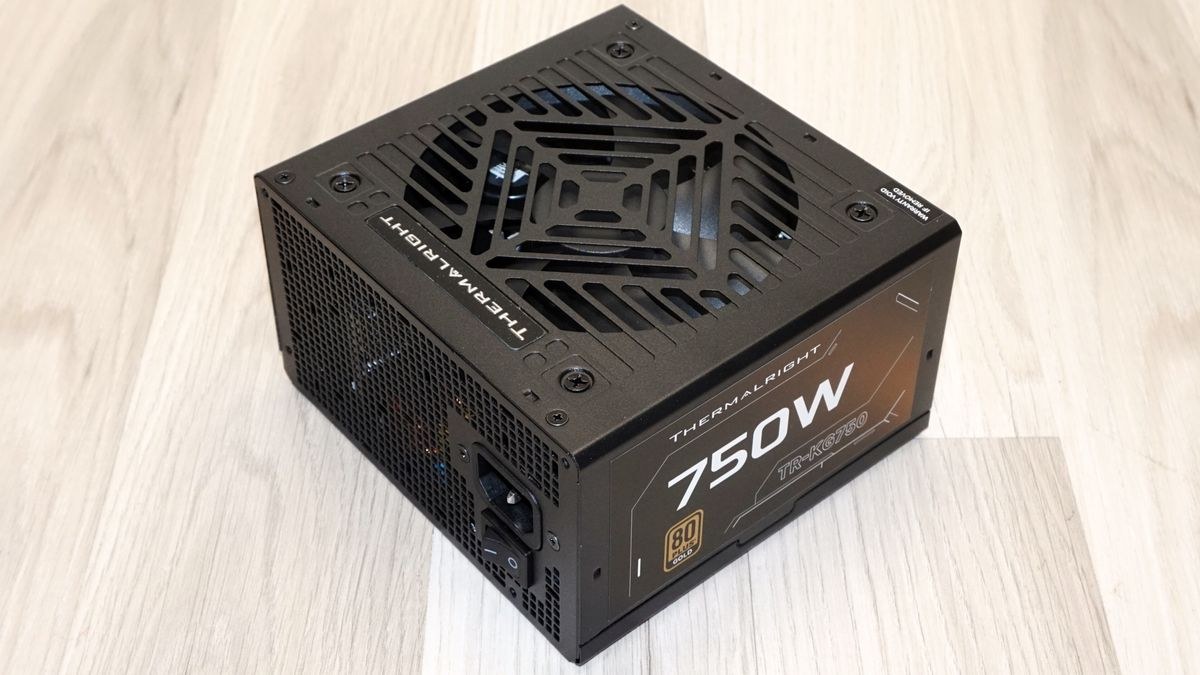
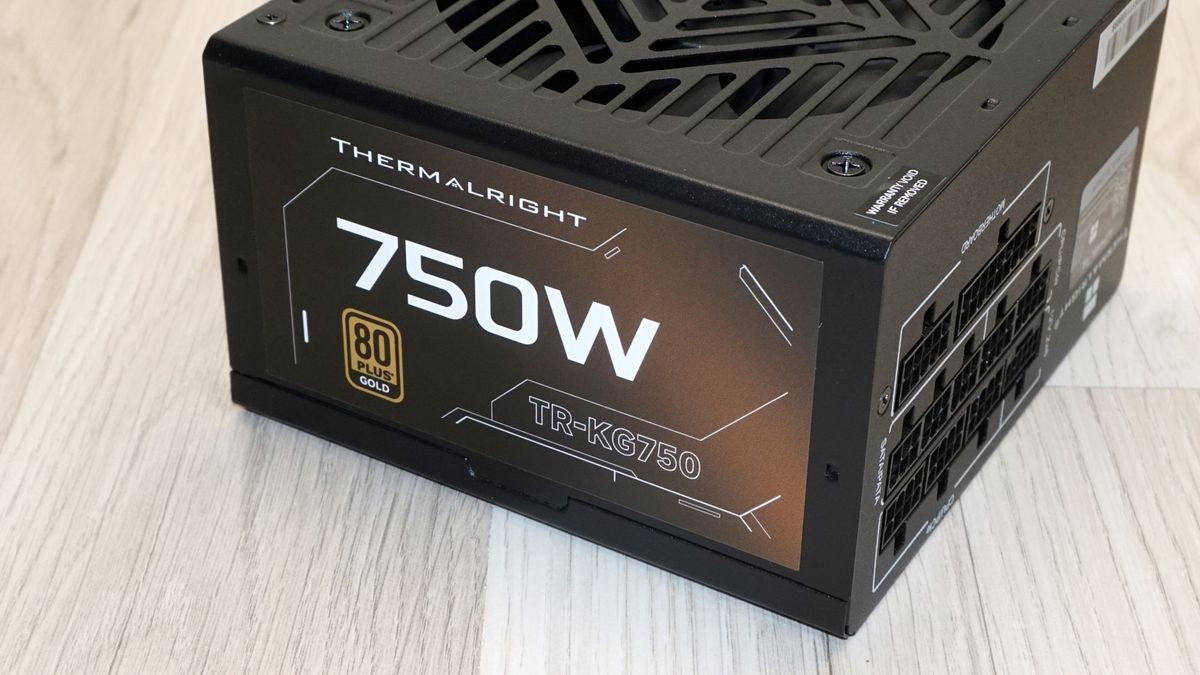
The specification label occupies the top face rather than a side panel—a more useful placement for a bottom-mounted supply sitting beneath a windowed case. Both side panels carry a large bronze-gradient decal displaying the wattage, model number, and 80 PLUS Gold badge. This decal serves as the only decoration; the finish underneath is unremarkable but honest—evenly applied, no orange peel, no sharp edges. The label repeats rail ratings, CCC certificate number, and internal model designation, revealing the platform identity. Build quality reflects the price: adequate steel gauge, aligned panels, nothing rattles, but none of the extra finishing that separates a $90 unit from a $150 one.
Internal Design
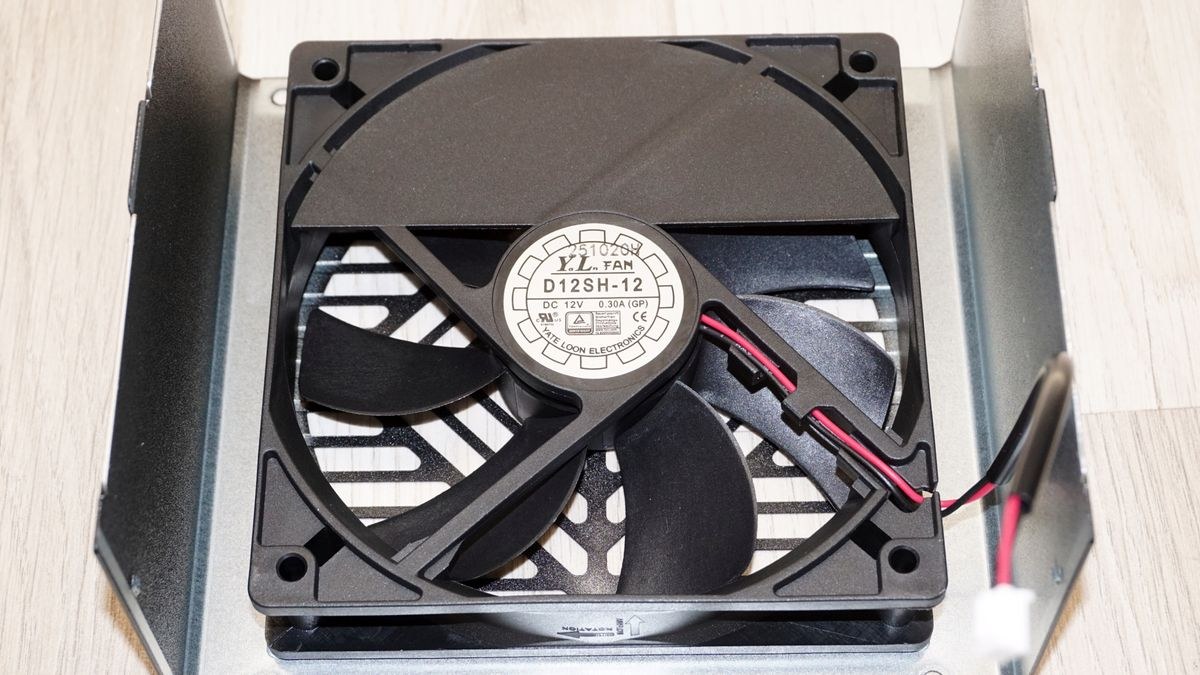
A 120 mm Yate Loon D12SH-12 rated for 12V at 0.30A handles cooling. Yate Loon is an established Chinese fan manufacturer, and the D-series represents its core sleeve-bearing line—making this the single most consequential cost-saving in the unit. Sleeve bearings operate quietly, comparable to fluid-dynamic alternatives at equivalent speed, but wear faster and prove more sensitive to heat and mounting orientation—all three factors matter in a supply that, as testing reveals, runs its fan constantly and pushes it hard as ambient temperature rises. The five-year warranty covers the fan, but it is not a component most owners will relish replacing.
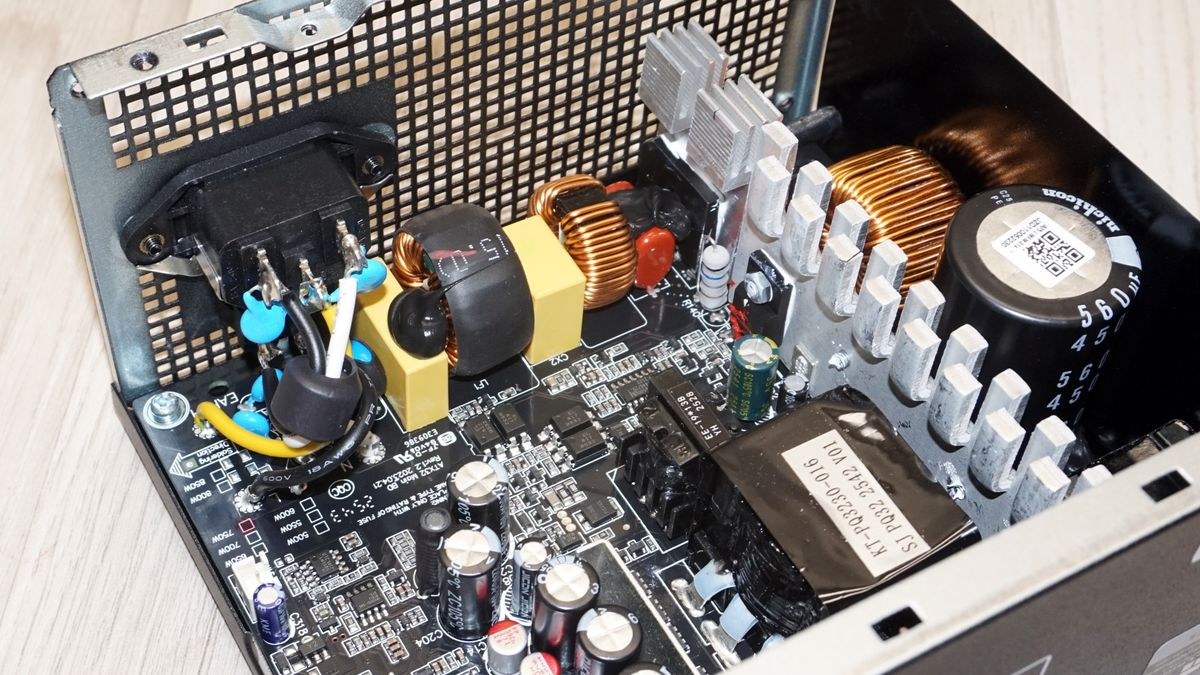
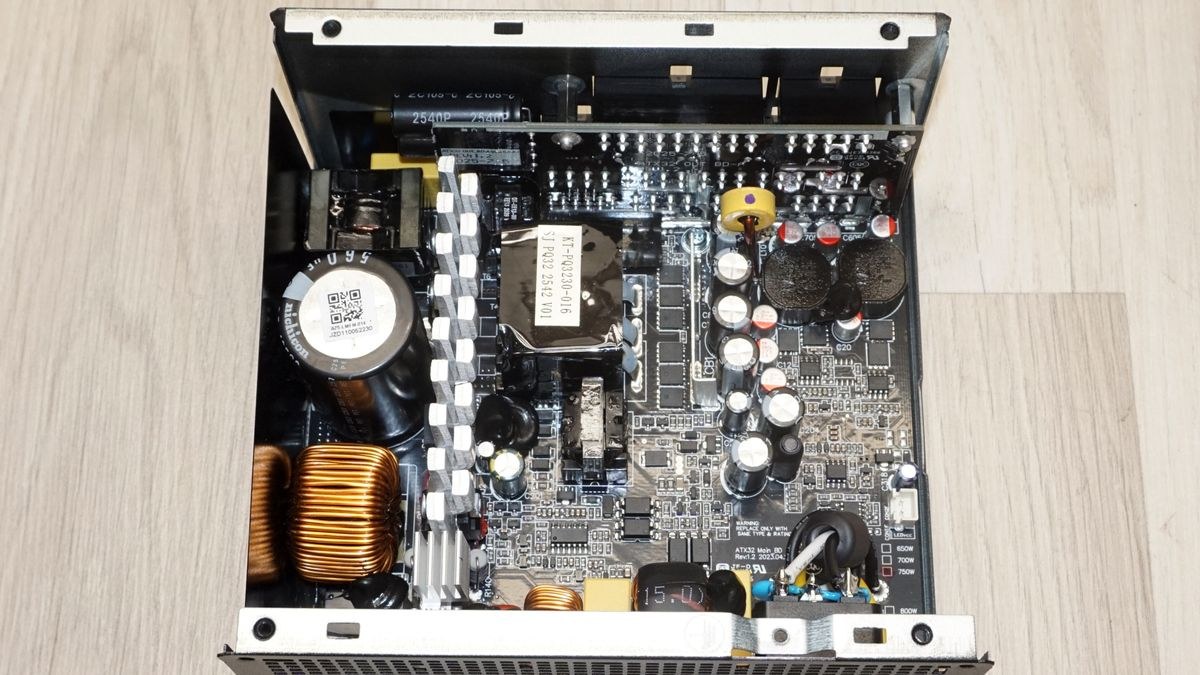
The HKC platform, supplied to Thermalright under the internal designation HKCMAX-750, forms the foundation. The main board silkscreen reads ATX32 Main BD Rev1.2. A row of wattage selection pads along the board edge spans 500W to 850W, with the 750W position populated—confirming this is a single design scaled across a product family rather than a layout engineered specifically for 750W. Component density is fair, soldering is tidy, and black silicone anchors larger parts. Only two heatsinks are fitted—a small one carrying input bridges and a taller finned unit shared by the APFC and primary switching stages—while everything on the secondary side relies on the PCB and a tiny sheet heatsink soldered to it.
The transient filtering stage begins at the AC receptacle's rear and continues on the main PCB. In total, four Y capacitors, two X capacitors, and two filtering inductors are present, along with an MOV and NTC thermistor—a complete filter with nothing omitted, though not a generous one. Two input rectifying bridges follow on their own small dedicated heatsink. The APFC stage employs two MOSFETs and a boost diode sharing the tall heatsink, paired with a large open-frame filtering coil, and the bulk capacitor is a Nichicon 450V/560 uF part from the 105C-rated GN(M) series. That capacitor stands as comfortably the best component in the unit and practically the only one sourced from a manufacturer with a genuine reliability record. The primary inversion stage uses a half-bridge arrangement built from two 65R160FR MOSFETs on the shared heatsink, feeding the main transformer.
The secondary side reveals where cost engineering becomes evident. The 12V rail is rectified by six Perfertway PWC012N04ES MOSFETs mounted directly on the main PCB with no dedicated heatsink, and the 3.3V and 5V rails derive from DC-to-DC converters also residing on the main board rather than a vertical daughterboard. As a layout, this is conventional and modern. The issue lies in provenance: essentially every active device in the conversion path—the bridges, APFC and primary MOSFETs, the six synchronous rectifiers—originates from manufacturers with no established track record in this application. Secondary filtering mixes Teapo parts with capacitors branded NICON that, despite carrying a series designation borrowed from Nippon Chemi-Con's catalog, do not appear to be genuine Nippon Chemi-Con or Nichicon products. Polymer capacitors handle high-frequency filtering on the modular board. None of this is unusual at this price point. However, it bears stating plainly that retail listings describing "all Japanese" capacitors refer only to the bulk capacitor and nothing else.
Cold Test Results (25°C Ambient)
Testing employed high-precision electronic loads with a maximum power draw of 2700 Watts, a Rigol DS5042M 40 MHz oscilloscope, an Extech 380803 power analyzer, two high-precision UNI-T UT-325 digital thermometers, an Extech HD600 SPL meter, a self-designed hotbox, and various other equipment.
At 25°C ambient, the TR-KG750 averaged 89.5% at 230 VAC and 88.5% at 115 VAC across the nominal load range, peaking at 91.2% and 90.3%, respectively, at 50% load and settling to 89.2% and 87.9% at sustained 750W. The curve is well shaped, displaying the usual broad plateau between 40% and 70% load with no collapse at the top end. What it lacks is margin. Against the 80 PLUS Gold thresholds at 115 VAC—87% at 20% load, 90% at 50%, and 87% at 100%—the measured 87.2%, 90.3%, and 87.9% clear the bar by 0.2, 0.3, and 0.9 percentage points. The unit's own 80 PLUS report reads slightly kinder at 90.2%, 91.4%, and 88.3%, but the conclusion remains unchanged: this is a Gold unit by a narrow margin.
Acoustically, the news is not encouraging. The Yate Loon spins whenever the supply is powered but remains quiet across the first half of the load range. The ramp through the middle accelerates gently, but steepens past 70% load, reaching 42 dB(A) at 600W and almost 51 dB(A) at sustained 750W. That is loud for an efficient 750W unit at room temperature. Thermally, the platform is comfortable at 25°C. The primary and secondary heatsinks stabilized at around 60°C—unremarkable numbers, with small heatsinks and mediocre efficiency being the obvious culprits.
Hot Test Results (~45°C Ambient)
Inside the hotbox at roughly 45°C ambient—five degrees beyond the unit's own 40°C rating—efficiency averaged 87.6% at 230 VAC and 86.6% at 115 VAC, an almost uniform 1.9-point loss against the cold run. Full load is where degradation concentrates: 85.8% at 230 VAC and 84.5% at 115 VAC, both 3.4 points down from the 25°C figures. A drop of that magnitude exceeds acceptable limits, placing the unit well outside Gold territory under heat, though it is being measured beyond its rated envelope and the curve's shape essentially holds throughout. The supply completed every load step without shutting down.
Heat transforms the fan from merely constant into genuinely intrusive. The floor rises to 37 dB(A), which is audible but not dramatic. It maintains reasonable noise figures up to 525W, then the curve breaks: between 525W and 600W the fan jumps almost ten decibels to 56 dB(A), settling at 58 dB(A) at sustained 750W. A step that abrupt points to a coarse thermal control scheme rather than a tuned curve, and at 58 dB(A) the power supply becomes likely the loudest component in almost any system. The internal readings explain the urgency: the primary heatsink reached well over 100°C at full load. Those are very high figures for parts of uncertain pedigree and for a 750W PSU, and while the unit held together for the duration, sustained full load at 45°C is not an environment we would ask this platform to inhabit.
Power Supply Quality
Voltage regulation is adequate rather than tight. Between 20% and 100% load, the 3.3V rail moved 1.2%, the 5V rail 1.4%, and the 12V rail 1.8%. The 12V figure is the one that matters, and it is the loosest of the three, sliding from 12.11V at 151.5W to 11.89V at 744.5W. That sits comfortably inside the ±5% ATX window and will not trouble any component, but it is roughly double what a well-tuned modern LLC platform delivers, with most of the drop arriving between 50% and 75% load rather than being spread evenly across the range.
Ripple suppression follows the same pattern of simple adequacy. On the 12V rail we measured 24 mV at 20% load rising to 62 mV at full load, against the 120 mV ATX limit—a comfortable pass with roughly 48% headroom, though the jump from 38 mV at 75% load to 62 mV at 100% is steeper than the rest of the curve. The minor rails run closer to their ceilings: 34 mV on 3.3V and 38 mV on 5V against a 50 mV limit, leaving 32% and 24% headroom respectively. Cross-load behavior was unremarkable, with 60 mV on 12V under the 12V-heavy test and 34 mV on 5V under the minor-rail test. None of this poses a problem for the hardware a 750W supply will realistically feed, but the minor rails have less room than we would expect from a DC-to-DC design.
During our thorough assessment, we evaluate the essential protection features of every power supply unit we review, including Over Current Protection (OCP), Over Voltage Protection (OVP), Over Power Protection (OPP), and Short Circuit Protection (SCP).
All protection mechanisms were verified and triggered correctly during testing. With the unit hot, OCP tripped at 140% on the 3.3V rail (28A), 142% on the 5V rail (28.4A), and 136% on the 12V rail (85A), with OPP shutting the supply down at 134% of rated output, or approximately 1005W. Those are generous thresholds, more generous than most mainstream 750W units carry, and they mean the platform will ride out the transient excursions a modern graphics card throws at it without complaint—which is precisely what ATX 3.1 compliance is meant to guarantee.
Bottom Line
What the TR-KG750 is, stated plainly, is an HKC platform wearing a Thermalright badge at a $91 price, and most of what follows is predictable. The specification sheet is current—ATX 3.1, PCIe 5.1, a native 12V-2x6 connector, full modularity, a compact 140 mm chassis—and the engineering is competent in the sense that nothing is missing or obviously wrong. The transient filter is complete, the topology is a modern half-bridge LLC with DC-to-DC minor rails, and the Nichicon bulk capacitor is a real Japanese part. Measured performance is broadly consistent with the class: regulation within 2% on every rail, ripple with meaningful headroom on 12V, and protection thresholds more generous than most.
The problems concentrate in two places. The first is efficiency, where the unit clears its 80 PLUS Gold thresholds at 115 VAC by a small margin. Certification is a floor, and this unit sits on it. Under heat, the margin vanishes entirely—84.5% at 115 VAC and full load—and with no Cybenetics listing, there is no other independent data to weigh against ours. The second is acoustics, and the fault there is part control, part hardware. The Yate Loon is quiet enough through the first half of the load range, but the curve steepens past 70%, and the supply reaches almost 51 dB(A) at sustained 750W at room temperature. In a warm case, it is worse: a ten-decibel step between 525W and 600W, and 58 dB(A) from there to full load. That is a coarse fan profile rather than a tuned one, and there is no fanless mode to fall back on at idle. It was little choice, as the heatsinks are too small to combat such thermal needs. Builders who care about a perfectly quiet machine can stop reading here.
Underneath those sit the component choices. The Nichicon bulk capacitor aside, the secondary filtering is Teapo and NICON, and every active device in the conversion path—bridges, APFC and primary MOSFETs, the six synchronous rectifiers—comes from manufacturers with no track record to point at. That is not automatically a defect; plenty of anonymous silicon runs happily for a decade. But it is unverifiable, and heatsink temperatures well over 100°C at 45°C ambient leave less comfort than we would like, as does a sleeve-bearing fan if asked to run continuously in that heat. The five-year warranty is doing real work in the value case here, and it is the correct length for this class rather than a generous one.
At $91, the TR-KG750 is around $30 cheaper than the Cooler Master MWE Gold 750 V4, and that comparison is the instructive one. The Cooler Master is quieter by a wide margin, holds tighter regulation, runs a cooler secondary side under heat, and carries a ten-year warranty; the Thermalright answers with a lower price, and concedes almost everything else. Set against the Thermaltake Toughpower GX3 850W or the MSI MAG A850GLS, the picture is similar—more wattage and better-documented platforms, for more money. The TR-KG750 earns its place on price alone. If the budget is fixed near $90 and the machine lives under a desk rather than on it, this is a defensible purchase with a current feature set and adequate measured performance behind it. If there is $30 of headroom, or if noise matters substantially, have a look at higher price tags.
Source: Tom's Hardware