DIY enthusiast achieves 3.11 tokens/second running 2.8T-parameter Kimi model on Optane and GPUs
A homelab builder combined Intel Optane persistent memory with two RTX 3090 graphics cards and a RAM drive to run Moonshot AI's Kimi K3 language model, achieving meaningful inference speeds through careful hardware orchestration.
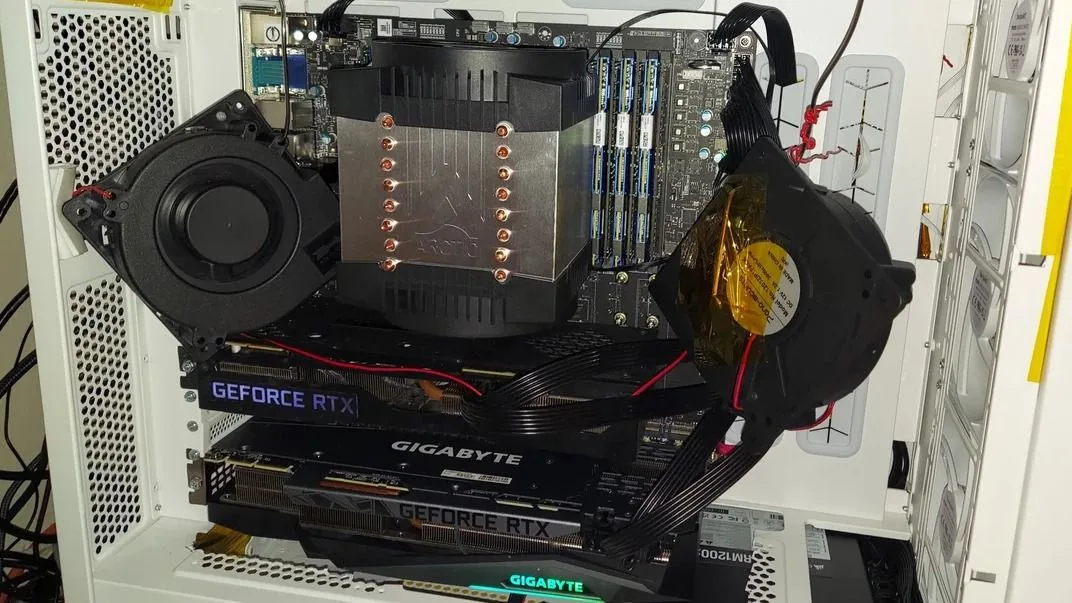
In a Reddit post, a homelab enthusiast documented enhancements to their second-generation Optane-based AI system, which now executes Moonshot's 2.8-trillion-parameter Kimi K3 model at 3.11 tokens per second for generation and 16.8 tokens per second during prompt evaluation. The system pairs two RTX 3090 graphics processors with Intel Optane persistent memory and a Linux RAM drive, demonstrating how creative hardware combinations can enable large model inference on consumer-grade equipment.
Follow-up: Kimi K3 Q2_K on second-gen Optane + 2× RTX 3090 — 3.11 t/s generation, 16.8 t/s prompt evalfrom r/homelab
Reddit homelabber
The builder achieved a significant performance jump by offloading 414 GB of the model—45 of 94 shards—onto a RAM drive using Linux's tmpfs. This modification alone delivered a 41% boost to generation speed and a 26% improvement to prompt evaluation performance. Without the RAM drive optimization but still using both GPUs, the system ran at 2.20 tokens per second for generation and 13.3 for prompt evaluation.
The two RTX 3090 cards contribute only 48 GB of combined VRAM—roughly 5.5% of the 865 GB model file—yet handle critical computational tasks. Kimi K3 is a mixture-of-experts architecture with 896 total experts, of which 16 are selected per token along with two shared experts, activating approximately 104 billion parameters from the full 2.8 trillion. The Q2_K quantization format reduces the model to 865 GB, averaging under 3 bits per parameter.
The system architecture distributes workloads strategically: routed-expert tensors remain on the CPU side in Optane and RAM, while the GPUs handle attention mechanisms, dense feed-forward layers, shared experts, and the key-value cache. This division places computationally intensive, token-universal operations on the faster GPU memory and compute, while the CPU-side storage manages the larger but less frequently accessed expert weights.
DRAM proves substantially faster than Optane for this workload, despite being slower than GPU VRAM. By moving model shards into tmpfs—which the Linux kernel documentation describes as "a file system which keeps all of its files in virtual memory"—the builder eliminated repeated reads from the slower persistent memory tier. The performance gains reflect this bandwidth improvement across the heterogeneous memory hierarchy.
The 3.11 tokens-per-second generation speed aligns with the builder's original prediction of "somewhere between 2 and 4 tokens per second." Achieving this required significant hardware modifications, including cutting the case and relocating the power supply to accommodate the GPUs and their cooling infrastructure. Thermal management remains demanding: the system retains two 12W blower fans for the Optane DIMMs, and the dual 350W-class GPUs add substantial heat generation.
Future optimization opportunities remain available, including customized quantization strategies that could reduce bandwidth and capacity demands on slower memory tiers. The builder acknowledges that raw token throughput alone cannot guide development; output quality must factor into any subsequent improvements to the system.