Custom Power Mod Offers Safer Alternative to Nvidia's Problematic 16-Pin Connector
A Reddit user has developed a quad 8-pin power-conversion kit that bypasses Nvidia's notorious 16-pin connector on high-end graphics cards, distributing power more safely across conventional PCIe connectors.

Nvidia's GeForce RTX 5090 has become nearly impossible to find in stock, with resellers asking $8,500 on Amazon. Now a custom solution is emerging to address one of the card's most serious design flaws. Reddit user DallasGrave has unveiled a quad 8-pin power conversion kit that sidesteps the problematic 16-pin (12VHPWR) power connector found on Nvidia's latest graphics cards, along with the subsequent 12V-2x6 revision. The device represents a meaningful step forward in tackling the thermal and safety issues that have plagued the 16-pin design.
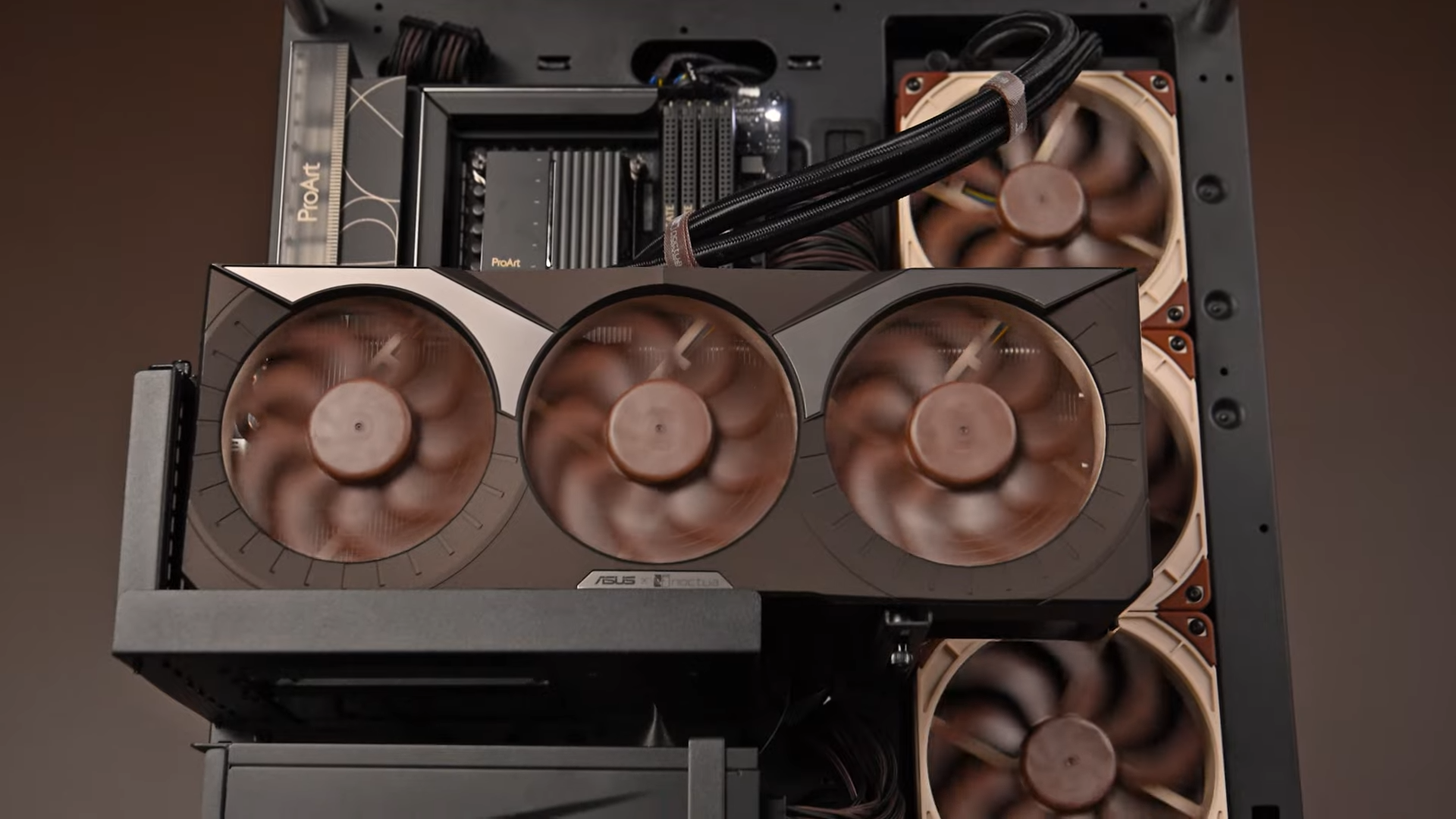
Rather than functioning as a simple adapter, DallasGrave's creation operates as a true power-conversion system. The kit mounts directly above the graphics card and incorporates a custom harness that solders to the card's PCB power rails. By bypassing the 16-pin connector entirely, the system redirects the card's substantial power requirements across four standard 8-pin PCIe power connectors, spreading the electrical load more evenly than the original design allows.
The mathematics of the solution illustrate its advantage. Each 8-pin PCIe connector supports up to 150W, meaning four connectors combined deliver the same 600W maximum capacity as the 16-pin connector. Yet the 16-pin design forces 50 amps through a densely packed arrangement of pins, creating a bottleneck. The conversion kit distributes this current across four larger, more widely-spaced connectors, reducing the concentration of heat and current at any single point.
Failures in 8-pin connectors occur far less frequently than those in 16-pin connectors, largely because of the physical differences between them. The 16-pin connector's compact form factor carries four times the wattage of a single 8-pin connector, generating higher current density and greater heat accumulation in a smaller space.
According to PCI-SIG specifications, each of the six power pins in a 16-pin connector can handle a maximum of 9.5 amps, theoretically supporting up to 684W or 57 amps total. When a 16-pin connector carries 600W (50 amps), each pin must handle approximately 8.33 amps—dangerously close to its rated limit. A standard 8-pin PCIe connector contains three power pins; four of these connectors provide 12 power pins combined. Spreading a 50-amp load across 12 pins means each pin carries only 4.17 amps, roughly half the per-pin current of the 16-pin design. This reduction substantially lowers wire and terminal temperatures and decreases the likelihood of heat-related failures.
DallasGrave's kit manages to trick the sense pins on the 16-pin connector into recognizing the full 600W capacity. According to the creator, testing has shown the system can handle up to 800W when modified with a shunt. The design offers flexibility: users can deploy it as an independent power source or run it in parallel with the native 16-pin connector to further distribute the load.
The developer is working on a custom backplate to improve the kit's aesthetic integration with graphics cards. The solution is not restricted to the RTX 5090 or any single manufacturer. DallasGrave indicates that production models are being prepared for nearly every variant currently available, including Nvidia's Founders Edition cards. The creator has not yet disclosed the official launch timeline, cost, or specific installation procedures.