Caterpillar and CoreWeave Tackle Construction Autonomy With Physical AI Infrastructure
Construction equipment makers are turning to physical AI to address labor shortages and productivity challenges, but the technology demands fundamentally different data center capabilities than traditional AI training.
A surge in infrastructure projects—data centers, power generation facilities and transportation networks—is driving growth in construction even as the sector grapples with falling productivity and a scarcity of qualified equipment operators. Physical AI, which enables machines to understand their environment and respond to it, is positioning itself as a potential remedy to these challenges.
Caterpillar Inc. has built substantial expertise deploying autonomous machinery in mining operations. Moving that capability into construction environments presents a different problem set, according to Brandon Hootman, vice president of physical AI platforms and construction autonomy at Caterpillar. Mining sites, once configured, remain relatively stable. Construction presents the inverse scenario. "Once that mine site gets instantiated, it does change, but it doesn't change frequently," Hootman explained. "You go to construction as an industry. Polar opposite of mining. If you think about all of the dynamics of what has to happen, taking a structured system and matching it to an unstructured environment, it's really, really challenging to do."
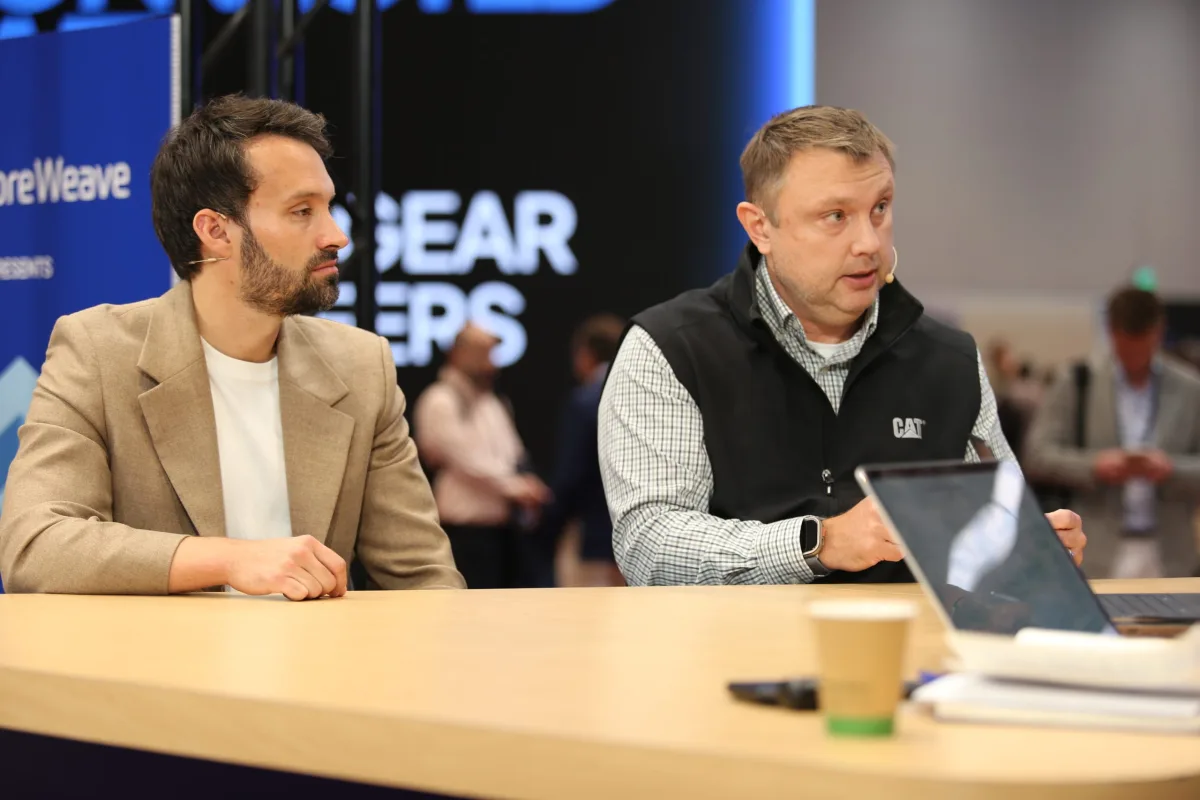
Hootman and Richard Ahlfeld, senior vice president of Physical AI at CoreWeave Inc., discussed the intersection of physical AI and infrastructure requirements during an appearance at the Fully Connected event, broadcast through theCUBE, the livestreaming platform operated by SiliconANGLE Media.
Physical AI changes what data centers must deliver
Data center infrastructure initially developed for foundation model training and later adapted for large-scale agentic inference now faces new demands. Teaching an excavator to operate autonomously involves collecting telemetry and visual information, running a digging operation through simulation a million times over, and applying reinforcement learning techniques. CoreWeave unveiled a Physical AI Field Engineering service that places its technical staff alongside customers' specialists to accelerate this process, Ahlfeld noted.
"Physical AI now is an entirely different beast," Ahlfeld said. "That requires, first of all, a lot of storage. It requires a different infrastructure."
Caterpillar's existing digital infrastructure contains roughly 18 petabytes of federated information sourced from its machines, dealer networks and customer operations, Hootman stated. Developing autonomous equipment demands perception information synchronized with machine commands and operational metrics.
"That 18 petabytes that we've collected so far is just a drop in the bucket to the amount of data that it actually takes to go train physical AI to operate in a world like a construction site," Hootman said. "But you take Light Detection and Ranging data, camera data, that multi-second control data and performance data coming back in, you're talking about terabytes of data within a given day for just one machine."
CoreWeave identified Caterpillar as an enterprise customer in its second-quarter financial disclosures. The equipment manufacturer started its engagement with CoreWeave during the current year, motivated by access to graphics processing unit resources and specialized knowledge, according to Hootman. The partnership leverages Nvidia technology and AI systems to process and categorize incoming operational data from the field.
https://www.youtube.com/embed/xOjSISLKbw0?feature=oembed
"Now you're taking things that were months to maybe weeks," Hootman said. "And now you're getting it down to hours and your feedback loop between that happening and being able to use it in your simulation environment, or your training environment, happens within the given workday."