Biren's Explosive Growth Signals Shift in China's AI Chip Market
A Chinese accelerator maker has seen its revenues skyrocket nearly 2,000% as U.S. export restrictions on advanced processors reshape the competitive landscape in the country.
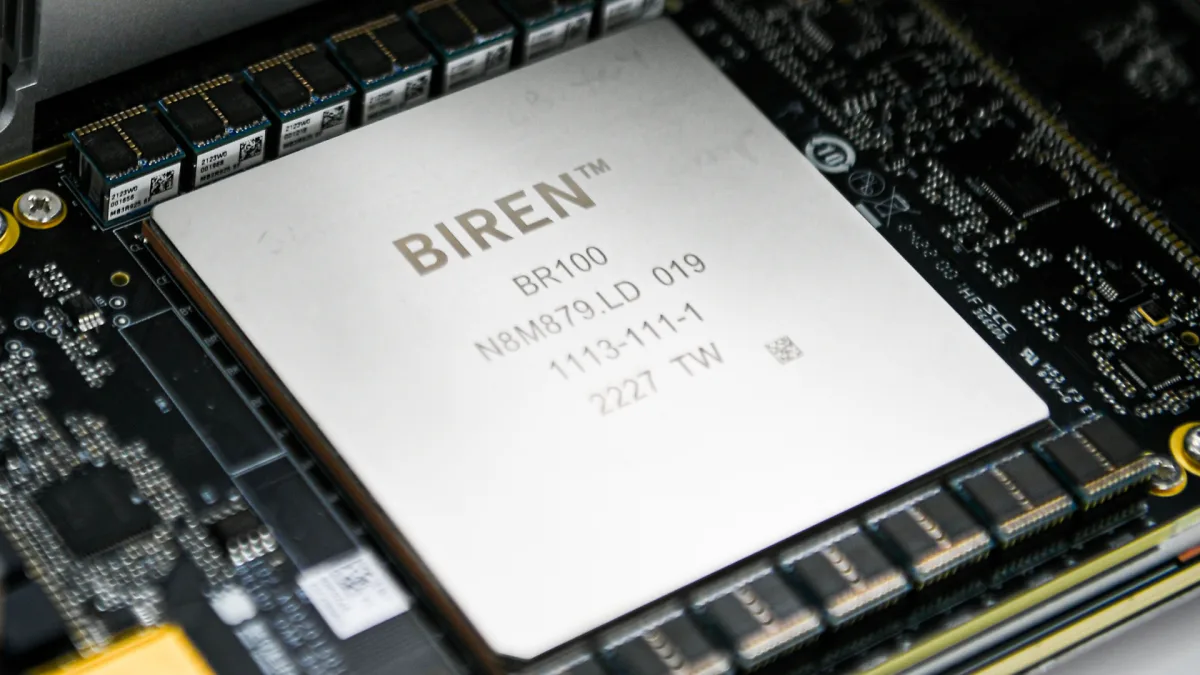
Biren Technology, which manufactures artificial intelligence accelerators for the Chinese market, has achieved extraordinary financial growth in the opening months of 2026 as demand for domestically produced chips intensifies. The surge follows the implementation of American export controls that have cut off supplies of Nvidia and AMD processors to the region, according to analysis from Jon Peddie Research.
During the first half of 2026, Biren generated $183.9 million in revenue, representing a 1,998% increase compared to approximately $8.665 million during the same period in 2025. The company's gross profit reached $78.552 million with a gross margin of 42.7%, though operating losses of $56.2 million persisted as the firm directed capital toward developing new products. These initiatives encompassed AI accelerators, optically-interconnected rack-scale infrastructure, and proprietary software solutions. For the full year 2025, Biren's total revenue amounted to $154.17 million, capturing less than 3% of China's AI accelerator market share according to TrendForce.
Biren has established itself as a recognized participant in China's semiconductor sector, with product offerings that demonstrate technical parity with competing solutions from AMD and Nvidia based on specifications. The company has brought to market three primary high-performance AI GPUs designated the BR106, BR110, and BR166, with additional models—the BR20X, BR30X, and BR31X—currently under development, per JPR. Beyond hardware, Biren has constructed the Birensupa software platform intended as a functional alternative to Nvidia's CUDA ecosystem and is advancing a rack-scale computing solution.
Historically, Chinese customers have demonstrated limited enthusiasm for locally manufactured accelerators, preferring even restricted versions of Nvidia's flagship products, which delivered superior performance characteristics and software environments. When Nvidia maintained market access to China, the company priced its H20 AI GPU between $12,000 and $15,000 per unit and delivered approximately 2.2 million accelerators to the country during the first half of 2025 before export restrictions took effect in May under the Trump administration's policies, according to TrendForce data. During that same timeframe, Biren's shipments numbered in the thousands or possibly tens of thousands across the entire year. Currently, Biren's unit volumes remain substantially smaller than Nvidia's 2025 performance.
While Biren's financial trajectory represents genuine and substantial improvement, the percentage growth reflects expansion from a minimal baseline during the first half of 2025, which inflates the apparent scale of the organization. Despite achieving $183.9 million in first-half revenue, Biren remains a comparatively modest participant in the global accelerator sector by absolute measures.

The critical question moving forward concerns Biren's capacity to secure sufficient manufacturing resources from SMIC and alternative suppliers to establish competitive positioning against larger domestic rivals including Huawei, Kunlunxin, and Cambricon. The company now possesses greater financial capacity than it held twelve months prior and encounters diminished competitive pressure from AMD and Nvidia due to American trade restrictions and China's corresponding prohibitions on American AI hardware. Nevertheless, possessing technically sound product designs represents merely one component of market success; Biren must now demonstrate the ability to produce accelerators at volumes matching customer requirements while meaningfully expanding its market position.