Starship's 15th Flight Reaches Orbit With Satellite Payload; Upper-Stage Catch Attempt Planned
SpaceX's Starship completed its 15th test flight Friday, successfully deploying 26 Starlink satellites into orbit. The company now aims for an unprecedented catch of the upper stage on Saturday, though the first-stage booster was diverted to the Gulf of Mexico.
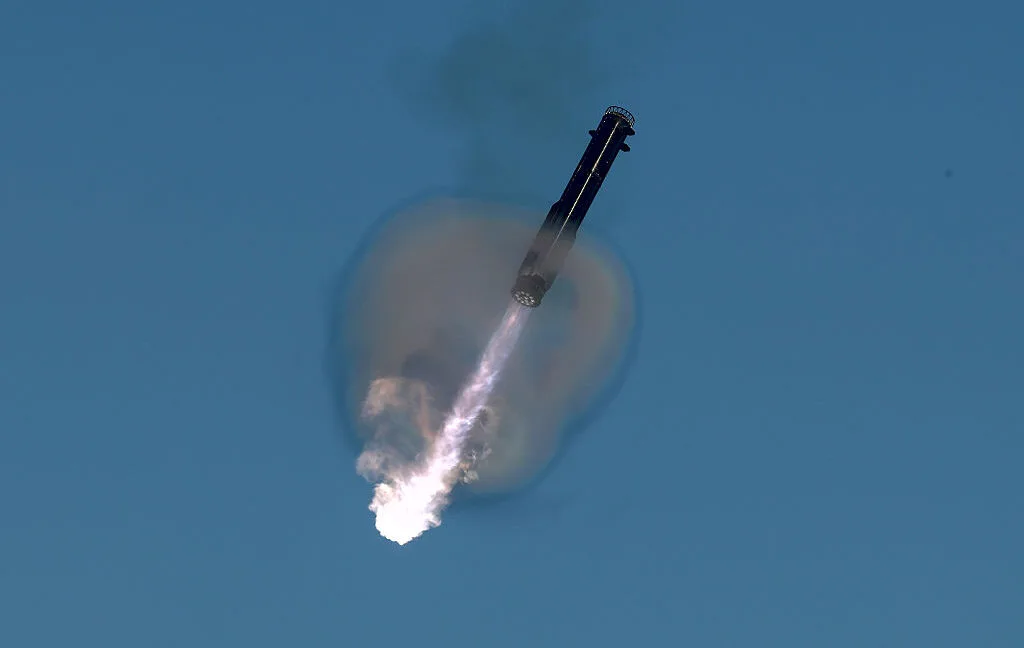
Starship launched on schedule Friday evening from the South Texas facility, marking the vehicle's 15th test flight over the past three years. Atmospheric conditions proved favorable for the launch, with minimal wind allowing the rocket's white exhaust plume to remain visible for an extended period. The massive vehicle ascended without incident, separating its upper stage above the Gulf of Mexico before the Starship upper stage ignited its Raptor engines and achieved a nominal orbital trajectory.
The first-stage booster's return to Starbase did not proceed as planned. An unspecified technical issue prompted SpaceX to command the vehicle to divert into the Gulf rather than attempt a catch at the launch tower, resulting in a powerful explosion visible from more than 10 miles away.
Primary mission, a success
Friday's launch successfully deployed 26 Starlink V3 satellites approximately 40 minutes into the flight. These satellites, equipped with solar panels spanning 60 meters when fully extended, reached orbit safely and will use onboard propulsion systems to adjust their altitude. The deployment confirms that Starship has become an operational, orbital-class rocket—the largest and most powerful vehicle ever launched into space.
SpaceX's immediate challenge involves transforming Starship into a rapidly reusable system capable of flying at significantly higher frequencies. The first-stage booster recovery represented a setback in this effort, as the company had intended to refurbish and reflew the vehicle. Although SpaceX has previously landed and reflown Starship boosters, it has not yet accomplished this with the latest version 3 iteration.
Saturday's potential upper-stage catch would represent an unprecedented achievement. SpaceX has never before attempted to recover Starship's upper stage. The vehicle must first pass a series of orbital and atmospheric health checks to ensure structural integrity before returning to Starbase, as it will traverse Mexican and U.S. airspace. If these tests confirm the vehicle's condition, the upper stage would land around 3:15 p.m. local time in Texas (21:15 UTC). Should the vehicle fail any checks, SpaceX has contingency options to de-orbit it into an ocean.
Testing the heat shield is critical
A successful upper-stage recovery would provide SpaceX with crucial data on vehicle performance during atmospheric reentry while advancing the company's reusability objectives. The heat shield protecting the upper stage during reentry represents one of Starship's most significant remaining development challenges. SpaceX intends to achieve rapid reusability, requiring tiles that balance minimal mass with exceptional heat resistance and durability while demanding only minimal refurbishment between flights.
Throughout the Starship program, SpaceX has continuously refined its tile design, seeking the optimal combination of weight, thermal protection, and longevity. For this flight, the company incorporated lessons from September's test flight, including reinforced retention mechanisms on tiles in high-risk areas prone to detachment during ascent and modifications addressing plasma flow pathways behind tiles. Additionally, a significant portion of this Starship's heat shield features a curved tile design that has demonstrated effectiveness in reducing thermal heating within the gaps separating individual tiles.