Google Debuts Gemini 4 Hydrogen, Retiring the Flash Line
Google has introduced Gemini 4 Hydrogen, a faster and more capable successor to its widely-used Gemini 3.8 Flash model, with immediate availability across most of the company's AI products.

Continuing its shift toward elemental nomenclature for AI models, Google has unveiled Gemini 4 Hydrogen as the direct replacement for Gemini 3.8 Flash. While the new naming convention sacrifices the clarity of earlier Pro and Flash designations, Hydrogen's role is straightforward: it succeeds the lightweight, cost-effective Flash variant that powers most Google AI services.
Unlike the staged rollouts that characterized Google's Argon and Carbon launches—which initially reached only cybersecurity researchers before expanding to premium subscribers—Hydrogen deployment has taken a more open approach. The model is now live across Google's product suite, though access tiers vary by service. In the Gemini app and AI Studio, availability remains restricted to AI Pro and Ultra subscribers, while AI Plus and free-tier users continue using the older Gemini 3.5 Flash-Lite. Google Search, however, is receiving Hydrogen access for all users.
Performance and Capabilities
Google asserts that Hydrogen delivers substantial gains over its predecessor. Operating across four thinking modes—low, medium, high, and the newly introduced xhigh—the model achieves 2.5 times faster performance than Flash 3.8 even when running in high mode. The company's internal testing indicates a reduction in hallucinations exceeding 5x relative to the older model.
Code generation represents another area of marked improvement. Hydrogen more than triples Flash 3.8's Terminal-Bench score, positioning it as a capable tool for developers building with agentic coding systems. In certain benchmarks, Hydrogen approaches Argon's capabilities, scoring 54 on the Artificial Analysis Intelligence Index using xhigh mode compared to Argon's 50.
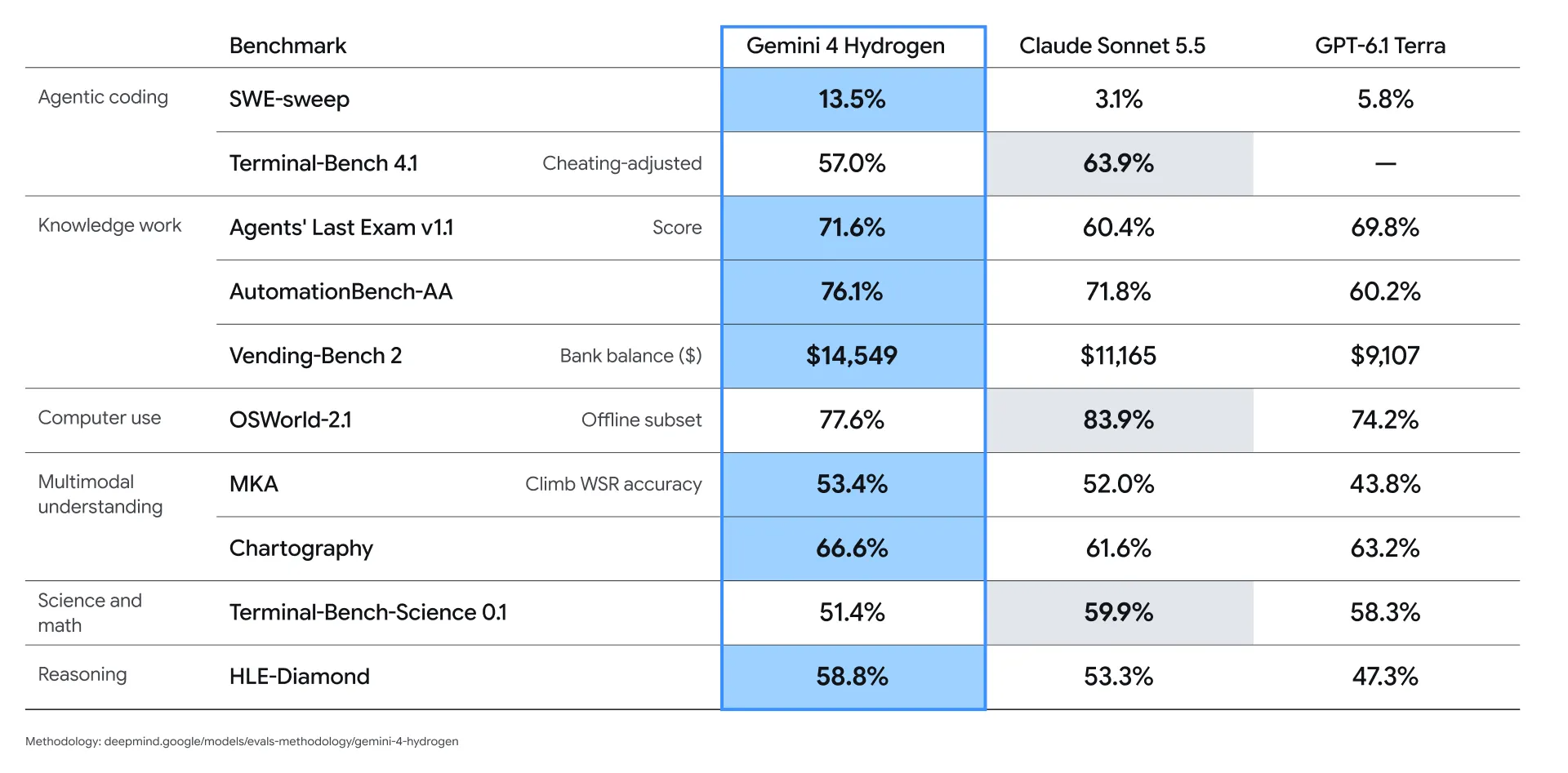
Google positions Hydrogen as the optimal choice for rapid code generation and test execution without consuming excessive token allocations, while reserving Argon and Carbon for extended reasoning tasks and security-sensitive applications.
Search Integration and API Pricing
The integration with Google Search marks what the company describes as its most significant update to AI-powered search functionality to date. Hydrogen should better process complex, multi-part queries, with both AI Overviews and AI Mode responses incorporating expanded visual content. Google also claims Hydrogen's search fan-out mechanism has been refined to surface additional source links, though the company has made similar assertions previously.
For developers accessing Hydrogen through the API, pricing remains consistent with Gemini 3.8 Flash: $1.50 per million input tokens and $7.50 per million output tokens. However, Argon and Carbon will see price increases beginning next month, rising from their current $2/$10 structure to $4/$20.