Google's TimesFM-3 Forecasting Model Dominates Benchmarks, But Commercial Use Remains Off-Limits
Google unveiled TimesFM-3, a powerful time-series forecasting model that outperforms competitors on multiple benchmarks, yet the company has restricted it to non-commercial use only.
On Monday, Google introduced TimesFM-3, a time-series forecasting model with 330 million parameters that was trained using more than a trillion data points drawn from both real-world and synthetic sources. The model is accessible via Hugging Face, though under a non-commercial license rather than an open one.
In the domain of business applications, time-series forecasting models function similarly to how large language models predict the next word, but they operate on numerical data instead. The past year has witnessed the emergence of several competing models, including Amazon's Chronos-2, Salesforce's Moirai 2.0, and Datadog's Toto 2.0. What distinguishes this new generation of forecasting tools is their capacity to process multiple time series simultaneously.
According to Google research scientists Ayush Jain and Rajat Sen, "most real-world forecasting problems are inherently multivariate: where multiple time series and auxiliary external features jointly impact the future forecast of a time series." They further note that historical sales figures alone provide incomplete information. "A good forecast should also draw on sales of related products (e.g., ice cream cones, syrups), historical foot traffic, and known future events like weather forecasts, promotions, and holidays."
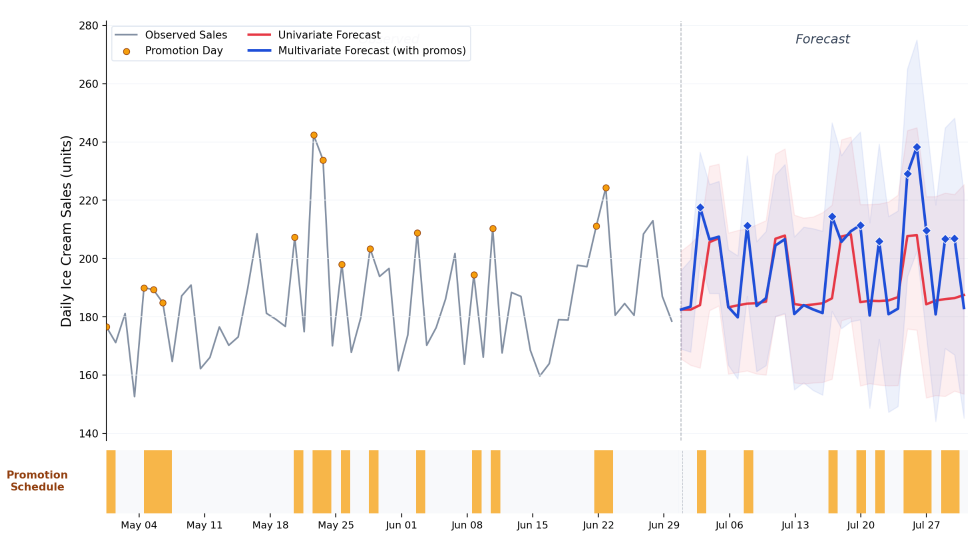
TimesFM-3 stands as Google's inaugural model engineered from the ground up to manage multiple time series while achieving zero-shot generalization capabilities. This design enables parallel forecasting of interconnected time series and incorporation of historical context such as foot traffic patterns.
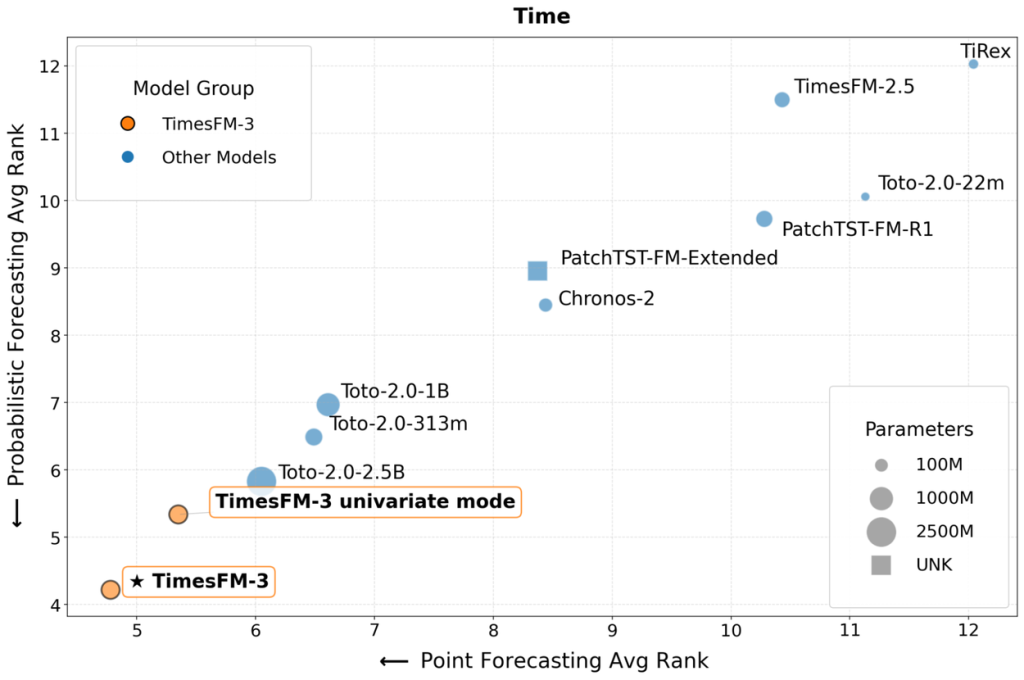
In comparative testing, TimesFM-3 surpasses its competitors across multiple evaluation frameworks, including Salesforce's Gift-Eval, Amazon and AutoGluon's FEV-Bench, and Time. Notably, TimesFM-2.5, which held state-of-the-art status when it debuted in September 2025, now ranks at the lower end of these same benchmarks—a testament to the rapid pace of advancement in this field.
The architecture
TimesFM-3 maintains the decoder-only transformer design of its predecessors, segmenting each time series into patches containing 32 data points and processing them similarly to how language models handle tokens.
The innovation lies in how these tokens traverse the model. Two distinct attention mechanisms now alternate throughout the network. One mechanism examines historical progression within a single series while enforcing strict causality, preventing the model from accessing future values. The second mechanism examines relationships across all series at any given time point, enabling information from one product line's promotion to influence forecasts for another.
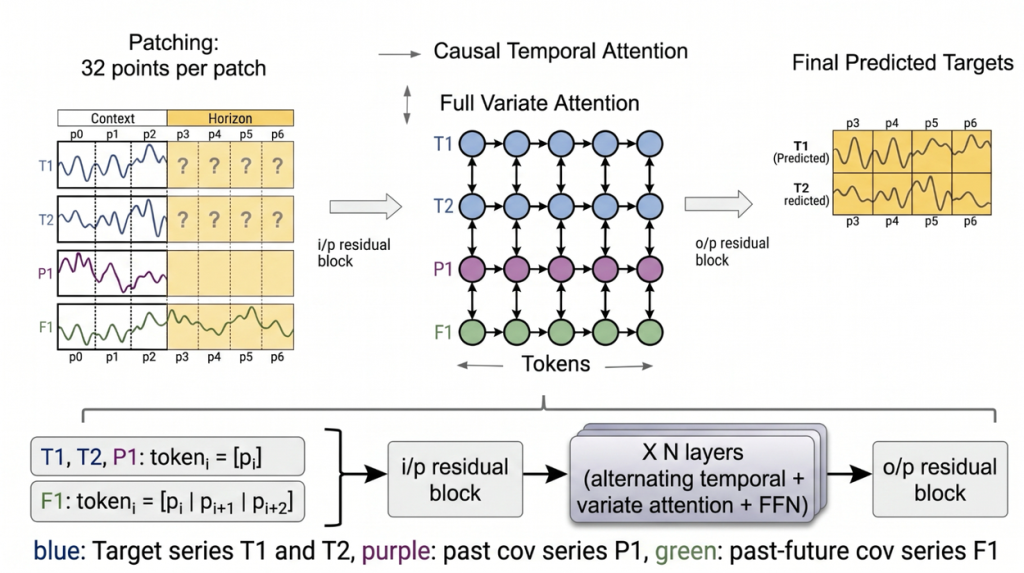
The decoding process has also undergone revision. Prior iterations generated forecasts sequentially, one patch at a time, introducing latency and accumulating prediction errors. TimesFM-3 instead adds masked placeholder tokens spanning the entire forecast window and completes them all in a single computational pass.
The non-commercial license
Google has opted to distribute TimesFM-3 under a non-commercial license, a decision that reflects an emerging pattern among model developers. TimesFM-2.5, by contrast, shipped with the Apache 2.0 license, as did Toto 2.0 and Chronos-2.
While the TimesFM-3 source code remains under the Apache license, Google specifies that "for the time being, TimesFM 3.0 pretrained weights are distributed under the separate timesfm-non-commercial-license-v1.0 license and are restricted to non-commercial, non-production use. Commercial or production use of the default pretrained weights is not permitted."
Google intends to transition TimesFM-3 into BitQuery's AI.FORECAST command, replacing TimesFM-2.5, demonstrating the company's active monetization strategy for these models. While integrating forecasting models into proprietary platforms is standard practice across the industry, Google's approach of restricting state-of-the-art weights while simultaneously offering a commercial pathway through its data warehouse platform signals where these research organizations believe future revenue opportunities lie.
Source: The New Stack