How Unitree's Founder Built a Robot Empire Through Obsessive Cost Control
Wang Xingxing's extreme micromanagement and focus on cutting expenses have made Unitree Robotics the world's leading producer of affordable humanoid robots, but the leadership approach may not scale as the company grows.
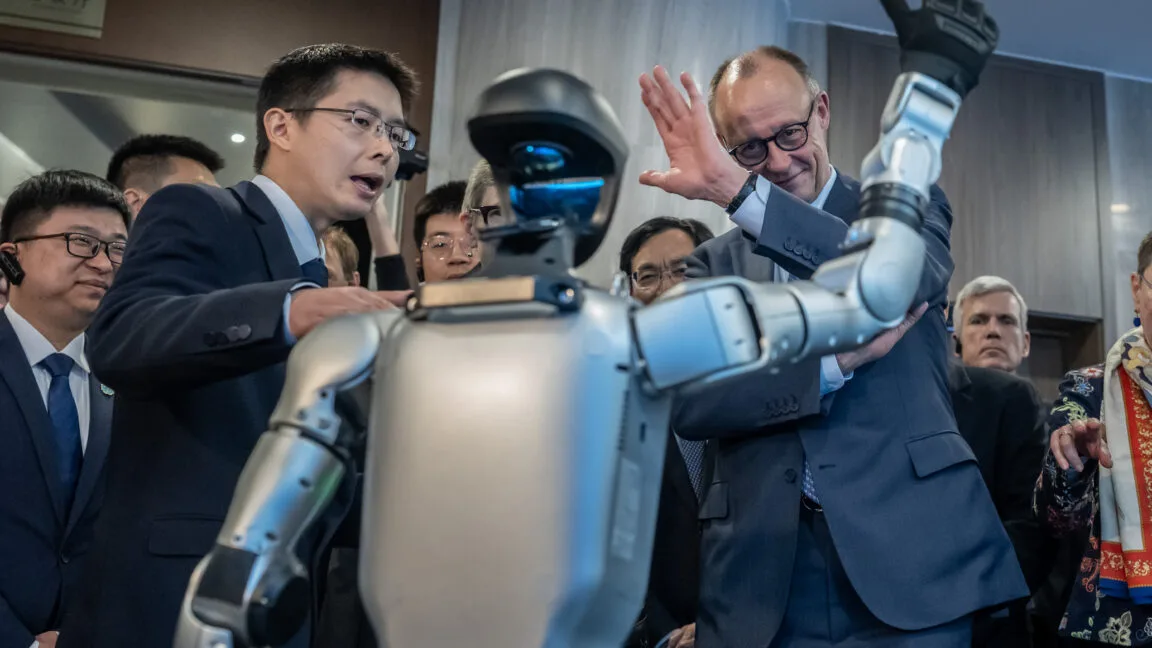
Unitree Robotics has emerged as the dominant force in global humanoid robot manufacturing, producing machines that undercut competitors on price—a position largely attributable to founder Wang Xingxing's relentless focus on cost reduction and hands-on control. Wang, who appeared prominently at a 2025 business symposium hosted by Chinese President Xi Jinping, saw his wealth surge after Unitree's initial public offering on the Shanghai Stock Exchange STAR Market on August 19. Yet reporting by Beijing-based Caijing Magazine, translated into English by ChinaTalk on September 10, reveals that this success rests on a leadership model built on extreme micromanagement that may prove difficult to sustain as the company expands.
According to interviews Caijing conducted with Unitree staff and investors, Wang personally oversees nearly every decision at the company, from broad strategic choices to granular product details such as material colors and screw dimensions. This obsession with detail, combined with aggressive cost discipline, has enabled Unitree to deliver some of the market's lowest-priced walking robots. The Unitree G1 humanoid, aimed at developers and researchers, carries a $13,500 price tag before shipping, while the consumer-focused Unitree R1 sells for $4,900. Robotics hardware engineers attributed these prices to deliberate design choices and structural engineering innovations.
The cost-cutting drive has come with a trade-off in quality assurance. Caijing's sources described early-generation Unitree robots as having an "extremely high" return rate for repairs, though the company has reportedly improved to the point where machines now survive their one-year or six-month warranty periods without failure. On the question of artificial intelligence, Wang has previously voiced doubt about large world models due to their computational demands. However, during the recent IPO roadshow, he indicated that Unitree intends to deploy large AI models as a foundation for physical AI capable of achieving an "autonomous loop of perception, decision, execution, evaluation, learning, and evolution," according to Caijing.
Extreme micromanagement and employee penalties
Wang's background in hardware structural engineering informs his hands-on approach. He maintains the habits of a driven founder—posting in work chats at 2 or 3 a.m. and spending much of his time at the office, including weekends. Employees characterize him as a direct communicator focused entirely on business matters, often cutting off staff mid-sentence. The absence of formal management structures means workers must queue to seek his approval on decisions, and his cost consciousness extends to personally signing off on expense reimbursements above 100 yuan (roughly $15).
This management style may work in an early-stage venture, but Unitree has grown to at least 480 employees as of this year, according to Rest of World. The company's incentive framework leans heavily toward penalties rather than rewards, with employees comparing notes on who receives less criticism. Wang reportedly assigned every senior executive a performance score of 1 on a scale ranging from 0 to 1.5. One veteran employee told Caijing that 2025 and 2026 have seen "the highest attrition of core staff in Unitree's history."
When Caijing initially sought comment, Unitree declined to respond. The company later issued a statement to other Chinese media outlets characterizing Caijing's reporting as containing substantial "misinformation" without elaborating on specific claims.
Can Unitree scale its success?
Wang's leadership model faces a critical test as Unitree competes with rivals such as AgiBot Robotics and UBTECH to expand manufacturing capacity. China's robotics sector benefits from significant government backing and an established supply chain for electronics and electric vehicle components. In July, the Ministry of Industry and Information Technology projected that China will produce more than 100,000 humanoid robots in 2026, a sharp jump from approximately 14,000 units manufactured globally in 2025, the vast majority in China.
Broader questions persist about the commercial viability and practical utility of humanoid robots. While Unitree has achieved profitability, its customer base consists primarily of universities and research institutions. Industrial deployment of humanoid robots remains largely confined to small-scale pilot programs. The IPO enthusiasm has also faded as Unitree's stock has fallen 50 percent below its post-listing peak, putting the company's market value around $30 billion, according to The Wall Street Journal.
Following the investor excitement surrounding Unitree, China's regulators have provided informal guidance indicating that future IPO approvals will be limited to humanoid robot companies that generate recurring revenue, are moving toward profitability, or demonstrate "real innovation," according to The Information. In the United States, the government implemented a ban on imports of foreign-made robots effective July 28, including humanoid robots and quadruped robots from Chinese manufacturers. This restriction prevents American universities and technology companies from purchasing Unitree's latest models for research and has forced the company's leading US distributor to shift toward domestic production.